
Abstract
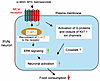
Hypothalamic melanocortin 4 receptors (MC4Rs) play a central role in regulating food intake and energy homeostasis. In fact, inactivating mutations in the MC4R gene are the most common form of monogenic obesity. Agonist activation of MC4Rs reduces food intake by modulating hypothalamic signaling circuits. Thus, a detailed understanding of the signaling pathways that regulate MC4R activity is of considerable translational relevance. Ligand-activated MC4Rs not only interact with heterotrimeric G proteins but also can recruit β-arrestin-2 (barr2) to the receptor. The potential functional role of barr2 in regulating the anorectic effects of MC4R signaling remains unexplored. In the present study, we used mutant mouse models to demonstrate MC4R-mediated activation of barr2/ERK signaling in MC4R neurons of the paraventricular nucleus leads to reduced food intake. We also found the appetite-suppressing effect of setmelanotide, an MC4R agonist FDA approved for the treatment of certain types of obesity, requires the presence of barr2 in MC4R-containing neurons. These data suggest that MC4R agonists able to promote MC4R/barr2 interactions with high efficacy may become useful as appetite-suppressing drugs.
Authors
Misbah Rashid, Lei Wang, Zhenzhong Cui, Oksana Gavrilova, Huiyan Lu, Kozo Kaibuchi, Sarah Zeitlmayr, Thomas Gudermann, Andreas Breit, Jürgen Wess
This file is in Adobe Acrobat (PDF) format. If you have not installed and configured the Adobe Acrobat Reader on your system.
Having trouble reading a PDF?
PDFs are designed to be printed out and read, but if you prefer to read them online, you may find it easier if you increase the view size to 125%.
Having trouble saving a PDF?
Many versions of the free Acrobat Reader do not allow Save. You must instead save the PDF from the JCI Online page you downloaded it from. PC users: Right-click on the Download link and choose the option that says something like "Save Link As...". Mac users should hold the mouse button down on the link to get these same options.
Having trouble printing a PDF?
- Try printing one page at a time or to a newer printer.
- Try saving the file to disk before printing rather than opening it "on the fly." This requires that you configure your browser to "Save" rather than "Launch Application" for the file type "application/pdf", and can usually be done in the "Helper Applications" options.
- Make sure you are using the latest version of Adobe's Acrobat Reader.


