
Research ArticleGastroenterologyNeuroscience
Open Access |  10.1172/jci.insight.199820
Proximal ganglionic intestine in Hirschsprung Disease is fibrotic and stiff
Prisca C. Obidike,1 Britney A. Hsu,2,3 Chioma Moneme,1 Oluyinka O. Olutoye II,2 Walker D. Short,2 Mary Hui Li,2,3 Swathi Balaji,2,3 Yuwen Zhang,1 Sundeep G. Keswani,2,3 and Lily S. Cheng1,2,3
1Division of Pediatric Surgery, Department of Surgery, University of Virginia, Charlottesville, Virginia, USA.
2Department of Surgery, Baylor College of Medicine, Houston, Texas, USA.
3Division of Pediatric Surgery, Department of Surgery, Texas Children’s Hospital, Houston, Texas, USA.
Address correspondence to: Lily S. Cheng, 409 Lane Rd., Charlottesville, Virginia, 22903, USA. Phone: 408.318.0900; Email: lilycheng@virginia.edu.
Authorship note: PCO and BAH contributed equally to this work.
Find articles by Obidike, P. in: PubMed | Google Scholar
1Division of Pediatric Surgery, Department of Surgery, University of Virginia, Charlottesville, Virginia, USA.
2Department of Surgery, Baylor College of Medicine, Houston, Texas, USA.
3Division of Pediatric Surgery, Department of Surgery, Texas Children’s Hospital, Houston, Texas, USA.
Address correspondence to: Lily S. Cheng, 409 Lane Rd., Charlottesville, Virginia, 22903, USA. Phone: 408.318.0900; Email: lilycheng@virginia.edu.
Authorship note: PCO and BAH contributed equally to this work.
Find articles by Hsu, B. in: PubMed | Google Scholar
1Division of Pediatric Surgery, Department of Surgery, University of Virginia, Charlottesville, Virginia, USA.
2Department of Surgery, Baylor College of Medicine, Houston, Texas, USA.
3Division of Pediatric Surgery, Department of Surgery, Texas Children’s Hospital, Houston, Texas, USA.
Address correspondence to: Lily S. Cheng, 409 Lane Rd., Charlottesville, Virginia, 22903, USA. Phone: 408.318.0900; Email: lilycheng@virginia.edu.
Authorship note: PCO and BAH contributed equally to this work.
Find articles by Moneme, C. in: PubMed | Google Scholar
1Division of Pediatric Surgery, Department of Surgery, University of Virginia, Charlottesville, Virginia, USA.
2Department of Surgery, Baylor College of Medicine, Houston, Texas, USA.
3Division of Pediatric Surgery, Department of Surgery, Texas Children’s Hospital, Houston, Texas, USA.
Address correspondence to: Lily S. Cheng, 409 Lane Rd., Charlottesville, Virginia, 22903, USA. Phone: 408.318.0900; Email: lilycheng@virginia.edu.
Authorship note: PCO and BAH contributed equally to this work.
Find articles by Olutoye, O. in: PubMed | Google Scholar
1Division of Pediatric Surgery, Department of Surgery, University of Virginia, Charlottesville, Virginia, USA.
2Department of Surgery, Baylor College of Medicine, Houston, Texas, USA.
3Division of Pediatric Surgery, Department of Surgery, Texas Children’s Hospital, Houston, Texas, USA.
Address correspondence to: Lily S. Cheng, 409 Lane Rd., Charlottesville, Virginia, 22903, USA. Phone: 408.318.0900; Email: lilycheng@virginia.edu.
Authorship note: PCO and BAH contributed equally to this work.
Find articles by Short, W. in: PubMed | Google Scholar
1Division of Pediatric Surgery, Department of Surgery, University of Virginia, Charlottesville, Virginia, USA.
2Department of Surgery, Baylor College of Medicine, Houston, Texas, USA.
3Division of Pediatric Surgery, Department of Surgery, Texas Children’s Hospital, Houston, Texas, USA.
Address correspondence to: Lily S. Cheng, 409 Lane Rd., Charlottesville, Virginia, 22903, USA. Phone: 408.318.0900; Email: lilycheng@virginia.edu.
Authorship note: PCO and BAH contributed equally to this work.
Find articles by Li, M. in: PubMed | Google Scholar
1Division of Pediatric Surgery, Department of Surgery, University of Virginia, Charlottesville, Virginia, USA.
2Department of Surgery, Baylor College of Medicine, Houston, Texas, USA.
3Division of Pediatric Surgery, Department of Surgery, Texas Children’s Hospital, Houston, Texas, USA.
Address correspondence to: Lily S. Cheng, 409 Lane Rd., Charlottesville, Virginia, 22903, USA. Phone: 408.318.0900; Email: lilycheng@virginia.edu.
Authorship note: PCO and BAH contributed equally to this work.
Find articles by Balaji, S. in: PubMed | Google Scholar
1Division of Pediatric Surgery, Department of Surgery, University of Virginia, Charlottesville, Virginia, USA.
2Department of Surgery, Baylor College of Medicine, Houston, Texas, USA.
3Division of Pediatric Surgery, Department of Surgery, Texas Children’s Hospital, Houston, Texas, USA.
Address correspondence to: Lily S. Cheng, 409 Lane Rd., Charlottesville, Virginia, 22903, USA. Phone: 408.318.0900; Email: lilycheng@virginia.edu.
Authorship note: PCO and BAH contributed equally to this work.
Find articles by Zhang, Y. in: PubMed | Google Scholar
1Division of Pediatric Surgery, Department of Surgery, University of Virginia, Charlottesville, Virginia, USA.
2Department of Surgery, Baylor College of Medicine, Houston, Texas, USA.
3Division of Pediatric Surgery, Department of Surgery, Texas Children’s Hospital, Houston, Texas, USA.
Address correspondence to: Lily S. Cheng, 409 Lane Rd., Charlottesville, Virginia, 22903, USA. Phone: 408.318.0900; Email: lilycheng@virginia.edu.
Authorship note: PCO and BAH contributed equally to this work.
Find articles by Keswani, S. in: PubMed | Google Scholar
1Division of Pediatric Surgery, Department of Surgery, University of Virginia, Charlottesville, Virginia, USA.
2Department of Surgery, Baylor College of Medicine, Houston, Texas, USA.
3Division of Pediatric Surgery, Department of Surgery, Texas Children’s Hospital, Houston, Texas, USA.
Address correspondence to: Lily S. Cheng, 409 Lane Rd., Charlottesville, Virginia, 22903, USA. Phone: 408.318.0900; Email: lilycheng@virginia.edu.
Authorship note: PCO and BAH contributed equally to this work.
Find articles by Cheng, L. in: PubMed | Google Scholar
Published February 10, 2026 - More info
JCI Insight. 2026;11(13):e199820. https://doi.org/10.1172/jci.insight.199820.
© 2026 Obidike et al. This work is licensed under the Creative Commons Attribution 4.0 International License. To view a copy of this license, visit http://creativecommons.org/licenses/by/4.0/.
Received: September 2, 2025; Accepted: January 12, 2026

-
Results
The proximal ganglionic colon in HSCR mice is stiff and fibrotic. Masson’s trichrome staining was performed on proximal ganglionic mouse colon to examine collagen content in the muscularis propria layer. Normoganglionosis was confirmed by IHC for the pan-neuronal marker, Tuj1 (Figure 1, A–F). Histological analysis of representative images showed greater collagen deposition, represented in blue by Masson’s trichrome staining, in the proximal ganglionic colon of HSCR mice (n = 12) compared with equivalent proximal colon segments of their WT littermates (n = 12) (Figure 2, A and B). Quantification of collagen deposition in both groups showed that HSCR mice had greater collagen content in the proximal colon than their WT littermates (116.92 ± 13.76 versus 108.04 ± 13.65, P = 0.006; Figure 2C). Similarly, the collagen content in the distal colon of the WT mice was significantly greater than the distal colon of HSCR mice (111.90 ± 10.83 versus 86.156 ± 11.32; P = 0.025).
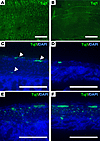 Figure 1
Reduced ganglion and neuronal density in the distal colon of HSCR mice. Aganglionosis of in the distal Ednrb–/– colon was confirmed by IHC for the panneuronal marker, Tuj1. (A and B) Whole mount IHC of the muscularis propria demonstrated abundant innervation of the ganglionic segment (A) and sparse innervation of the aganglionic segment (B) in the Ednrb–/– mouse. (C and D) Similarly, tissue sections of the proximal colon in the Ednrb–/– mouse confirmed the presents of myenteric and submucosal ganglia (C; white arrowheads), whereas sparse and small ganglia are seen in the distal colon (D). (E and F) In contrast, equivalent segments of the proximal and distal colon in the WT (Ednrb+/+) littermate demonstrate abundant ganglia in both proximal and distal segments (E and F). Scale bar: 500 μm for A and B, and is 100 μm for C–F.
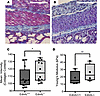 Figure 2
HSCR mice have stiff and fibrotic proximal ganglionic colon. (A and B) Representative images of the proximal ganglionic colon in WT (Ednrb+/+, A) and HSCR (Ednrb–/–, B) mice are shown with Masson’s trichrome staining to quantify fibrosis. Atomic force microscopy was used to quantify stiffness. (C and D) When normalized to age-matched WT littermates (n = 12), HSCR (n = 12) mice had significantly greater collagen content in the muscularis propria (C; *P = 0.006). HSCR (n = 4) mice also had significantly greater stiffness (D; **P = 0.0003) when compared with WT littermates (n = 4). Each data point represents the average of at least 5 fields of view of 1 biological replicate. Student’s 2-tailed t test used for statistical analysis. Scale bar: 100 μm for A and B.
Atomic force microscopy (AFM) was used to examine the stiffness of the colonic tissue from HSCR and their WT littermates. The elastic modulus, which represents the stiffness, is the force required to deform these tissues. The AFM cantilever probe was brought in contact with the muscularis propria layer as identified by microscopy, and the elastic modulus was obtained. We observed that the proximal colon of HSCR was significantly stiffer than that of WT mice (25.29 ± 11.96 versus 18.17 ± 9.31 kPa, P = 0.015; Figure 2D).
Dysregulation of ECM-related genes in HSCR proximal ganglionic colon. Bulk RNA-seq was performed to examine the relative expression of ECM-related genes in the proximal colon of HSCR compared with WT mice (Figure 3A). RNA was extracted from homogenized LMMP samples obtained from the freshly dissected proximal colon and sequenced to construct a polyA enrichment library. Differential expression analysis demonstrated 1,012 genes uniquely dysregulated in the proximal colon of HSCR mice, 908 unique to WT littermates, and 11,846 genes shared between both groups (Figure 3B). A volcano plot comparing gene expression between HSCR and WT proximal colon identified
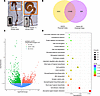 Figure 3
Differential gene expression in proximal ganglionic colon. (A) The longitudinal muscle and myenteric plexus from the proximal colons of HSCR (Ednrb–/–) and WT (Ednrb+/+) littermates were analyzed for differences in RNA expression. (B) Venn diagram comparing differentially expressed genes (DEGs) in the proximal colon of HSCR and WT mice identified 1,012 uniquely dysregulated genes in HSCR and 908 in WT with 11,846 genes in common between both groups. (C) Volcano plot of RNA-seq shows that 2,108 genes were differentially expressed with 1,009 upregulated genes and 1,099 downregulated genes. (D) Lollipop plot of top enriched KEGG pathways among DEGs.
In total, 1,009 genes were upregulated and 1,099 genes were downregulated (log2FC > ± 1, Padj < 0.05) (Figure 3C). Kyoto Encyclopedia of Genes and Genomes (KEGG) enrichment analysis revealed statistically significant differences in pathways related to neuroactive ligand-receptor interaction and cell adhesion molecules between HSCR and WT mice (Figure 3D).
We also queried differentially expressed genes specifically for genes involved in focal adhesion (22), ECM-receptor interaction (23), neuroactive ligand-receptor interactions (24), ECM (25), and fibrosis (26) (Supplemental Tables 1 and 2; supplemental material available online with this article; https://doi org/10.1172/jci.insight.199820DS1). Of the 62 individual genes in these pathways, 10 were significantly up- or downregulated (Padj < 0.05) (Figure 4, A and B). Specifically, the proximal ganglionated colon of HSCR mice demonstrated increased expression of genes encoding Thrombospondin 4 (Thbs4), matrix metallopeptidase 7 (Mmp7), and Syndecan-1 (Sdc1). Downregulated genes included Vascular cell adhesion molecule 1 (Vcam1), Collagen type IX, α 2 subunit (Col9a2), Opioid receptor κ 1 (Oprk1), Solute carrier family (sodium-dependent inorganic phosphate cotransporter) member 6 (Slc17a6), Tachykinin 1 (Tac1), Preproenkephalin (Penk), and Solute carrier family 5 (choline transporter) member 7 (Slc5a) (Figure 4B).
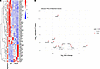 Figure 4
Extracellular matrix–related differential gene expression in proximal ganglionic colon. (A) Heatmap comparison of differentially expressed genes involved in focal adhesion, fibrosis, ECM-receptor interaction, and neuroactive ligand–receptor pathways in the proximal colon of HSCR and WT mice (*Padj <0.05). (B) Volcano plot showing Log2FC of 10 statistically significant genes (Padj < 0.05) involved in fibrosis and extracellular matrix.
Ganglionic intestinal tissue of patients with HSCR is fibrotic. To validate our findings in humans, we obtained intestinal tissue specimens from patients with HSCR (n = 6) and age-matched controls (n = 3) with no history of congenital colorectal disease who underwent bowel resection, ostomy formation, or ostomy closure (Table 1). Intestinal tissues were examined with Masson’s trichrome staining to quantify collagen content in the muscularis propria and the submucosa (Figure 5, A–D). Notably, the collagen content in the submucosa was significantly greater in the ganglionic intestinal tissue of patients with HSCR compared with equivalent segments from control patients (184.91 ± 34.30 versus 133 ± 27.02, P = 0.001; Figure 5, E and F). In contrast, there was no significant difference in the collagen content of the muscularis propria between HSCR and control patients (186.40 ± 37.92 versus 148.45 ± 53.14, P = 0.082).
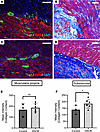 Figure 5
Patients with HSCR have increased fibrosis in ganglionic intestine. (A and C) Representative immunofluorescence images of the proximal ganglionic intestine in healthy control patients (A) and in patients with Hirschsprung disease (HSCR; C) confirms the presence of normal ganglion cells within the muscularis propria (Tuj1 is a pan-neuronal marker, SMA is smooth muscle actin, DAPI denotes cell nuclei). (B and D) Masson’s trichrome staining was used to compare collagen content between control patients (B) and patients with HSCR (D). (E and F) Patients with HSCR (n = 6) had increased fibrosis in the muscularis propria (E; P = 0.08) and significantly increased fibrosis in the submucosa (F; *P = 0.0002) when normalized to age- and site-matched controls (n = 3). Each data point represents the average of at least 5 fields of view of 1 biological replicate. Student’s 2-tailed t test used for statistical analysis. Scale bar: 100 μm for A–D.
Comparison of fibrosis in HSCR, intestinal atresia, and ARM. To determine whether fibrosis in the proximal ganglionic colon in HSCR is due to disease-related pathology or secondary to chronic intestinal distention, we compared collagen content between distended proximal and nondistended distal intestine in patients with intestinal atresia (Table 1). There were no significant differences in the collagen content in either submucosa (168.42 ± 8.61 versus 160.43 ± 5.35, P = 0.103) or muscularis propria (186.99 ± 10.21 versus 194.43 ± 15.94, P = 0.154) of the distended and nondistended intestine in patients with intestinal atresia (Figure 6, E and F).
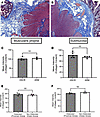 Figure 6
No difference in fibrosis in age-matched HSCR, ARM, and patients with intestinal atresia. (A and B) Representative Masson’s trichrome staining of proximal ganglionated intestinal tissues from age-matched patients with HSCR (A) and ARM (B). (C and D) No notable difference in fibrosis was observed between patients with HSCR (n = 4) and ARM (n = 3) in either the muscular propria or the submucosa. (E and F) Patients with jejunoileal atresia had no notable difference in fibrosis between distended proximal and nondistended distal intestinal segments (n = 3 each). Each data point represents the average of at least 5 fields of view of 1 biological replicate. Student’s 2-tailed t test used for statistical analysis. Scale bar: 100 μm for A and B.
To further assess whether intestinal fibrosis was specific to HSCR, we quantified fibrosis in age- and site-matched tissues from patients with HSCR and ARM. Patients with ARM were chosen as they were the closest age and tissue match for younger patients with HSCR. No significant differences in the collagen content in either the submucosa (80.42 ± 12.39 versus 76.64 ± 6.82, P = 0.373) or the muscularis propria were observed (102.78 ± 9.08 versus 105.11 ± 6.02, P = 6286) in the HSCR compared with ARM tissues (Figure 6, A–D).


