
Go to The Journal of Clinical Investigation
  • About
  • Editors
  • Consulting Editors
  • For authors
  • Publication ethics
  • Publication alerts by email
  • Transfers
  • Advertising
  • Job board
  • Contact
  • Physician-Scientist Development
  • Current issue
  • Past issues
  • By specialty
    • COVID-19
    • Cardiology
    • Immunology
    • Metabolism
    • Nephrology
    • Oncology
    • Pulmonology
    • All ...
  • Videos
  • Collections
    • In-Press Preview
    • Resource and Technical Advances
    • Clinical Research and Public Health
    • Research Letters
    • Editorials
    • Perspectives
    • Physician-Scientist Development
    • Reviews
    • Top read articles

  • Current issue
  • Past issues
  • Specialties
  • In-Press Preview
  • Resource and Technical Advances
  • Clinical Research and Public Health
  • Research Letters
  • Editorials
  • Perspectives
  • Physician-Scientist Development
  • Reviews
  • Top read articles
  • About
  • Editors
  • Consulting Editors
  • For authors
  • Publication ethics
  • Publication alerts by email
  • Transfers
  • Advertising
  • Job board
  • Contact
Epithelial SLPI expression in severe inflammatory bowel disease relates to high IL-17 and neutrophil programming
Sandrine Nugteren, Beatriz Calado, Ytje Simons-Oosterhuis, Daniëlle H. Hulleman-van Haaften, Willem K. Smits, Renz C.W. Klomberg, Bastiaan Tuk, Mohammed Charrout, Dicky J. Lindenbergh-Kortleve, Michail Doukas, Mathijs A. Sanders, Gregory van Beek, Johanna C. Escher, Lissy de Ridder, Maria Fernanda Pascutti, Janneke N. Samsom
View: Text | PDF
Research Article Gastroenterology Immunology

Epithelial SLPI expression in severe inflammatory bowel disease relates to high IL-17 and neutrophil programming

  • Text
  • PDF
Abstract

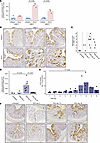
Heterogeneity in disease severity and treatment response in inflammatory bowel disease (IBD) likely evolves from individual differences in host-microbiota-immune interactions. Histological evaluation of intestinal biopsies is central to diagnosis, but histological parameters that define underlying immune mechanisms are limited. We investigated histological features that distinguish individual patient immune profiles in therapy-naive pediatric IBD patients (age 6–18 years) using biopsy immunohistochemistry and transcriptomics and plasma proteomics across two cohorts. High colonic epithelial expression of secretory leukocyte protease inhibitor (SLPI), a microbiota-induced regulator of epithelial function, occurred in IBD patients with high clinical disease activity and more severe endoscopic and microscopic disease activity. SLPI expression was related to increased neutrophil infiltration, transcriptomic signatures of activation, and genes known to associate with therapeutic resistance. High SLPI colocalized with high densities of IL-17–secreting cells and was associated with high plasma concentrations of Th17-related immune proteins. Additionally, patients with high intestinal SLPI had an intrinsically different immunotype, in which circulating neutrophils exhibited altered transcription of genes involved in neutrophil granule formation, phagocytosis, oxidative phosphorylation, and interferon signaling. Thus, high colonic SLPI expression at diagnosis associates with severe IBD, increased IL-17A–neutrophil pathway responses, and altered transcriptomic wiring of circulating neutrophils.

Authors

Sandrine Nugteren, Beatriz Calado, Ytje Simons-Oosterhuis, Daniëlle H. Hulleman-van Haaften, Willem K. Smits, Renz C.W. Klomberg, Bastiaan Tuk, Mohammed Charrout, Dicky J. Lindenbergh-Kortleve, Michail Doukas, Mathijs A. Sanders, Gregory van Beek, Johanna C. Escher, Lissy de Ridder, Maria Fernanda Pascutti, Janneke N. Samsom

×

Supporting data values - Download (1.31 MB)

No preview available for this file type: xlsx
Use the download link to access the file.
Advertisement

Copyright © 2026 American Society for Clinical Investigation
ISSN 2379-3708

Sign up for email alerts