
Abstract
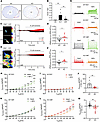
Resident cardiac fibroblast–derived (RCF-derived) cardiac myofibroblasts (CMFs) contribute to myocardial repair but also drive adverse ventricular remodeling and contractile dysfunction after myocardial infarction (MI). The sodium-activated potassium channel Slick (Slo2.1) has been described in cardiomyocyte (CM) mitochondria; however, transcriptomic analyses indicate higher Slick expression in RCFs/CMFs. Here, we investigated the role of Slick in cardiac fibroblast function and post-MI remodeling. Using live-cell imaging and whole-cell patch-clamp recordings, we found that plasma membrane Slick channels in RCFs and CMFs regulated potassium (K+) efflux and modulated store-operated calcium entry (SOCE), particularly in CMFs. Global Slick KO and conditional CMF-specific KO hearts exhibited reduced fibrosis and preserved left ventricular function after ischemia/reperfusion injury. This cardioprotection was associated with diminished CMF activation and proliferation, reduced inflammation, and improved CM survival after MI. Collectively, these findings identify fibroblast Slick channels as regulators of SOCE-dependent fibrogenesis and demonstrate that their deletion mitigates maladaptive remodeling and functional decline after MI.
Authors
Jiaqi Yang, Lin Zhu, David Spähn, Melanie Cruz Santos, Sophia Schanz, Selina Maier, Lena Birkenfeld, Helmut Bischof, Anna Roslan, Nina Wettschureck, Oliver Borst, Lucas Matt, Robert Lukowski
This file is in Adobe Acrobat (PDF) format. If you have not installed and configured the Adobe Acrobat Reader on your system.
Having trouble reading a PDF?
PDFs are designed to be printed out and read, but if you prefer to read them online, you may find it easier if you increase the view size to 125%.
Having trouble saving a PDF?
Many versions of the free Acrobat Reader do not allow Save. You must instead save the PDF from the JCI Online page you downloaded it from. PC users: Right-click on the Download link and choose the option that says something like "Save Link As...". Mac users should hold the mouse button down on the link to get these same options.
Having trouble printing a PDF?
- Try printing one page at a time or to a newer printer.
- Try saving the file to disk before printing rather than opening it "on the fly." This requires that you configure your browser to "Save" rather than "Launch Application" for the file type "application/pdf", and can usually be done in the "Helper Applications" options.
- Make sure you are using the latest version of Adobe's Acrobat Reader.


