
Abstract
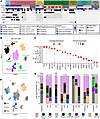
Although well-differentiated thyroid carcinoma (WDTC) is characterized by a robust treatment response, aggressive subtypes, such as anaplastic thyroid carcinoma (ATC), remain highly lethal. To understand thyroid cancer evolution in both children and adults, we analyzed single-cell transcriptomes of 423,733 cells from 81 samples and spatially resolved key tumor and microenvironment populations across 28 tumors with spatial transcriptomics, including rare and unique composite WDTC/ATC tumors and pediatric diffuse sclerosing thyroid carcinomas. Additionally, we identified gene signatures of stromal cell populations in 5 large thyroid cancer bulk RNA-sequencing cohorts. Through this multi-institutional effort, we defined a population of POSTN+ myofibroblast cancer-associated fibroblasts (myCAFs) that are intimately associated with invasive tumor cells and correlate with poor prognosis, lymph node metastasis, and disease progression in thyroid carcinoma. We also revealed a population of inflammatory CAFs that are distant to tumor cells and are found in the inflammatory stromal microenvironment of autoimmune thyroiditis. Together, our study provides spatial profiling of thyroid cancer evolution in samples with mixed WDTC/ATC histopathology and identifies a prognostic myCAF subtype with potential clinical utility in predicting aggressive disease in both children and adults.
Authors
Matthew A. Loberg, George J. Xu, Sheau-Chiann Chen, Hua-Chang Chen, Claudia C. Wahoski, Kailey P. Caroland, Megan L. Tigue, Heather A. Hartmann, Jean-Nicolas Gallant, Courtney J. Phifer, Andres A. Ocampo, Dayle K. Wang, Reilly G. Fankhauser, Kirti A. Karunakaran, Chia-Chin Wu, Maxime Tarabichi, Sophia M. Shaddy, James L. Netterville, Sarah L. Rohde, Carmen C. Solórzano, Lindsay A. Bischoff, Naira Baregamian, Barbara A. Murphy, Jennifer H. Choe, Jennifer R. Wang, Eric C. Huang, Quanhu Sheng, Luciane T. Kagohara, Elizabeth M. Jaffee, Ryan H. Belcher, Ken S. Lau, Fei Ye, Ethan Lee, Vivian L. Weiss
This file is in Adobe Acrobat (PDF) format. If you have not installed and configured the Adobe Acrobat Reader on your system.
Having trouble reading a PDF?
PDFs are designed to be printed out and read, but if you prefer to read them online, you may find it easier if you increase the view size to 125%.
Having trouble saving a PDF?
Many versions of the free Acrobat Reader do not allow Save. You must instead save the PDF from the JCI Online page you downloaded it from. PC users: Right-click on the Download link and choose the option that says something like "Save Link As...". Mac users should hold the mouse button down on the link to get these same options.
Having trouble printing a PDF?
- Try printing one page at a time or to a newer printer.
- Try saving the file to disk before printing rather than opening it "on the fly." This requires that you configure your browser to "Save" rather than "Launch Application" for the file type "application/pdf", and can usually be done in the "Helper Applications" options.
- Make sure you are using the latest version of Adobe's Acrobat Reader.


