
Abstract
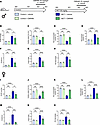
Pulmonary arterial hypertension (PAH) is a rare and incurable disease characterized by progressive narrowing of pulmonary arteries (PA), resulting in right ventricular (RV) hypertrophy, RV failure, and eventually death. Orai1 inhibition has emerged as promising therapeutic approach to mitigate PAH. In this study, we investigated the efficacy of a clinically applicable selective Orai1 inhibitor, CM5480, and its effects when combined with standard PAH therapies in a preclinical PAH model. In male and female monocrotaline PAH-rats, CM5480 monotherapy improved hemodynamics, PA, and RV remodeling, as confirmed by RV catheterization, echocardiography, histology, and unbiased RNA-Seq. Standard PAH therapies, ambrisentan or sildenafil, achieved modest improvements in experimental PAH. In contrast, combination therapies with CM5480 yielded significantly greater benefits in reducing PA remodeling and improving cardiac function compared with monotherapies. Furthermore, in vitro experiments showed that Orai1 knockdown reduced pulmonary endothelial cell dysfunction in PAH and that the Orai1 pathway is independent of standard PAH-targeted pathways in PA smooth muscle cells (PASMCs). Finally, we found enhanced Orai1 expression/function in PASMCs and pulmonary vein SMCs from patients with pulmonary veno-occlusive disease. These findings suggest that Orai1 inhibition represents a potentially novel and complementary therapeutic strategy for PAH by acting at pulmonary vascular and RV levels.
Authors
Anaïs Saint-Martin Willer, Grégoire Ruffenach, Bastien Masson, Kristelle El Jekmek, Angèle Boët, Rui Adão, Mathieu Gourmelon, Antoine Beauvais, Jessica Sabourin, Mary Dutheil, Maria-Rosa Ghigna, Laurent Tesson, Séverine Ménoret, Ignacio Anegon, Fabrice Bauer, Vincent de Montpréville, Sudarshan Hebbar, Carmen Brás-Silva, Kenneth Stauderman, Marc Humbert, Olaf Mercier, David Montani, Véronique Capuano, Fabrice Antigny
This file is in Adobe Acrobat (PDF) format. If you have not installed and configured the Adobe Acrobat Reader on your system.
Having trouble reading a PDF?
PDFs are designed to be printed out and read, but if you prefer to read them online, you may find it easier if you increase the view size to 125%.
Having trouble saving a PDF?
Many versions of the free Acrobat Reader do not allow Save. You must instead save the PDF from the JCI Online page you downloaded it from. PC users: Right-click on the Download link and choose the option that says something like "Save Link As...". Mac users should hold the mouse button down on the link to get these same options.
Having trouble printing a PDF?
- Try printing one page at a time or to a newer printer.
- Try saving the file to disk before printing rather than opening it "on the fly." This requires that you configure your browser to "Save" rather than "Launch Application" for the file type "application/pdf", and can usually be done in the "Helper Applications" options.
- Make sure you are using the latest version of Adobe's Acrobat Reader.


