
Abstract
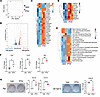
Parathyroid hormone (PTH) regulates serum calcium and phosphate through its actions in bone and kidney and is used to increase bone in osteoporosis treatment. In bone, PTH targets osteoblasts and osteocytes to regulate bone remodeling but also bone marrow stromal cells (BMSCs), regulating their differentiation in the osteoblast or the adipocyte lineage. PTH exerts its action through the PTH/PTH-related peptide (PTHrP) receptor, a G protein–coupled receptor (GPCR), activating adenylyl cyclase and phospholipase C (PLC). Although the effects of cAMP and PKA are well characterized, little is known about the effects of PLC activation or on the crosstalk between PTH signaling and other pathways. Here, bulk RNA-Seq of PTH-treated murine BMSC line (W-20) revealed significant changes in the Hippo pathway. In addition to increasing its transcription, PTH stabilized YAP protein, a key target of Hippo, by decreasing YAP/LArge Tumor Suppressor kinase 1 (LATS1) interaction, YAPS127 phosphorylation, and YAP ubiquitination, leading to YAP nuclear translocation and expression of YAP target genes. Similar events occurred in osteocyte cell lines. This occurred via an increase in Src kinase activity: We identified YAPY428 as a key tyrosine residue phosphorylated by Src in response to PTH. Preventing YAPY428 phosphorylation led to YAP instability, blocking both osteogenic and adipogenic differentiation of W-20 cells. These results demonstrate active crosstalk between the PTH/PTHrP and the Hippo signaling pathways and reveal that PTH signaling utilizes the PLC/Ca2+/Src tyrosine kinase signaling cascade to influence YAP stability, antagonizing Hippo signaling and favoring stromal cell differentiation. Thus, PTH signaling counteracts the effects of Hippo signaling in BMSCs to favor their differentiation.
Authors
Sara Monaci, Mengrui Wu, Hiroyuki Okada, Kedkanya Mesil, Byeong-Rak Keum, Maisa Monseff Rodrigues da Silva, Clifford J. Rosen, Francesca Gori, Roland Baron
This file is in Adobe Acrobat (PDF) format. If you have not installed and configured the Adobe Acrobat Reader on your system.
Having trouble reading a PDF?
PDFs are designed to be printed out and read, but if you prefer to read them online, you may find it easier if you increase the view size to 125%.
Having trouble saving a PDF?
Many versions of the free Acrobat Reader do not allow Save. You must instead save the PDF from the JCI Online page you downloaded it from. PC users: Right-click on the Download link and choose the option that says something like "Save Link As...". Mac users should hold the mouse button down on the link to get these same options.
Having trouble printing a PDF?
- Try printing one page at a time or to a newer printer.
- Try saving the file to disk before printing rather than opening it "on the fly." This requires that you configure your browser to "Save" rather than "Launch Application" for the file type "application/pdf", and can usually be done in the "Helper Applications" options.
- Make sure you are using the latest version of Adobe's Acrobat Reader.


