
Research ArticleGeneticsOphthalmology
Open Access |  10.1172/jci.insight.189615
CRISPR/Cas-mediated activation of genes associated with inherited retinal dystrophies in human cells for diagnostic purposes
Valentin J. Weber,1 Alice Reschigna,2 Maximilian J. Gerhardt,2 Thomas Heigl,1 Klara S. Hinrichsmeyer,1 Sander van den Engel,1 Dina Y. Otify,3 Zoran Gavrilov,1 Frank Blaser,4 Isabelle Meneau,4 Christian Betz,5 Hanno J. Bolz,5,6 Martin Biel,3 Stylianos Michalakis,2 and Elvir Becirovic1
1Laboratory for Retinal Gene Therapy, Department of Ophthalmology, University Hospital Zurich, University of Zurich, Zurich, Switzerland.
2Department of Ophthalmology, LMU University Hospital, LMU Munich, Munich, Germany.
3Department of Pharmacy – Center for Drug Research, LMU Munich, Munich, Germany.
4Department of Ophthalmology, University Hospital Zurich, Zurich, Switzerland.
5Bioscientia Human Genetics, Bioscientia Institute of Medical Diagnostics, Ingelheim, Germany.
6Institute of Human Genetics, University Hospital Cologne, Faculty of Medicine, University of Cologne, Cologne, Germany.
Address correspondence to: Elvir Becirovic, Wagistr. 14, 8952 Schlieren, Switzerland. Phone: 41432533016; Email: elvir.becirovic@uzh.ch. Or to: Stylianos Michalakis, Mathildenstr. 8, 80336 Munich, Germany. Phone: 4989218077325; Email: michalakis@lmu.de.
Find articles by Weber, V. in: PubMed | Google Scholar
1Laboratory for Retinal Gene Therapy, Department of Ophthalmology, University Hospital Zurich, University of Zurich, Zurich, Switzerland.
2Department of Ophthalmology, LMU University Hospital, LMU Munich, Munich, Germany.
3Department of Pharmacy – Center for Drug Research, LMU Munich, Munich, Germany.
4Department of Ophthalmology, University Hospital Zurich, Zurich, Switzerland.
5Bioscientia Human Genetics, Bioscientia Institute of Medical Diagnostics, Ingelheim, Germany.
6Institute of Human Genetics, University Hospital Cologne, Faculty of Medicine, University of Cologne, Cologne, Germany.
Address correspondence to: Elvir Becirovic, Wagistr. 14, 8952 Schlieren, Switzerland. Phone: 41432533016; Email: elvir.becirovic@uzh.ch. Or to: Stylianos Michalakis, Mathildenstr. 8, 80336 Munich, Germany. Phone: 4989218077325; Email: michalakis@lmu.de.
Find articles by Reschigna, A. in: PubMed | Google Scholar
1Laboratory for Retinal Gene Therapy, Department of Ophthalmology, University Hospital Zurich, University of Zurich, Zurich, Switzerland.
2Department of Ophthalmology, LMU University Hospital, LMU Munich, Munich, Germany.
3Department of Pharmacy – Center for Drug Research, LMU Munich, Munich, Germany.
4Department of Ophthalmology, University Hospital Zurich, Zurich, Switzerland.
5Bioscientia Human Genetics, Bioscientia Institute of Medical Diagnostics, Ingelheim, Germany.
6Institute of Human Genetics, University Hospital Cologne, Faculty of Medicine, University of Cologne, Cologne, Germany.
Address correspondence to: Elvir Becirovic, Wagistr. 14, 8952 Schlieren, Switzerland. Phone: 41432533016; Email: elvir.becirovic@uzh.ch. Or to: Stylianos Michalakis, Mathildenstr. 8, 80336 Munich, Germany. Phone: 4989218077325; Email: michalakis@lmu.de.
Find articles by Gerhardt, M. in: PubMed | Google Scholar
1Laboratory for Retinal Gene Therapy, Department of Ophthalmology, University Hospital Zurich, University of Zurich, Zurich, Switzerland.
2Department of Ophthalmology, LMU University Hospital, LMU Munich, Munich, Germany.
3Department of Pharmacy – Center for Drug Research, LMU Munich, Munich, Germany.
4Department of Ophthalmology, University Hospital Zurich, Zurich, Switzerland.
5Bioscientia Human Genetics, Bioscientia Institute of Medical Diagnostics, Ingelheim, Germany.
6Institute of Human Genetics, University Hospital Cologne, Faculty of Medicine, University of Cologne, Cologne, Germany.
Address correspondence to: Elvir Becirovic, Wagistr. 14, 8952 Schlieren, Switzerland. Phone: 41432533016; Email: elvir.becirovic@uzh.ch. Or to: Stylianos Michalakis, Mathildenstr. 8, 80336 Munich, Germany. Phone: 4989218077325; Email: michalakis@lmu.de.
Find articles by
Heigl, T.
in:
PubMed
|
Google Scholar
|

1Laboratory for Retinal Gene Therapy, Department of Ophthalmology, University Hospital Zurich, University of Zurich, Zurich, Switzerland.
2Department of Ophthalmology, LMU University Hospital, LMU Munich, Munich, Germany.
3Department of Pharmacy – Center for Drug Research, LMU Munich, Munich, Germany.
4Department of Ophthalmology, University Hospital Zurich, Zurich, Switzerland.
5Bioscientia Human Genetics, Bioscientia Institute of Medical Diagnostics, Ingelheim, Germany.
6Institute of Human Genetics, University Hospital Cologne, Faculty of Medicine, University of Cologne, Cologne, Germany.
Address correspondence to: Elvir Becirovic, Wagistr. 14, 8952 Schlieren, Switzerland. Phone: 41432533016; Email: elvir.becirovic@uzh.ch. Or to: Stylianos Michalakis, Mathildenstr. 8, 80336 Munich, Germany. Phone: 4989218077325; Email: michalakis@lmu.de.
Find articles by Hinrichsmeyer, K. in: PubMed | Google Scholar
1Laboratory for Retinal Gene Therapy, Department of Ophthalmology, University Hospital Zurich, University of Zurich, Zurich, Switzerland.
2Department of Ophthalmology, LMU University Hospital, LMU Munich, Munich, Germany.
3Department of Pharmacy – Center for Drug Research, LMU Munich, Munich, Germany.
4Department of Ophthalmology, University Hospital Zurich, Zurich, Switzerland.
5Bioscientia Human Genetics, Bioscientia Institute of Medical Diagnostics, Ingelheim, Germany.
6Institute of Human Genetics, University Hospital Cologne, Faculty of Medicine, University of Cologne, Cologne, Germany.
Address correspondence to: Elvir Becirovic, Wagistr. 14, 8952 Schlieren, Switzerland. Phone: 41432533016; Email: elvir.becirovic@uzh.ch. Or to: Stylianos Michalakis, Mathildenstr. 8, 80336 Munich, Germany. Phone: 4989218077325; Email: michalakis@lmu.de.
Find articles by den Engel, S. in: PubMed | Google Scholar
1Laboratory for Retinal Gene Therapy, Department of Ophthalmology, University Hospital Zurich, University of Zurich, Zurich, Switzerland.
2Department of Ophthalmology, LMU University Hospital, LMU Munich, Munich, Germany.
3Department of Pharmacy – Center for Drug Research, LMU Munich, Munich, Germany.
4Department of Ophthalmology, University Hospital Zurich, Zurich, Switzerland.
5Bioscientia Human Genetics, Bioscientia Institute of Medical Diagnostics, Ingelheim, Germany.
6Institute of Human Genetics, University Hospital Cologne, Faculty of Medicine, University of Cologne, Cologne, Germany.
Address correspondence to: Elvir Becirovic, Wagistr. 14, 8952 Schlieren, Switzerland. Phone: 41432533016; Email: elvir.becirovic@uzh.ch. Or to: Stylianos Michalakis, Mathildenstr. 8, 80336 Munich, Germany. Phone: 4989218077325; Email: michalakis@lmu.de.
Find articles by Otify, D. in: PubMed | Google Scholar
1Laboratory for Retinal Gene Therapy, Department of Ophthalmology, University Hospital Zurich, University of Zurich, Zurich, Switzerland.
2Department of Ophthalmology, LMU University Hospital, LMU Munich, Munich, Germany.
3Department of Pharmacy – Center for Drug Research, LMU Munich, Munich, Germany.
4Department of Ophthalmology, University Hospital Zurich, Zurich, Switzerland.
5Bioscientia Human Genetics, Bioscientia Institute of Medical Diagnostics, Ingelheim, Germany.
6Institute of Human Genetics, University Hospital Cologne, Faculty of Medicine, University of Cologne, Cologne, Germany.
Address correspondence to: Elvir Becirovic, Wagistr. 14, 8952 Schlieren, Switzerland. Phone: 41432533016; Email: elvir.becirovic@uzh.ch. Or to: Stylianos Michalakis, Mathildenstr. 8, 80336 Munich, Germany. Phone: 4989218077325; Email: michalakis@lmu.de.
Find articles by Gavrilov, Z. in: PubMed | Google Scholar
1Laboratory for Retinal Gene Therapy, Department of Ophthalmology, University Hospital Zurich, University of Zurich, Zurich, Switzerland.
2Department of Ophthalmology, LMU University Hospital, LMU Munich, Munich, Germany.
3Department of Pharmacy – Center for Drug Research, LMU Munich, Munich, Germany.
4Department of Ophthalmology, University Hospital Zurich, Zurich, Switzerland.
5Bioscientia Human Genetics, Bioscientia Institute of Medical Diagnostics, Ingelheim, Germany.
6Institute of Human Genetics, University Hospital Cologne, Faculty of Medicine, University of Cologne, Cologne, Germany.
Address correspondence to: Elvir Becirovic, Wagistr. 14, 8952 Schlieren, Switzerland. Phone: 41432533016; Email: elvir.becirovic@uzh.ch. Or to: Stylianos Michalakis, Mathildenstr. 8, 80336 Munich, Germany. Phone: 4989218077325; Email: michalakis@lmu.de.
Find articles by Blaser, F. in: PubMed | Google Scholar
1Laboratory for Retinal Gene Therapy, Department of Ophthalmology, University Hospital Zurich, University of Zurich, Zurich, Switzerland.
2Department of Ophthalmology, LMU University Hospital, LMU Munich, Munich, Germany.
3Department of Pharmacy – Center for Drug Research, LMU Munich, Munich, Germany.
4Department of Ophthalmology, University Hospital Zurich, Zurich, Switzerland.
5Bioscientia Human Genetics, Bioscientia Institute of Medical Diagnostics, Ingelheim, Germany.
6Institute of Human Genetics, University Hospital Cologne, Faculty of Medicine, University of Cologne, Cologne, Germany.
Address correspondence to: Elvir Becirovic, Wagistr. 14, 8952 Schlieren, Switzerland. Phone: 41432533016; Email: elvir.becirovic@uzh.ch. Or to: Stylianos Michalakis, Mathildenstr. 8, 80336 Munich, Germany. Phone: 4989218077325; Email: michalakis@lmu.de.
Find articles by Meneau, I. in: PubMed | Google Scholar
1Laboratory for Retinal Gene Therapy, Department of Ophthalmology, University Hospital Zurich, University of Zurich, Zurich, Switzerland.
2Department of Ophthalmology, LMU University Hospital, LMU Munich, Munich, Germany.
3Department of Pharmacy – Center for Drug Research, LMU Munich, Munich, Germany.
4Department of Ophthalmology, University Hospital Zurich, Zurich, Switzerland.
5Bioscientia Human Genetics, Bioscientia Institute of Medical Diagnostics, Ingelheim, Germany.
6Institute of Human Genetics, University Hospital Cologne, Faculty of Medicine, University of Cologne, Cologne, Germany.
Address correspondence to: Elvir Becirovic, Wagistr. 14, 8952 Schlieren, Switzerland. Phone: 41432533016; Email: elvir.becirovic@uzh.ch. Or to: Stylianos Michalakis, Mathildenstr. 8, 80336 Munich, Germany. Phone: 4989218077325; Email: michalakis@lmu.de.
Find articles by Betz, C. in: PubMed | Google Scholar
1Laboratory for Retinal Gene Therapy, Department of Ophthalmology, University Hospital Zurich, University of Zurich, Zurich, Switzerland.
2Department of Ophthalmology, LMU University Hospital, LMU Munich, Munich, Germany.
3Department of Pharmacy – Center for Drug Research, LMU Munich, Munich, Germany.
4Department of Ophthalmology, University Hospital Zurich, Zurich, Switzerland.
5Bioscientia Human Genetics, Bioscientia Institute of Medical Diagnostics, Ingelheim, Germany.
6Institute of Human Genetics, University Hospital Cologne, Faculty of Medicine, University of Cologne, Cologne, Germany.
Address correspondence to: Elvir Becirovic, Wagistr. 14, 8952 Schlieren, Switzerland. Phone: 41432533016; Email: elvir.becirovic@uzh.ch. Or to: Stylianos Michalakis, Mathildenstr. 8, 80336 Munich, Germany. Phone: 4989218077325; Email: michalakis@lmu.de.
Find articles by Bolz, H. in: PubMed | Google Scholar
1Laboratory for Retinal Gene Therapy, Department of Ophthalmology, University Hospital Zurich, University of Zurich, Zurich, Switzerland.
2Department of Ophthalmology, LMU University Hospital, LMU Munich, Munich, Germany.
3Department of Pharmacy – Center for Drug Research, LMU Munich, Munich, Germany.
4Department of Ophthalmology, University Hospital Zurich, Zurich, Switzerland.
5Bioscientia Human Genetics, Bioscientia Institute of Medical Diagnostics, Ingelheim, Germany.
6Institute of Human Genetics, University Hospital Cologne, Faculty of Medicine, University of Cologne, Cologne, Germany.
Address correspondence to: Elvir Becirovic, Wagistr. 14, 8952 Schlieren, Switzerland. Phone: 41432533016; Email: elvir.becirovic@uzh.ch. Or to: Stylianos Michalakis, Mathildenstr. 8, 80336 Munich, Germany. Phone: 4989218077325; Email: michalakis@lmu.de.
Find articles by Biel, M. in: PubMed | Google Scholar
1Laboratory for Retinal Gene Therapy, Department of Ophthalmology, University Hospital Zurich, University of Zurich, Zurich, Switzerland.
2Department of Ophthalmology, LMU University Hospital, LMU Munich, Munich, Germany.
3Department of Pharmacy – Center for Drug Research, LMU Munich, Munich, Germany.
4Department of Ophthalmology, University Hospital Zurich, Zurich, Switzerland.
5Bioscientia Human Genetics, Bioscientia Institute of Medical Diagnostics, Ingelheim, Germany.
6Institute of Human Genetics, University Hospital Cologne, Faculty of Medicine, University of Cologne, Cologne, Germany.
Address correspondence to: Elvir Becirovic, Wagistr. 14, 8952 Schlieren, Switzerland. Phone: 41432533016; Email: elvir.becirovic@uzh.ch. Or to: Stylianos Michalakis, Mathildenstr. 8, 80336 Munich, Germany. Phone: 4989218077325; Email: michalakis@lmu.de.
Find articles by
Michalakis, S.
in:
PubMed
|
Google Scholar
|
1Laboratory for Retinal Gene Therapy, Department of Ophthalmology, University Hospital Zurich, University of Zurich, Zurich, Switzerland.
2Department of Ophthalmology, LMU University Hospital, LMU Munich, Munich, Germany.
3Department of Pharmacy – Center for Drug Research, LMU Munich, Munich, Germany.
4Department of Ophthalmology, University Hospital Zurich, Zurich, Switzerland.
5Bioscientia Human Genetics, Bioscientia Institute of Medical Diagnostics, Ingelheim, Germany.
6Institute of Human Genetics, University Hospital Cologne, Faculty of Medicine, University of Cologne, Cologne, Germany.
Address correspondence to: Elvir Becirovic, Wagistr. 14, 8952 Schlieren, Switzerland. Phone: 41432533016; Email: elvir.becirovic@uzh.ch. Or to: Stylianos Michalakis, Mathildenstr. 8, 80336 Munich, Germany. Phone: 4989218077325; Email: michalakis@lmu.de.
Find articles by Becirovic, E. in: PubMed | Google Scholar
Published October 7, 2025 - More info
JCI Insight. 2025;10(22):e189615. https://doi.org/10.1172/jci.insight.189615.
© 2025 Weber et al. This work is licensed under the Creative Commons Attribution 4.0 International License. To view a copy of this license, visit http://creativecommons.org/licenses/by/4.0/.


-
Results
To provide proof of principle for CATALYTEC, we initially focused on the IRD genes ABCA4, RPE65, MYO7A, and USH2A for several reasons: (a) These genes are frequently mutated in the corresponding diseases: ABCA4, Stargardt disease (STGD1); RPE65, Leber congenital amaurosis (LCA) and retinitis pigmentosa (RP); USH2A, RP and Usher syndrome (USH). (b) Three of these genes (USH2A, MYO7A, and ABCA4) are very large, complicating the identification of potentially pathogenic mutations, particularly those located in noncoding regions. (c) For RPE65-associated IRD, an approved AAV gene supplementation therapy (voretigene neparvovec) is available. Improved genetic testing could help to assess pathogenicity of novel RPE65 variants and thus qualify affected patients for treatment.
Our initial gene activation experiments were performed and optimized in HEK293T cells transfected with cassettes expressing nuclease-deficient dCas9-VPR, one of the most effective CRISPRa systems (11, 12), in combination with single guide (sg) RNAs targeting the transcriptional start site (TSS) region of the respective genes (Figure 1A). We were able to identify sgRNAs for efficient activation of each of these genes. Multiplexing experiments demonstrated that the combination of multiple sgRNA cassettes resulted in simultaneous activation of all genes without any substantial loss of activation efficiency (Figure 1D). Using RT-PCR, we could amplify all fragments covering the entire coding region and parts of the untranslated regions (Figure 1, B and C, and Supplemental Figure 1; supplemental material available online with this article; https://doi.org/10.1172/jci.insight.189615DS1). The identity of all bands was confirmed by Sanger sequencing.
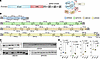 Figure 1
Transcriptional activation of IRD genes in transfected HEK293T. (A) Scheme depicting the expression plasmid and the corresponding dCas9-VPR protein bound to a gene of interest (GOI). dCas9-VPR, driven by either the CMV or SFFV promoter, was combined with a cassette expressing sgRNAs, targeting RPE65, ABCA4, MYO7A, or USH2A. For simultaneous gene activation, multiple sgRNA cassettes were combined. pA, poly(A) signal. (B) Primer design for RT-PCR analysis. Primer binding sites (black arrows) and PCR product lengths in base pairs (bp) are shown in the schematic representation of the transcripts. Colored boxes represent numbered exons of the respective genes. UTR, untranslated region. (C) RT-PCR result for each gene transcript after transcriptional activation in HEK293T cells. kbp, kilobase pairs. (D) RT-qPCR result for each gene activation (n = 3). MX, multiplexed gene transcriptional activation by combination of multiple sgRNA cassettes. R65, RPE65; M7, MYO7A; A4, ABCA4; U2A, USH2A. Values are shown as mean ± SEM. Statistics/multiple comparisons were calculated with 1-way ANOVA and Dunnett’s test.
In the first attempts to establish a robust and simple protocol for the transfection of PBMCs and skin fibroblasts from healthy individuals, we tested various commonly used transfection techniques (e.g., calcium phosphate, lipofection, and electroporation). For most of these approaches, however, we observed no or weak expression of the transfected GFP reporter gene.
Since lentiviral vectors (LVs) have been shown to efficiently transduce nondividing cells (13), we investigated the efficacy of gene activation upon transduction with LVs. In our experiments, using dual LVs, each expressing GFP or dsRed, we obtained high cotransduction efficiencies for human skin fibroblasts and PBMCs (Supplemental Figure 2, A and B). Surprisingly, the dual LV approach for gene transcriptional activation in transduced HEK293T, fibroblasts, and PBMCs led to a relatively weak transcriptional activation of ABCA4, despite numerous optimization steps (e.g., use of high multiplicity of infections [MOIs], different promoters etc., Supplemental Figure 2, C–F). These results suggest that dCas9-VPR delivered via LVs is substantially less efficient in activating target genes compared with delivery by plasmid transfection. To elucidate the causes for the low activity of dCas9-VPR in cells transduced with the corresponding LVs, we generated a HEK293T cell line stably expressing dCas9-VPR through genomic integration of the corresponding cassette (Supplemental Figure 3A). After transduction of these cells with LVs expressing only the sgRNAs targeting the individual genes, we detected a robust transcriptional activation of ABCA4, MYO7A, and USH2A. A similarly high activation was also achieved in a multiplexing approach, in which all 3 genes were targeted simultaneously (Supplemental Figure 3B). Together with the results shown in Supplemental Figure 2, this indicates that the efficiency of transcriptional activation is not compromised by LV-mediated delivery of sgRNAs, excluding a general impact of LVs on gene activation. A possible explanation for our observation of low-level gene activation in all cell types upon LV-based administration of dCas9-VPR is that dCas9-VPR is not well tolerated by LV vectors due to its size (5.8 kb). To test this hypothesis, we used a shorter variant of this CRISPRa system, dCas9-VPRmini (Supplemental Figure 3C) (14). However, this approach also did not lead to increased activation efficiency compared with full-length dCas9-VPR (Supplemental Figure 3D).
From this set of unfavorable results, we concluded that the LV-based approach in combination with dCas9-VPR–mediated transcriptional activation of genes is not suitable for diagnostic purposes.
Achieving reasonable levels of transcriptional activation for genes of interest in PBMCs or skin fibroblasts from healthy individuals is a prerequisite for establishing a robust protocol for diagnostic purposes in patient cells. So far, although we initially obtained high activation efficiencies for the individual IRD genes in transfected HEK293T cells, none of the previously described approaches has reached this goal. In another attempt, we used nucleofection for transferring sgRNA and transgene plasmids into our primary target cells. Nucleofection of a GFP-encoding cassette resulted in robust expression of this reporter in both cell types (Supplemental Figure 4A). Next, we nucleofected the dCas9-VPR expression cassette together with sgRNAs targeting MYO7A, USH2A, ABCA4, or RPE65. Using RT-qPCR, we observed high activation efficiencies for ABCA4 and RPE65. Additionally, we were able to detect the entire coding and untranslated regions using RT-PCR (Figure 2, A and B, and Supplemental Figure 5). By comparison, we found that MYO7A is already endogenously expressed in human skin fibroblasts and in PBMCs, respectively, in sufficient amounts to be detected by RT-PCR. Nevertheless, after transcriptional activation a moderate increase in MYO7A expression was detectable via RT-qPCR (Supplemental Figure 4, B and C). For USH2A, we could only detect RNA corresponding to exons 1–7, 45–55, and the 3′-UTR (Supplemental Figure 4, D and E). To optimize transcriptional activation of USH2A in PBMCs, we replaced dCas9-VPR with p65-HSF1-Suntag, another effective CRISPRa module (12). However, similar to dCas9-VPR, p65-HSF1-Suntag led to an efficient USH2A activation in HEK293T cells, but no expression of relevant transcripts was detectable in PBMCs (Supplemental Figure 6C).
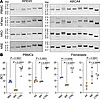 Figure 2
RT-(q)PCR analyses of transcriptionally activated genes in human PBMCs and fibroblasts. (A) RT-PCR results for RPE65 (left) and ABCA4 (right). Transcriptionally activated PBMCs and fibroblasts are compared to human retinal organoids (hROs) and human retina (hRE) with endogenously expressed RPE65 and ABCA4. (B) RT-qPCR results for transcriptionally activated RPE65 (R65) and ABCA4 (A4) in PBMCs (left; n = 5) and fibroblasts (right; n = 5). MX, multiplexed transcriptional activation of both genes (n = 3). Values are given as mean ± SEM. Statistics/multiple comparisons were calculated using 1-way ANOVA and Dunnett’s test.
As shown previously, inhibition of nonsense-mediated mRNA decay (NMD) could increase the expression of activated transcripts in patient-derived cells, such as skin fibroblasts (15, 16). Indeed, using cycloheximide to inhibit NMD in PBMCs, we were able to detect larger parts of the USH2A transcript covering exons 1–46 and the 3′-UTR (Supplemental Figure 6, A and B).
One possible explanation for the discrepancy in efficiency of USH2A activation between HEK293T cells and PBMCs would be that sgRNA target sites contain some nonpathogenic variants, such as single-nucleotide polymorphisms (SNPs), or small insertion and deletion (INDEL) sites. However, we found no INDELs or SNPs that overlapped with the sgRNA binding sites of the USH2A and RPE65 genes. Nevertheless, multiple SNPs were identified in binding regions of sgRNAs targeting ABCA4 and MYO7A (Supplemental Table 6).
So far, we have achieved efficient activation in PBMCs for 3 of the 4 genes examined, enabling detection of the entire transcript. The fact that USH2A could not be efficiently activated may be due to the sheer size of the gene/transcript (>800 kb/>18.9 kb). Another explanation could be that our CATALYTEC approach is less efficient in PBMCs than in HEK293T cells. To address this, we activated 2 additional genes associated with the Usher 2 subtype: PDZD7 and ADGRV1, with the latter gene being comparable to USH2A with respect to its gene/transcript size (>600 kb/>19.5 kb). The corresponding RT-qPCR data from PBMCs show a substantial increase in gene expression for both genes. Moreover, the activation efficiency was stronger in PBMCs compared with HEK293T cells (Supplemental Figure 7), suggesting that neither the gene’s size nor the inherent inefficiency of CATALYTEC in PBMCs was the main cause of the low and incomplete activation of USH2A in these cells.
For RPE65 and ABCA4, we detected several splice variants besides the expected RT-PCR bands encoding the full-length proteins, most of which resulted in frameshifts and premature termination codons (PTCs) (Supplemental Tables 1 and 2). The corresponding bands could represent alternative splicing that might differ in PBMCs and in the retina.
To test how the splice pattern observed in PBMCs compared to that of human retinal cells, we performed RT-PCR of RNA samples isolated from human donor retinas and human retinal organoids using the same primer pairs. We observed a very similar band pattern compared to the RT-PCR results from skin fibroblasts and PBMCs, suggesting no major differences in mRNA splicing of ABCA4 and RPE65 between the different cell and tissue types (Figure 2A).
Although RT-PCR is a robust method for the qualitative detection of mRNA splicing defects, it is less suitable for the reliable quantification of the results. In addition, particularly for low-abundance transcripts, it is susceptible to artificial variations, manifesting during cDNA synthesis and subsequent PCR amplification. To overcome the drawbacks of RT-PCR and to validate our results with additional methods, we analyzed RNA from PBMCs of several healthy individuals using 2 next-generation RNA sequencing (RNA-Seq) techniques: short-read RNA-Seq (Illumina) and long-read RNA-Seq (PacBio Revio) (Figure 3A). Additionally, to compare the transcript pattern of activated genes in PBMCs to their counterparts from a more native environment, we performed long-read sequencing of RNA isolated from human retinal organoids.
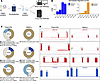 Figure 3
Short- and long-read RNA-Seq of transcriptionally activated PBMCs. (A) Workflow diagram from PBMC isolation to short- and long-read RNA-Seq. (B) Normalized fragment counts for RPE65 (left, blue) and ABCA4 (right, orange) of 4 analyzed samples (nos. 1–4) compared to untreated control samples. CPM, counts per million. (C) Proportion of different read categories for each ABCA4, RPE65, and MYO7A after long-read RNA-Seq of human retinal organoids (left) and activated PBMCs (right). (D) Sashimi plot for the evaluation of alternative splicing of ABCA4 (red) and RPE65 (blue) at respective locations found after RT-PCR and Sanger sequencing (Supplemental Tables 1 and 2). Red and blue bars represent reads covering the respective exons. Red and blue lines connecting these bars represent reads spanning the respective exon-exon junction.
Short-read RNA-Seq of samples with transcriptionally activated ABCA4 and RPE65 showed a robust increase in gene expression for both genes in comparison to nontreated control samples (Figure 3B). Splice junction analysis of ABCA4 demonstrated that the level of transcriptional activation achieved with CATALYTEC is in principle sufficient to analyze the different transcript isoforms (Supplemental Figure 4F). Simultaneous transactivation of ABCA4 and RPE65 and single transactivation of MYO7A led to full transcript coverage by long-read RNA-Seq, corroborating the increase in gene expression as previously determined via RT-qPCR and short-read RNA-Seq (Supplemental Figure 8A). The respective consensus sequences, constructed by clustering similar reads and eliminating potential artifacts, were used to identify isoforms of biological relevance. For RPE65 and MYO7A, several full-length isoforms were identified as consensus sequences (Supplemental Figure 8B). In contrast, only 1 consensus sequence was obtained for ABCA4, as multiple transcript reads were excluded in the filtering process.
Long-read RNA-Seq of human retinal organoids resulted in the identification of more than 500 sequence reads within the ABCA4 gene, of which more than 95% were classified as incomplete splice matches or novel in catalog. Only a few reads were sequenced for RPE65 (n = 5) and MYO7A (n = 19; Figure 3C). Sequencing of transcriptionally activated PBMCs resulted in only 1 read within the ABCA4 gene. For MYO7A and RPE65, long-read sequencing showed similar or higher transcript abundance in PBMCs compared with human retinal organoids (Figure 3C).
Following long-read RNA-Seq of human retinal organoids, we were able to confirm alternative splicing of ABCA4 and RPE65 in PBMCs, previously identified after Sanger sequencing of RT-PCR amplicons (Supplemental Tables 1 and 2, and Figure 3D).
Finally, we applied the described CATALYTEC protocol to 1 patient with confirmed biallelic RPE65-associated LCA (P1), 2 patients with the clinical phenotype of rod-cone dystrophy (RP, P2 and P3) but unclear molecular genetic diagnosis, and 3 patients with the clinical diagnosis of ABCA4-associated STGD (P4–P6) (Table 1 and Figure 4).
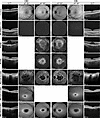 Figure 4
Clinical phenotype of patients. The top panel shows optical coherence tomography (OCT), 30° and 55° fundus autofluorescence (AF) images of a healthy subject (control). The next 3 lower panels show the corresponding images of 3 individuals (P1–P3) with confirmed RPE65-associated retinal disease (RPE65-LCA and RP). P1 shows no AF due to severe RPE65 deficiency. The last 3 panels show the corresponding images of 3 individuals (P4–P6) with confirmed ABCA4-associated retinal disease (STGD1). OD, oculus dexter. OS, oculus sinister.
All patients, except for P3, had previously undergone molecular genetic testing, of whom only P1 and P4 had a definite molecular genetic diagnosis (compound heterozygosity), which was confirmed by segregation analysis.
P1 is a 6-year-old male who has been severely visually impaired from birth and received a genetic diagnosis of RPE65-associated LCA at the age of 5 years. He was treated with voretigene neparvovec at the age of 6 years (17). P2 and P3 are 2 female siblings who first experienced impaired vision (night blindness and, in the further course, visual field restriction) in their early 20s with the clinical diagnosis of rod-cone dystrophy (RP) lacking a definite genetic diagnosis. In 2013, panel sequencing of 42 IRD genes in P2 revealed 3 heterozygous variants of unknown significance in RPE65, CRB1, and RP1L1, respectively (Table 1). WES performed in 2021 did not identify any additional candidate variants. P4 is a 49-year-old female who first experienced visual deterioration at the age of 33 years representing late-onset STGD with pronounced macular atrophy and foveal sparing (Figure 4). P5 is a 28-year-old female and P6 is her 31-year-old brother, both diagnosed with macular dystrophy at the ages of 19 and 21, respectively.
Potentially pathogenic compound heterozygous mutations in ABCA4 and RPE65 were found in all STGD1 patients (P4–P6) and in P1, respectively (Table 1).
We performed the CATALYTEC on PBMCs of these patients and analyzed the RNA by RT-PCR. P1 carries c.11+5G>A within the extended splice donor consensus sequence of exon 1 in the RPE65 gene. According to RT-PCR analysis, this mutation does not severely affect mRNA splicing at that position (Figure 5B and Supplemental Figure 9). For the second mutation affecting the canonical consensus sequence of the splice acceptor site in intron 7 (c.726-2A>T, Figure 5A), RT-PCR analysis revealed a clear difference in the band pattern compared with the unaffected control sample, experimentally confirming the splicing divergence. Sanger sequencing of these bands revealed partial skipping of exon 8 and complete inclusion of intron 7 (Figure 5, B and C).
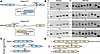 Figure 5
RPE65 and ABCA4 transcript analysis in patient samples. (A) Scheme highlighting the position of the c.726-2A>T mutation in RPE65 (patient P1; blue) and c.1937+1G>A mutation in ABCA4 (patient P4; orange). Colored boxes represent exons, the line in between represents the intron. (B) RT-PCR results for patients P1–P6 in comparison to a healthy human control sample (CTRL). (C) Scheme summarizing Sanger sequencing result of the numbered bands 1 and 2 of sample P1 shown in B. PTC, premature termination codon. (D) Scheme summarizing the results of RT-PCR analysis of the numbered bands 1–3 from sample P4, as indicated in B.
The c.1937+1G>A mutation of P4 disrupts the splice donor site of exon 13 in ABCA4 (Figure 5A). A previous case study has associated this mutation with severe phenotypes, including STGD and macular degeneration (18). A recent publication reported that it causes aberrant splicing by activating cryptic splice donor sites within exon 13 and intron 13, ultimately resulting in a 132 bp in-frame deletion (19). This conclusion was based on data obtained with a minigene assay. Potential consequences at the protein level, such as p.[(Y.603_S646del, F647*)], have not yet been experimentally validated. For this mutation, we visually detected an increased ratio of alternative exon 15 splicing in comparison with healthy control samples in RT-PCR (Figure 5, B and D, and Supplemental Figure 9). As described in Table 1, this alternatively spliced ABCA4 variant leads to an in-frame skipping of exon 15. However, the significance of this deletion for ABCA4 protein expression, stability, and function remains unclear and is outside the focus of this study. For all other patients carrying potentially pathogenic mutations in IRD genes analyzed herein, no obvious effects on splicing were detected (Figure 5B).
Taken together, these results suggest that our CATALYTEC is in principle suitable for the detection and quantification of splicing mutations in patients’ PMBCs.


