
Abstract
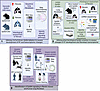
Pulmonary fibrosis (PF) is a pathology associated with interstitial lung diseases (ILDs), including idiopathic pulmonary fibrosis (IPF). Fibrosis promotes continual secretion of extracellular matrix (ECM), producing nonfunctional scar tissue and causing organ failure. This study investigated the tyrosine kinase receptor Ephrin type-B receptor 4 (EphB4) as a mediator of PF. To this end, we generated mice with conditional Col1a2-driven deletion of Ephb4 and used a preclinical mouse model of PF, total and single nuclei RNA (snRNA) sequencing, NanoString, previously published single-cell data, computational analysis, and functional assays of mouse and human healthy control and IPF lung fibroblasts. Col1a2-CreERT–driven Ephb4 deletion, or EphB4 inhibition via NVP-BHG712, markedly protected against bleomycin-induced PF. Total RNA-Seq of fibroblasts isolated from Ephb4-deficient fibrotic mouse lungs exhibited reduced expression of ECM, ER Cargo, and protein trafficking–related genes. NVP-BHG712 reduced expression of these identified genes in mouse lung fibroblasts under fibrotic conditions in vitro. snRNA-Seq of mouse lungs treated with NVP-BHG712 identified transcriptomic changes of ECM genes in specific fibroblast subpopulations. RNA-Seq, computational, and functional assays using mouse and human IPF fibroblasts identified elastin as a key mediator involved in EphB4 signaling. Combined, our data show that EphB4 is a crucial mediator of PF.
Authors
Brian Wu, Starlee S. Lively, Shabana Vohra, Noah Fine, Chiara Pastrello, Anca Maglaviceanu, Osvaldo Espin-Garcia, Evan Pollock-Tahiri, Sayaka Nakamura, Paramvir Kaur, Keemo Delos Santos, Jason S. Rockel, Pratibha Potla, Himanshi Gupta, Poulami Datta, Laura Tang, Jacob Kwon, Akihiro Nakamura, Matthew B. Buechler, Rajiv Gandhi, Jiangping Wu, Boris Hinz, Igor Jurisica, Mohit Kapoor
This file is in Adobe Acrobat (PDF) format. If you have not installed and configured the Adobe Acrobat Reader on your system.
Having trouble reading a PDF?
PDFs are designed to be printed out and read, but if you prefer to read them online, you may find it easier if you increase the view size to 125%.
Having trouble saving a PDF?
Many versions of the free Acrobat Reader do not allow Save. You must instead save the PDF from the JCI Online page you downloaded it from. PC users: Right-click on the Download link and choose the option that says something like "Save Link As...". Mac users should hold the mouse button down on the link to get these same options.
Having trouble printing a PDF?
- Try printing one page at a time or to a newer printer.
- Try saving the file to disk before printing rather than opening it "on the fly." This requires that you configure your browser to "Save" rather than "Launch Application" for the file type "application/pdf", and can usually be done in the "Helper Applications" options.
- Make sure you are using the latest version of Adobe's Acrobat Reader.


