
Go to The Journal of Clinical Investigation
  • About
  • Editors
  • Consulting Editors
  • For authors
  • Publication ethics
  • Publication alerts by email
  • Transfers
  • Advertising
  • Job board
  • Contact
  • Physician-Scientist Development
  • Current issue
  • Past issues
  • By specialty
    • COVID-19
    • Cardiology
    • Immunology
    • Metabolism
    • Nephrology
    • Oncology
    • Pulmonology
    • All ...
  • Videos
  • Collections
    • In-Press Preview
    • Resource and Technical Advances
    • Clinical Research and Public Health
    • Research Letters
    • Editorials
    • Perspectives
    • Physician-Scientist Development
    • Reviews
    • Top read articles

  • Current issue
  • Past issues
  • Specialties
  • In-Press Preview
  • Resource and Technical Advances
  • Clinical Research and Public Health
  • Research Letters
  • Editorials
  • Perspectives
  • Physician-Scientist Development
  • Reviews
  • Top read articles
  • About
  • Editors
  • Consulting Editors
  • For authors
  • Publication ethics
  • Publication alerts by email
  • Transfers
  • Advertising
  • Job board
  • Contact
Pan-H7 influenza human antibody virus neutralization depends on avidity and steric hindrance
Iuliia M. Gilchuk, Jinhui Dong, Ryan P. Irving, Cameron D. Buchman, Erica Armstrong, Hannah L. Turner, Sheng Li, Andrew B. Ward, Robert H. Carnahan, James E. Crowe Jr.
View: Text | PDF
Research Article Immunology Infectious disease Virology

Pan-H7 influenza human antibody virus neutralization depends on avidity and steric hindrance

  • Text
  • PDF
Abstract

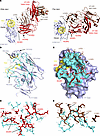
H7N9 avian influenza virus is a zoonotic influenza virus of public health concern, with a 39% mortality rate in humans. H7N9-specific prevention or treatments for humans have not been approved. We previously isolated a human monoclonal antibody (mAb) designated H7-235 that broadly reacts to diverse H7 viruses and neutralizes H7N9 viruses in vitro. Here, we report the crystal structure of H7 HA1 bound to the fragment antigen-binding region (Fab) of recombinant H7-235 (rH7-235). The crystal structure revealed that rH7-235 recognizes residues near but outside of the receptor binding site (RBS). Nevertheless, the rH7-235 IgG potently inhibits hemagglutination mediated by H7N9 viruses due to avidity effect and Fc steric hindrance. This mAb prophylactically protects mice against weight loss and death caused by challenge with lethal H7N9 viruses in vivo. rH7-235 mAb neutralizing activity alone is sufficient for protection when used at a high dose in a prophylactic setting. This study provides insights into mechanisms of viral neutralization by protective, broadly reactive anti-H7 antibodies, informing the rational design of therapeutics and vaccines against H7N9 influenza virus.

Authors

Iuliia M. Gilchuk, Jinhui Dong, Ryan P. Irving, Cameron D. Buchman, Erica Armstrong, Hannah L. Turner, Sheng Li, Andrew B. Ward, Robert H. Carnahan, James E. Crowe Jr.

×

Supporting data values - Download (2.03 MB)

No preview available for this file type: xlsx
Use the download link to access the file.
Advertisement

Copyright © 2026 American Society for Clinical Investigation
ISSN 2379-3708

Sign up for email alerts