
Abstract
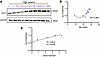
Alzheimer disease (AD) is characterized by plaques and tangles, including calcium dysregulation and glycated products produced by reactive carbonyl compounds. AD brains have increased glyoxalase I (GLO1), a major scavenger of inflammatory carbonyl compounds, at early, but not later, stages of disease. Calcium dysregulation includes calcium leak from phosphorylated ryanodine receptor 2 (pS2808-RyR2), seen in aged macaques and AD mouse models, but the downstream consequences of calcium leak remain unclear. Here, we show that chronic calcium leak is associated with increased GLO1 expression and activity. In macaques, we found age-related increases in GLO1 expression in the prefrontal cortex (PFC), correlating with pS2808-RyR2, and localized to dendrites and astrocytes. To examine the relationship between GLO1 and RyR2, we used S2808D-RyR2 mutant mice exhibiting chronic calcium leak through RyR2, and found increased GLO1 expression and activity in the PFC and hippocampus as early as 1 month and as late as 21 months of age, with a bell-shaped aging curve. These aged S2808D-RyR2 mice demonstrated impaired working memory. As with macaques, GLO1 was expressed in astrocytes and neurons. Proteomics data generated from S2808D-RyR2 synaptosomes confirmed GLO1 upregulation. Altogether, these data suggest potential association between GLO1 and chronic calcium leak, providing resilience in early stages of aging.
Authors
Elizabeth Woo, Dibyadeep Datta, Shveta Bathla, Hannah Beatty, Pinar Caglayan, Ashley Kristant Albizu, TuKiet T. Lam, Jean Kanyo, Mary Kate Joyce, Shannon Leslie, Stacy Uchendu, Jonathan DeLong, Qinyue Stacy Guan, Jiaxin Li, Efrat Abramson, Alison L. Herman, Dawson Cooper, Pawel Licznerski, Tamas L. Horvath, Elizabeth A. Jonas, Angus C. Nairn, Amy F.T. Arnsten, Lauren H. Sansing
This file is in Adobe Acrobat (PDF) format. If you have not installed and configured the Adobe Acrobat Reader on your system.
Having trouble reading a PDF?
PDFs are designed to be printed out and read, but if you prefer to read them online, you may find it easier if you increase the view size to 125%.
Having trouble saving a PDF?
Many versions of the free Acrobat Reader do not allow Save. You must instead save the PDF from the JCI Online page you downloaded it from. PC users: Right-click on the Download link and choose the option that says something like "Save Link As...". Mac users should hold the mouse button down on the link to get these same options.
Having trouble printing a PDF?
- Try printing one page at a time or to a newer printer.
- Try saving the file to disk before printing rather than opening it "on the fly." This requires that you configure your browser to "Save" rather than "Launch Application" for the file type "application/pdf", and can usually be done in the "Helper Applications" options.
- Make sure you are using the latest version of Adobe's Acrobat Reader.


