
Abstract
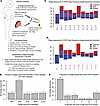
Bacteriophages, viruses that parasitize bacteria, are abundant in the human microbiome and may influence human health, in part, through their interactions with bacterial hosts. Whether endogenous bacteriophages or their products are vertically transmitted from mother to fetus during human pregnancy is not known. Here, we searched for bacteriophage sequences from five bacteriophage databases (474,031 total sequences) in cell-free DNA (cfDNA) of paired maternal and umbilical cord blood samples from two independent cohorts. First, we sequenced cfDNA from 10 pairs of maternal and cord blood samples, including four pairs affected by preeclampsia. We validated our findings in a previously published dataset of 62 paired maternal and cord blood samples, including 43 pairs from preterm or chorioamnionitis-affected deliveries. We identified 94 and 596 bacteriophage sequences in maternal and cord blood cfDNA samples from the first and second cohort, respectively. We identified 58 phage sequences across maternal-infant dyads and 581 phage sequences that were unique to a single sample. We did not identify any phage sequences consistently associated with preeclampsia, preterm, or chorioamnionitis-affected samples. This study demonstrated the presence of bacteriophage DNA in human cord blood at birth, providing evidence that the human fetus is exposed to bacteriophage DNA in utero.
Authors
Jennifer A. Sequoia, Naomi L. Haddock, Paw Mar Gay, Layla J. Barkal, Purnima Narasimhan, Nadine Martinez, Virginia D. Winn, Paul L. Bollyky
This file is in Adobe Acrobat (PDF) format. If you have not installed and configured the Adobe Acrobat Reader on your system.
Having trouble reading a PDF?
PDFs are designed to be printed out and read, but if you prefer to read them online, you may find it easier if you increase the view size to 125%.
Having trouble saving a PDF?
Many versions of the free Acrobat Reader do not allow Save. You must instead save the PDF from the JCI Online page you downloaded it from. PC users: Right-click on the Download link and choose the option that says something like "Save Link As...". Mac users should hold the mouse button down on the link to get these same options.
Having trouble printing a PDF?
- Try printing one page at a time or to a newer printer.
- Try saving the file to disk before printing rather than opening it "on the fly." This requires that you configure your browser to "Save" rather than "Launch Application" for the file type "application/pdf", and can usually be done in the "Helper Applications" options.
- Make sure you are using the latest version of Adobe's Acrobat Reader.


