
Abstract
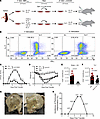
In multiple sclerosis (MS) lesions, CD8 T cells outnumber CD4 T cells, suggesting that they contribute to MS pathology. However, little is known about the role of CD8 T cells in MS, partly due to the prevalent use of experimental autoimmune encephalomyelitis (EAE) models mediated by CD4 T cells, which have limited involvement of CD8 T cells. Importantly, MS and EAE differ in both their distribution of CNS lesions and neurologic deficits, indicating differences in CNS inflammation. MS lesions are more commonly found in the brain, whereas EAE lesions are more frequent in the spinal cord. Additionally, neurologic deficits in MS rarely parallel the ascending paralysis typical for CD4 T cell–mediated EAE (CD4-EAE). In contrast, CD8-EAE models suggest that CD8 T cells preferentially cause brain inflammation; however, little is known about how brain and spinal cord inflammation may differ, or how CD8 T cells contribute to these differences. We have established an adoptive CD8-EAE mouse model characterized by brain-centered inflammation, ataxia, and weight loss. CNS inflammation in the brain and spinal cord differed in immune cell numbers, cellular composition, and inflammatory signatures. CD8-EAE could be suppressed by blocking IFN-γ, and exacerbated by blocking PD-1, with concomitant changes in the numbers of CNS-infiltrating monocytes. Most CD8 T cells in the CNS were CD11c+, suggesting that they are the pathogenic subset. We describe a robust CD8-EAE model, identify differences between brain and spinal cord inflammation, and characterize mechanisms that control CD8 T cell–mediated neuroinflammation, thereby furthering understanding of EAE and MS.
Authors
Daniel Hwang, Gholamreza Azizi, Larissa Lumi Watanabe Ishikawa, Maryam Seyedsadr, Arin Cox, Soohwa Jang, Ezgi Kasimoglu, Abdolmohamad Rostami, Guang-Xian Zhang, Bogoljub Ciric
This file is in Adobe Acrobat (PDF) format. If you have not installed and configured the Adobe Acrobat Reader on your system.
Having trouble reading a PDF?
PDFs are designed to be printed out and read, but if you prefer to read them online, you may find it easier if you increase the view size to 125%.
Having trouble saving a PDF?
Many versions of the free Acrobat Reader do not allow Save. You must instead save the PDF from the JCI Online page you downloaded it from. PC users: Right-click on the Download link and choose the option that says something like "Save Link As...". Mac users should hold the mouse button down on the link to get these same options.
Having trouble printing a PDF?
- Try printing one page at a time or to a newer printer.
- Try saving the file to disk before printing rather than opening it "on the fly." This requires that you configure your browser to "Save" rather than "Launch Application" for the file type "application/pdf", and can usually be done in the "Helper Applications" options.
- Make sure you are using the latest version of Adobe's Acrobat Reader.


