
Oncology
Abstract
Immune checkpoint inhibitors (ICIs) such as anti-PD-1 and anti-CTLA-4 antibodies are used to induce an immune response against many types of tumors. However, ICIs often also induce autoimmune responses, referred to as immune-related adverse events (irAEs), which occur unpredictably and at varying levels of severity in ICI-treated patients. The immunologic factors that predispose patients to the development of severe irAE are largely unclear. Here, we utilized high dimensional mass cytometry immunophenotyping of longitudinal blood samples from patients with metastatic melanoma treated with combination anti-PD-1/CTLA4 ICI therapy in the context of a clinical trial to characterize alterations in immune profiles induced by combination ICI therapy and to identify immune features associated with development of severe irAEs. Deep T cell profiling highlighted that ICI therapy induces prominent expansions of activated, CD38hi CD4+ and CD8+ T cells, which are frequently bound by the therapeutic anti-PD-1 antibody, as well as substantial changes in regulatory T cell phenotypes. However, neither the baseline frequency nor the extent of expansion of these cell populations was associated with development of severe irAEs. Rather, single cell-association testing revealed naïve CD4+ T cell abundance pre-treatment as significantly associated with the development of severe irAEs. Biaxial gating of naïve CD4+ T cells confirmed a significant positive association of naïve CD4+ T cell proportion and development of a severe irAE and with the number of irAEs developed in this cohort. Results from this broad profiling study indicate the abundance of naïve CD4+ T cells as a predictive feature for the development of severe irAEs following combination anti-PD-1/CTLA4 ICI therapy.
Authors
Kathryne E. Marks, Alice Horisberger, Mehreen Elahee, Ifeoluwakiisi A. Adejoorin, Nilasha Ghosh, Michael A. Postow, Laura Donlin, Anne R. Bass, Deepak A. Rao
Abstract
Survival in chronic myeloid leukemia (CML) was dramatically improved by development of tyrosine kinase inhibitors (TKIs) directed to the BCR::ABL1 oncogene. Unfortunately, ~30% of CML patients develop TKI-resistance during prolonged treatment, with enhanced blast crisis risk. Oxidation Resistance 1 (Oxr1) regulates anti-oxidant pathways that detoxify reactive oxygen species (ROS) generated by the phagocyte-NADPH oxidase. In the current studies, we found that Oxr1 expression increased in hematopoietic stem and progenitor cells (HSPCs) from CML mice versus controls; decreased during TKI-induced remission; and rose during chronic phase relapse. Oxr1 has long and short isoforms, and we found increased short, but decreased long, Oxr1 in mice or humans during CML relapse. We determined long Oxr1 prevents ROS accumulation in CML marrow, but short Oxr1 is a dominant negative. Previously, we found exaggerated and sustained emergency granulopoiesis in CML mice, with repeated episodes facilitating relapse during TKI-remission. In the current studies, we found knocking-down Oxr1 in murine marrow further accelerates CML progression during this physiologic stress. We found increased DNA-damage in HSPCs from these mice, including a BCR::ABL1 kinase-domain mutation found in TKI-resistant human CML. These studies suggest long Oxr1 detoxifies ROS to decrease mutagenesis in CML, but aberrant short Oxr1 expression enhances progression.
Authors
weiqi huang, Bin Liu, Liping Hu, Chi-Hao Luan, Priyam Patel, Elizabeth T. Bartom, Elizabeth A. Eklund
Abstract
Glioblastoma (GBM) is an aggressive brain tumor that often progresses despite resection and treatment. Timely and continuous assessment of GBM progression is critical to expedite secondary surgery or enrollment in clinical trials. However, current progression detection requires costly and specialized magnetic resonance imaging (MRI), which, in the absence of new symptoms or signs, is usually scheduled every 2 to 3 months. Here, we hypothesized that changes in daily activity associate with GBM growth and disease progression. We found that wheel-running activity in GBM-bearing mice declined as tumors grew, and preceded weight loss and circadian breakdown by over a week. Temozolomide treatment in the morning, but not evening, significantly reduced tumor size and restored daily locomotion in mice. In a pilot study of six GBM patients wearing an actigraphy watch, wrist movement provided a feasible and continuous longitudinal indicator of daily activity with one-minute resolution. Following tumor resection and radiation, daily activity declined in two patients 19 and 55 days before detection of progression by MRI, but did not change for the four patients with stable disease. These results suggest that daily activity tracking using wearable devices may serve as a real-time indicator and potential monitoring tool for GBM progression and treatment efficacy.
Authors
Maria F. Gonzalez-Aponte, Sofia V. Salvatore, Anna R. Damato, Ruth G.N. Katumba, Grayson R. Talcott, Omar H. Butt, Jian L. Campian, Jingqin Luo, Joshua B. Rubin, Olivia J. Walch, Erik D. Herzog
Abstract
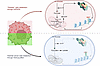
Therapeutics blocking PI3K/mTOR complex 1 (mTORC1) are commonly used for tumor treatment, and at times achieve major responses, yet minimal residual disease (MRD) persists, leading to tumor relapse. We developed multiple MRD models both in vitro (rapamycin persistent, RP) and in vivo after mTORC1 inhibition. All 11 RP/MRD cell lines showed complete growth and signaling insensitivity to rapamycin but variable sensitivity to bi-steric mTORC1 inhibitors, with MtorS2035 mutations identified in 4 of 7 RP cell lines. Multiomic analyses identified a pronounced shift toward oxidative phosphorylation and away from glycolysis with increased mitochondrial number in all RP/MRD models. MYC and SWI/SNF expression was significantly enhanced. Both the SWI/SNF inhibitor AU-15330 and the mitochondrial complex I oxidative phosphorylation inhibitor IACS-010759 showed pronounced synergy with bi-steric mTORC1 inhibitors to cause cuproptotic cell death in RP/MRD cells, suggesting these combinations as a potential patient treatment strategy for rapalog resistance.
Authors
Heng Du, Heng-Jia Liu, Magdalena Losko, Yu Chi Yang, Min Yuan, Elizabeth P. Henske, John M. Asara, Mallika Singh, David J. Kwiatkowski
Abstract
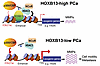
HOXB13 is a prostate-specific transcription factor best known for its role as an androgen receptor (AR) cofactor. Recent evidence suggests that HOXB13 plays critical AR-independent functions in repressing lipogenic programs and promoting prostate cancer (PCa) metastasis. However, the mechanisms linking HOXB13 loss to tumor metastasis remain unclear. Here, we show that p300 and CBP co-occupy lipogenic enhancers suppressed by HOXB13 and HDAC3 and are essential for enhancer activation and target gene expression following HOXB13 depletion. Loss of HOXB13 induces lipid-sensitive matrix metalloproteinases (MMPs), promoting increased cell motility. Importantly, pharmacological inhibition of p300 and CBP blocks HOXB13-loss-driven lipogenesis, reduces MMP expression, and decreases cell migration in vitro and tumor metastasis in vivo. Analysis of clinical samples revealed that HOXB13 expression is reduced in metastatic hormone-sensitive PCa compared with matched primary tumors, further supporting its role in tumor metastasis. These findings demonstrate that HOXB13 downregulation promotes PCa metastasis through p300- and CBP-dependent lipogenic and motility pathways, which may be targeted by p300 inhibition.
Authors
Xiaodong Lu, Liu Peng, Qi Chu, Samantha Ye, Mingyang Liu, Maha Hussain, Mehmet A. Bilen, Lara R. Harik, Jonathan Melamed, Jonathan C. Zhao, Jindan Yu
Abstract
Patients with cutaneous T cell lymphoma (CTCL) experience high morbidity and mortality due to S. aureus skin infections and sepsis, but the underlying mechanisms remain unclear. We have previously identified high levels of LAIR2, a decoy protein for the inhibitory receptor LAIR1, in advanced CTCL. Mice lack a LAIR2 homolog, so we used Lair1 knock-out (KO) mice to model LAIR2 overexpression. In a model of S. aureus skin infection, Lair1 KO mice had significantly larger abscesses and areas of dermonecrosis compared to WT despite similar bacterial burdens. Lair1 KO exhibited a pattern of increased inflammatory responses in infection and sterile immune stimulation, with increased production of proinflammatory cytokines and myeloid chemokines, neutrophil ROS, and collagen/ECM pathway proteins, including collagens and complement factors. These findings support the notion that loss of LAIR1 signaling causes an excessive inflammatory response that exacerbates tissue damage and does not improve infection control. Underscoring the clinical relevance of our findings, CTCL skin lesions exhibited similarly increased expression in cytokine and collagen/ECM remodeling pathways, suggesting that high levels of LAIR2 promote excessive inflammatory tissue damage and compromise host defense against S. aureus infection. LAIR signaling represents a promising target for therapeutic development in CTCL and other inflammatory diseases.
Authors
Hannah K. Dorando, Evan C. Mutic, Kelly L. Tomaszewski, Yulia Korshunova, Ling Tian, Mellisa K. Stefanov, Chaz C. Quinn, Deborah J. Veis, Juliane Bubeck Wardenburg, Amy C. Musiek, Neha Mehta-Shah, Jacqueline E. Payton
Abstract
Authors
Carolina M. Larrain, Jack H. Victory, Priyanka P. Desai, Lindsay R. Friedman, Hannah Stepp, Rachel Ashe, Kirsten Remmert, Surajit Sinha, Emily C. Smith, Nicole Russell, Tracey Pu, Alyssa V. Eade, Justine F. Burke, Jason Ho, Michael B. Yaffe, David E. Kleiner, Keith Schmidt, William D. Figg, Jonathan M. Hernandez
Abstract
BACKGROUND. Predictive biomarkers to guide chemotherapy decisions for metastatic castration resistant prostate cancer (mCRPC) are lacking. Preclinical studies indicate that circulating tumor cell (CTC) studies of chromosomal instability (CTC-CIN) can predict taxane resistance. METHODS. The CARD trial randomized subjects with mCRPC progressing within a year of treatment with an androgen receptor pathway inhibitor (ARPI; enzalutamide or abiraterone acetate plus prednisolone/prednisone) to cabazitaxel or the alternative ARPI. As a pre-planned biomarker analysis, CTCs were isolated from blood samples obtained at baseline; cycle two, and end of treatment. Associations between baseline CTC and CTC-CIN counts with imaging-based progression free survival (ibPFS), overall survival (OS), time to prostate-specific antigen (PSA) progression, RECIST 1.1 objective response rate (ORR), and PSA50 response rate (PRR) were assessed. RESULTS. High baseline CTC-CIN counts significantly associated with worse OS after adjustment for confounding variables (median OS, 15.3 vs 8.9 months; univariate HR, 2.16; 95% CI, 1.52 – 3.06; p < 0.001; multivariate HR, 1.56; 95% CI, 1.01 – 2.43; p = 0.047). Detectable CTC-CIN counts at baseline may predict a lack of ibPFS and OS benefit when comparing cabazitaxel to ARPI. CONCLUSION. This preplanned biomarker analysis of CARD confirms that CTC-CIN counts are a clinically useful prognostic and predictive biomarker of taxane resistance in mCRPC. Detectable CTC-CIN at baseline defines a patient subpopulation with unmet clinical needs in which alternative therapeutics should be tested. TRIAL REGISTRATION. CARD ClinicalTrials.gov number, NCT02485691. FUNDING. Funded by Sanofi and Epic Sciences.
Authors
Ossian Longoria, Jan Rekowski, Santosh Gupta, Nick Beije, Klaus Pantel, Eleni Efstathiou, Cora Sternberg, Daniel Castellano, Karim Fizazi, Bertrand Tombal, Adam Sharp, Oliver Sartor, Sandrine Macé, Christine Geffriaud-Ricouard, Richard Wenstrup, Ronald de Wit, Johann de Bono
Abstract
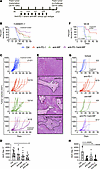
Macrophage migration inhibitory factor (MIF) is an upstream regulatory cytokine that is associated with advanced disease and poor outcomes in multiple cancer types, including melanoma. We investigated whether anti-MIF therapy could enhance the antitumor effects of the immune checkpoint inhibitor anti–programmed cell death 1 (anti–PD-1) in 2 murine tumor models. The therapeutic efficacy of anti-MIF, alone or combined with anti–PD-1, was tested in the YUMMER1.7 melanoma and MC38 colorectal cancer models. Tumor growth and survival were assessed in untreated Mif-knockout (KO) and low-expression human MIF allele (CATT5) mice and compared with wild-type (WT) or high-expression MIF allele (CATT7) mice. Tumor-bearing animals underwent cytokine profiling, tumor immunohistochemistry, flow cytometry, and scRNA-Seq. We also correlated functional variant MIF alleles with melanoma incidence and progression in patients. Our results showed that combined anti-MIF and anti–PD-1 significantly reduced tumor growth, improved survival, and promoted tumor regression, accompanied by enhanced TH1 cytokine levels, increased macrophage activation–related cytokines, and increased type 1 conventional dendritic cells. scRNA-Seq analysis revealed an expansion of intratumor Cd74/C1q/Aif1-expressing macrophages, which exhibited an antitumor phenotype, in response to anti-MIF therapy. MIF-KO and CATT5 mice exhibited reduced tumor burdens compared with WT or CATT7 mice alone and in the presence of anti–PD-1. In patients with melanoma, the high-MIF expression genotype (-173C/C) occurred at higher frequencies compared with healthy controls. These findings highlight that the addition of anti-MIF to anti–PD-1 reduces tumor growth, enhances antitumor responses, prolongs survival, and augments key intratumor immune cell populations involved in immune activation against tumors. This approach merits further consideration for clinical trial development.
Authors
Thuy T. Tran, Gabriela Athziri Sánchez-Zuno, Lais Osmani, Jasmine Caulfield, Caroline Naomi Valdez, Marta Piecychna, Lin Leng, Michelle E. Armstrong, Seamas C. Donnelly, Carlo B. Bifulco, Terri Clister, Rajan P. Kulkarni, Lin Zhang, Mario Sznol, Lucia Jilaveanu, Harriet M. Kluger, Insoo Kang, Richard Bucala
Abstract
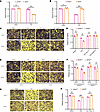
Apoptosis and necroptosis are 2 distinct destinies of cells stimulated with TNF-α; however, it remains unclear how apoptosis and necroptosis are differentially regulated. This study validates the key regulatory role of speckle-type POZ protein (SPOP) in balancing apoptosis and necroptosis. SPOP promotes the polyubiquitination and degradation of receptor-interacting serine/threonine-protein kinase 3 (RIPK3), thereby inhibiting necrosome formation and decreasing cellular sensitivity to necroptosis. Conversely, SPOP interacted with RIPK1 independently of its E3 ubiquitin ligase activity, protecting it from ubiquitination and degradation, thereby enhancing RIPK1 expression and cellular sensitivity to apoptosis. Inhibiting RIPK1 kinase activity with 7-Cl-O-Nec-1 impeded both SPOP-mediated apoptosis and SPOP deficiency–mediated necroptosis. Besides, inhibition or loss of RIPK3 rescued SPOP deficiency–mediated necroptosis. Pancancer analyses indicated that the SPOP/RIPK1/RIPK3 axis is dysfunctional in a variety of tumors. In 3 representative tumor types with high expression of SPOP and RIPK1, kidney renal clear cell carcinoma, liver hepatocellular carcinoma, and breast invasive carcinoma, this regulatory mechanism remains applicable. Based on these findings, a combination therapy using the second mitochondria-derived activator of caspases (Smac) mimetic SM164 and sunitinib was developed, demonstrating a more pronounced efficacy than sunitinib monotherapy, and this sensitizing effect was dependent on the expression level of RIPK1. These results suggest that the combination of Smac mimetics with tyrosine kinase inhibitors holds potential clinical value for tumors with dysregulated SPOP/RIPK1/RIPK3 signaling.
Authors
Yuzhong Ye, Changjie Yue, Zaosong Zheng, Hailong Ruan, Yuanpeng Zhang, Qi Miao, Xiaoping Zhang, Wen Xiao, Lei Liu
No posts were found with this tag.


