
Infectious disease
Abstract
Mucosal secretory IgA (sIgA) plays a central role in protecting against the invasion of respiratory pathogen via the upper respiratory tract. To understand how intranasal booster induces mucosal sIgA response in humans, we first used liquid chromatography-tandem mass spectrometry for peptide identification of immunoglobulin (MS Ig-Seq) and single-cell B-cell receptor sequencing (scBCR-seq) to identify mucosal spike-specific sIgA monoclonal antibodies (mAbs) after intranasal booster. These mucosal sIgA mAbs exhibited enhanced neutralization up to 100-fold against SARS-CoV-2 variants compared to their monomeric IgG and IgA isotypes. Deep sequencing and longitudinal analysis of B-cell receptor repertoires revealed that nasal booster re-stimulates memory B cells primed by intramuscularly vaccination to undergo IgA class switching, somatic hypermutation, and clonal expansion. Single-cell sequencing revealed that intranasal booster upregulated the expression of mucosal homing receptors in spike-specific IgA-expressing B cells. This increase coincided with a transient increase of cytokines and chemokines that facilitate B cell recruitment in the nasal mucosa. Our findings demonstrate that intranasal booster can be an effective strategy for inducing upper respiratory mucosal sIgA and establishing mucosal immune protection.
Authors
Si Chen, Zhengyuan Zhang, Zihan Lin, Li Yin, Lishan Ning, Wenming Liu, Qian Wang, Chenchen Yang, Bo Feng, Ying Feng, Yongping Wang, Hengchun Li, Ping He, Huan Liang, Yichu Liu, Zhixia Li, Bo Liu, Yang Li, Diana Boraschi, Linbing Qu, Xuefeng Niu, Nanshan Zhong, Pingchao Li, Ling Chen

Abstract
Cardiac arrhythmias increase during acute SARS-CoV-2 infection and in long COVID syndrome, by unknown mechanisms. This study explored the acute and long-term effects of COVID-19 on cardiac electrophysiology and the cardiac conduction system (CCS) in a hamster model. Electrocardiograms and subpleural pressures were recorded by telemetry for 4 weeks after SARS-CoV-2 infection, and interferon-stimulated gene expression and macrophage infiltration of the CCS were assessed at 4 days and 4 weeks postinfection. COVID-19 induced pronounced tachypnea and cardiac arrhythmias, including bradycardia and persistent atrioventricular block, though no viral protein expression was detected in the heart. Arrhythmias developed rapidly, partially reversed, and then redeveloped, indicating persistent CCS injury. COVID-19 induced cardiac cytokine expression, connexin mislocalization, and CCS macrophage remodeling. Interestingly, sterile innate immune activation by direct cardiac injection of polyinosinic:polycytidylic acid (PIC) induced arrhythmias similar to those of COVID-19. PIC strongly induced cytokine secretion and interferon signaling in hearts, human induced pluripotent stem cell–derived cardiomyocytes, and engineered heart tissues, accompanied by alterations in excitation-contraction coupling. Importantly, the pulmonary and cardiac effects of COVID-19 were blunted by JAK/STAT inhibition or a mitochondrially targeted antioxidant, indicating that SARS-CoV-2 infection indirectly leads to arrhythmias by innate immune activation and redox stress, which could have implications for long COVID syndrome.
Authors
Deepthi Ashok, Ting Liu, Misato Nakanishi-Koakutsu, Joseph Criscione, Meghana Prakash, Alexis Tensfeldt, Byunggik Kim, Bryan Ho, Julian Chow, Morgan Craney, Mark J. Ranek, Brian L. Lin, Kyriakos Papanicolaou, Agnieszka Sidor, D. Brian Foster, Hee Cheol Cho, Andrew Pekosz, Jason Villano, Deok-Ho Kim, Brian O’Rourke
Abstract
Few HIV-specific epitopes restricted by non-classical HLA-E have been described, and even less is known about the functional profile of responding CD8 T cells (CD8s). This study evaluates the functional characteristics of CD8s targeting the Gag epitope KF11 (KAFSPEVIPMF) restricted by either HLA-E (E-CD8s) or HLA-B57 (B57-CD8s). CD8s from eight people with HIV (PWH) were cocultured with KF11 peptide presented by cell lines expressing HLA-B*57:01, HLA-E*01:01 or E*01:03. CD8 responses were analyzed using scRNA-seq and scTCR-seq. Supernatants were also assessed for soluble protein profiling. HLA-I multimers were developed to identify CD8s restricted by HLA-B57 and/or HLA-E ex vivo. B57-CD8s secreted higher levels of cytotoxic cytokines such as IFNγ, whereas E-CD8s produced more chemotactic cytokines, including RANTES, CXCL10 (IP-10), and IL27, findings which were corroborated through scRNA sequencing. TCR clonotypes stimulated by KF11 were cross-restricted by HLA-B*57 and HLA-E*01/03 as demonstrated by in vitro T cell reporter assays and ex vivo multimer screening. Ex vivo CD8s were singly restricted by HLA-B57 and HLA-E, with dual restriction only observed in PWH with lower viral load. These findings demonstrate that certain HIV-specific CD8s in PWH exhibit dual restriction by HLA-B*57 and HLA-E*01/03, leading to functionally distinct immune responses depending upon the restricting allele(s).
Authors
Kevin J. Maroney, Michael A. Rose, Allisa K. Oman, Abha Chopra, Hua-Shiuan Hsieh, Zerufael Derza, Rachel Waterworth, Mark A. Brockman, Spyros A. Kalams, Anju Bansal, Paul A. Goepfert
Abstract
Urinary tract infections (UTIs) are the most common severe bacterial infections in young children, often associated with vesicoureteral reflux (VUR). To explore host genetic-microbiota interactions and their clinical implications, we analyzed the urinary microbiota (urobiota) and conducted genome-wide association studies (GWAS) for bacterial abundance traits in pediatric UTI and VUR patients from the RIVUR and CUTIE cohorts. We identified four urobiota community types based on relative abundance, characterized by the genera Enterococcus, Prevotella, Pseudomonas, and Escherichia/Shigella, and their associations with VUR, age, and toilet training. Children with VUR exhibited decreased microbial diversity and increased abundance of genera that included opportunistic pathogens, suggesting a disrupted urobiota. We detected genome-wide significant genetic associations with urinary bacterial relative abundances, in or near candidate genes including CXCL12, ABCC1, and ROBO1, which are implicated in urinary tract development and response to infection. We showed that Cxcl12 is induced 12 hours after uropathogenic bacterial infection in mouse bladder. The association with CXCL12 suggests a genetic link between UTI, VUR and cardiovascular phenotypes later in life. These findings provide the first characterization of host genetic influences on the pediatric urobiota in UTI and VUR, offering insights into the interplay between disease, host genetics and the urobiota composition.
Authors
Miguel Verbitsky, Pavan Khosla, Daniel Bivona, Atlas Khan, Yask Gupta, Heekuk Park, Tian H. Shen, Aryan Ghotra, Katherine Xu, Iman A. Ghavami, Priya Krithivasan, Jeremiah Martino, Tanya Sezin, Tze Y. Lim, Victoria Kolupaeva, Nita A. Limdi, Yuan Luo, Hakon Hakonarson, Simone Sanna-Cherchi, Krzysztof Kiryluk, Cathy L. Mendelsohn, Anne-Catrin Uhlemann, Jonathan Barasch, Ali G. Gharavi
Abstract
BACKGROUND. Fecal Microbiota Transplantation (FMT) is the most effective therapy for recurrent Clostridioides difficile infection (rCDI), yet its mechanism of action remains poorly understood. METHODS. We report the results of a clinical trial of subjects undergoing FMT therapy for rCDI (n=16), analyzing colon biopsies, plasma, peripheral blood mononuclear cells, and stool at the time of FMT and two-month follow-up. Plasma and colon biopsy samples were also collected from healthy controls for comparison with rCDI patients. Microbiome composition, colonic gene expression, and immune changes were evaluated through high-throughput sequencing and immunoprofiling via flow cytometry. RESULTS. No subjects experienced recurrence at follow-up. FMT significantly altered the intestinal microbiome but had no significant impact on the systemic immune system. In contrast, FMT promoted broad changes in colonic transcriptional profiles compared to both pre-FMT and healthy control biopsies, inhibiting genes associated with pro-inflammatory signaling and upregulating type 2 immunity and proliferative pathways (Myc and mTORC1). FMT increased expression of IL-33 and the type 2 immune EGFR family ligand amphiregulin, potentially explaining upregulation of Myc and mTORC1 pathways. Spatial transcriptomics demonstrated that these changes were localized to the colonic epithelium. Comparison of transcriptional profiles with available single cell gene sets determined that post-FMT biopsies were enriched in signatures associated with proliferative cell types while repressing signatures of differentiated colonocytes. CONCLUSIONS. We conclude that FMT promotes proliferation of the colonic epithelium in rCDI patients, which may drive regeneration and protect against subsequent CDI. REGISTRATION. Clinicaltrials.gov NCT02797288. FUNDING. NIH grants R01 AI152477, R01 AI124214, and K23 AI163368.
Authors
G. Brett Moreau, Jiayi Tian, Nick R. Natale, Farha Naz, Mary K. Young, Uma Nayak, Mehmet Tanyüksel, Isaura Rigo, Gregory R. Madden, Mayuresh M. Abhyankar, Nicholas Hagspiel, Savannah Brovero, Mark Worthington, Brian Behm, Chelsea Marie, William A. Petri Jr., Girija Ramakrishnan
Abstract
Herpes Simplex Virus 2 (HSV-2) infection results in variable rates of local viral shedding in anogenital skin. The impact of episodic viral exposures on immune cells in adjacent mucosal tissues, including the genital tract, is unknown. However, any immune responses at this site could impact protective mucosal immunity, tissue homeostasis, and adverse health outcomes. To investigate the impact of HSV-2 on cervicovaginal tract immunity, we applied flow cytometry, immunofluorescent imaging, analysis of soluble immune factors, and spatial transcriptomics to cervicovaginal tissue and blood samples provided by a total of 232 HSV-2-seropositive and seronegative participants, with genital HSV-2 shedding evaluated at the time of biopsy. This unique dataset was used to define and spatially map immune cell subsets and localized gene expression via spatial transcriptomics. HSV-2-seropositivity alone was associated with minimal differences in cervicovaginal and circulating T cell phenotypes. However, the vaginal mucosa during active HSV-2 shedding was associated with alterations in T cell, macrophage, and dendritic cell localization and gene expression consistent with increased immune surveillance, with immune activating and suppressing signals potentially reinforcing mucosal tissue homeostasis.
Authors
Finn MacLean, Rachael M. Zemek, Adino Tesfahun Tsegaye, Jessica B. Graham, Jessica L. Swarts, Sarah C. Vick, Nicole B. Potchen, Irene Cruz Talavera, Lakshmi Warrier, Julien Dubrulle, Lena K. Schroeder, Anna Elz, David Sowerby, Ayumi Saito, Katherine K. Thomas, Matthias Mack, Joshua T. Schiffer, R. Scott McClelland, Keith R. Jerome, Bhavna H. Chohan, Kenneth Ngure, Nelly Rwamba Mugo, Evan W. Newell, Jairam R. Lingappa, Jennifer M. Lund
Abstract
Toll-like receptor 7 (TLR7) agonists are promising immunostimulatory agents for the treatment of chronic infections and cancer. However, their systemic toxicity remains a challenge. In this study, SA-5, a novel liver-targeted, orally available TLR7 agonist, was evaluated for pharmacokinetics, safety, and efficacy in young and aged macaques across 1–10 mg/kg repeated doses. Safety was evaluated through hematologic, biochemical, and flow cytometric profiling, while efficacy was assessed via IFN-α production, gene expression of interferon-stimulated genes, and plasmacytoid dendritic cell activation. A principal component analysis (PCA)-based composite scoring system was used to integrate multimodal parameters. SA-5 induced dose-dependent type I IFN with limited systemic inflammation, with 3 mg/kg showing optimal balance. SA-5 had comparable immunostimulatory activity to GS-9620 but with reduced adverse biomarker shifts. In aged macaques, efficacy was maintained with modestly increased safety responses. These findings support SA-5 as a safer next-generation TLR7 agonist effective across age groups, highlighting integrated biomarker profiling in preclinical immunomodulatory drug development.
Authors
Shokichi Takahama, Takahiro Tomiyama, Sachiyo Yoshio, Yuta Nagatsuka, Hirotomo Murakami, Takuto Nogimori, Mami Kochi, Shoko Ochiai, Hidenori Kimura, Akihisa Fukushima, Tatsuya Kanto, Takuya Yamamoto
Abstract
The immune mechanisms induced by the Bacillus Calmette-Guérin (BCG) vaccine, and the subset of which mediate protection against tuberculosis (TB), remain poorly understood. This is further complicated by difficulties to verify vaccine-induced protection in humans. Although research in animal models, namely mice and non-human primates (NHPs), has begun to close this knowledge gap, discrepancies in the relative importance of biological pathways across species limit the utility of animal model-derived biological insights in humans. To address these challenges, we applied a systems modeling framework, Translatable Components Regression (TransCompR), to identify human blood transcriptional variability which could predict Mtb challenge outcomes in BCG-vaccinated NHPs. These protection-associated pathways included both innate and adaptive immune activation mechanisms, along with signaling via type I interferons and anti-mycobacterial T helper cytokines. We further partially validated the associations between these mechanisms and protection in humans using publicly available microarray data collected from BCG-vaccinated infants who either developed TB or remained healthy during two years of follow-up. Overall, our work demonstrates how species translation modeling can leverage animal studies to generate hypotheses about the mechanisms that underlie human infectious disease and vaccination outcomes, which may be difficult or impossible to ascertain using human data alone.
Authors
Kate Bridges, Denis Awany, Anele Gela, Temwa-Dango Mwambene, Sherry L. Kurtz, Richard E. Baker, Karen L. Elkins, Christopher M. Sassetti, Thomas J. Scriba, Douglas A. Lauffenburger
Abstract
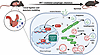
Sepsis contributes substantially to mortality rates worldwide, yet clinical trials that have focused on its underlying pathogenesis have failed to demonstrate benefits. Recently, enhancing self-defense has been regarded as an emerging therapeutic approach. Autophagy is a self-defense mechanism that protects septic mice, but its regulatory factor is still unknown. Moreover, the role of interferon regulatory factor 7 (IRF7) in sepsis has been debated. Here, we showed that Irf7 deficiency increased mortality during polymicrobial sepsis. Furthermore, IRF7 drove macrophages to protect against sepsis. Mechanistically, IRF7 is a transcription factor that upregulates the expression of autophagy-related genes responsible for autophagosome formation and autolysosome maturation, induces autophagic killing of bacteria, and ultimately reduces septic organ injury. Recombinant adeno-associated virus 9–Irf7–mediated IRF7 overexpression promoted the autophagic clearance of pathogens and improved sepsis outcomes, which may be the mechanism underlying the observed improvement in bacterial clearance. These findings provide evidence that IRF7 is the underlying regulatory factor that drives autophagy to eliminate pathogens in macrophages during sepsis. Collectively, IRF7 overexpression represents a potential host-directed therapeutic strategy for preclinical sepsis models, operating independently of antibiotic mechanisms.
Authors
Guiming Chen, Kangxin Li, Haihua Luo, Lianxu Zhao, Yong Jiang

Abstract
Primary exposure to influenza antigens during infancy shapes the humoral response to subsequent exposures. Development of a universal vaccine approach to protect newborns against influenza would represent a major step forward. In our previous study, we showed vaccination of newborn African green monkeys (AGMs) with an adjuvanted hemagglutinin (HA) stem nanoparticle induced robust IgG responses with broad recognition across HAs. Here, we examined the cellular responses in the lung-draining lymph node of these vaccinated newborn AGMs following challenge with a heterologous H1N1 virus. Our results show that vaccination is associated with early HA stem IgG+ B cell and antibody-secreting cell responses following infection, consistent with a rapidly recalled memory response. In addition, there was evidence of an increase in both HA stem– and head–specific plasma cells in vaccinated animals, suggesting a vaccine-engendered benefit for novel antibodies targeting HA epitopes. Finally, challenge was associated with preferential increases in antibodies that cross-react with H5 HA, suggesting improved protection against this divergent strain. Overall, these findings indicate that HA stem with AddaVax as adjuvant generates a stem-specific cross-reactive memory pool in newborn AGMs with the potential to be rapidly recalled upon infection.
Authors
Kali F. Crofts, Beth C. Holbrook, Courtney L. Page, Maya Sangesland, Masaru Kanekiyo, Martha Alexander-Miller
No posts were found with this tag.


