
Submit a comment
Abstract
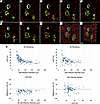
Chronic hyperglycemia induces microvascular complications in patients with type 2 diabetes (T2D), particularly diabetic retinopathy, nephropathy, and neuropathy. We revisited the pancreatic vasculature to reexamine such damage in 3D. Using thick pancreatic tissue slices, we analyzed volumetric intraislet capillary density (vICD) and peri-islet volumetric exocrine capillary density (vECD) as well as interface capillary counts along the islet periphery to quantify vascular integration between the islets and surrounding acinar cells. Contrary to the previous reports, vICD was not homogeneous but highly heterogeneous across the five species studied (human, monkey, pig, ferret, and mouse), especially in smaller islets. vICD became less variable with increasing islet size, converging at approximately 20%. With this foundation of islet vascularization, pancreatic tissues from non-diabetic and T2D subjects consisting of 8 age- and sex-matched pairs (age range of 35–65 years with various duration: 0–15 years) were examined. Strikingly, no significant differences in microvascular density were found; mean vICD and mean vECD were nearly equivalent between the groups. Capillary integration with respect to islet size was comparable. These findings suggest that integrated pancreatic blood flow with robust crosstalk between the endocrine and exocrine pancreas may facilitate microvascular preservation in T2D via local distribution of insulin.
Authors
Alex M. Tollefson, Frank R. Marsico, Manami Hara
Guidelines
The Editorial Board will only consider comments that are deemed relevant and of interest to readers. The Journal will not post data that have not been subjected to peer review; or a comment that is essentially a reiteration of another comment.
- Comments appear on the Journal’s website and are linked from the original article’s web page.
- Authors are notified by email if their comments are posted.
- The Journal reserves the right to edit comments for length and clarity.
- No appeals will be considered.
- Comments are not indexed in PubMed.
Specific requirements
- Maximum length, 400 words
- Entered as plain text or HTML
- Author’s name and email address, to be posted with the comment
- Declaration of all potential conflicts of interest (even if these are not ultimately posted); see the Journal’s conflict-of-interest policy
- Comments may not include figures


