
Submit a comment
Abstract
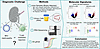
BK polyomavirus–associated nephropathy (BKVN) adversely impacts kidney allograft survival and often mimics acute T cell–mediated rejection (TCMR), confounding diagnosis and management. To address this conundrum, we performed unbiased RNA sequencing of urinary cells matched to biopsies classified as BKVN with intragraft inflammation (BKVN-P), BKVN without inflammation (BKVN-N), TCMR, or no rejection (NR). BKVN-N displayed dominant host DNA replication, cell cycle, and repair programs, while BKVN-P samples exhibited expansive innate immune activation, antigen presentation, chemokine upregulation, and epithelial injury. Both BKVN subtypes shared signatures of T cell exhaustion and mature and tolerogenic dendritic cell activation but differed in immune orientation — Th1 predominance in BKVN-N versus Treg and CD8 enrichment in BKVN-P. Compared with TCMR samples, BKVN-P lacked robust TCR/CD28 signaling and was enriched for viral and innate modules; BKVN-N lacked alloimmune activation. B cell exhaustion characterized BKVN-N, while BKVN-P displayed robust B cell activation with metabolic downregulation. A ratiometric urinary cell biomarker, CXCL10 mRNA/CD3E mRNA, distinguished both BKVN subtypes from TCMR with diagnostic accuracy, replicated by quantitative reverse transcription PCR for clinical translation, and confirmed in an independent cohort. These findings demonstrate the utility of urinary cell transcriptomics for resolving viral injury from alloimmunity, enabling precision diagnostics and targeted immunomodulation in kidney transplantation.
Authors
Franco B. Mueller, Carol Li, Darshana M. Dadhania, Surya V. Seshan, Thalia Salinas, Vijay K. Sharma, Jenny Z. Xiang, Hans H. Hirsch, Thangamani Muthukumar, Manikkam Suthanthiran
Guidelines
The Editorial Board will only consider comments that are deemed relevant and of interest to readers. The Journal will not post data that have not been subjected to peer review; or a comment that is essentially a reiteration of another comment.
- Comments appear on the Journal’s website and are linked from the original article’s web page.
- Authors are notified by email if their comments are posted.
- The Journal reserves the right to edit comments for length and clarity.
- No appeals will be considered.
- Comments are not indexed in PubMed.
Specific requirements
- Maximum length, 400 words
- Entered as plain text or HTML
- Author’s name and email address, to be posted with the comment
- Declaration of all potential conflicts of interest (even if these are not ultimately posted); see the Journal’s conflict-of-interest policy
- Comments may not include figures


