
Submit a comment
Abstract
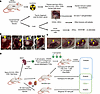
Stem cell–derived β cells offer a promising approach for type 1 diabetes (T1D) treatment. However, the processes of graft infiltration and rejection by immune cells remain poorly understood in humans. In this study, autologous or allogeneic stem cell–derived islets (SC-islets) were transplanted in human immune system mice and analyzed 14 to 18 weeks later. Imaging mass cytometry revealed unique characteristics of SC-islet grafts, including a high percentage of glucagon+ cells and the presence of cysts and CD57+ enterochromaffin cells, features not typically observed in endogenous or transplanted allogeneic primary pancreatic islets. Allogeneic SC-islet grafts exhibited heavy immune infiltration, cell proliferation, and pro-fibrotic processes, whereas autologous grafts showed minimal infiltration and little fibrosis. In some mice, autologous T cells expressing islet antigen-reactive (IAR) T cell receptors (TCRs) were adoptively transferred. Three weeks after transfer, autologous grafts injected with IAR-TCR+ T cells showed negligible immune infiltration, even though IAR-TCR+ T cells were detected in the spleen. Under the conditions tested, human SC-islet grafts were not rejected by an autologous immune system, even in the presence of autoreactive T cells, pointing to several limitations that remain to be addressed for a model of spontaneous autologous SC-islet infiltration and destruction.
Authors
Camillo Bechi Genzano, Giorgia Zanetti, Qian Du, Daniel Traum, Deeksha Lahori, Grant M. Downes, Sakshi A. Bhatele, Xiaolan Ding, Kyle D. Apley, Rebuma Firdessa Fite, Matthew Ishahak, Enrique Eduardo Sanchez-Castro, Jeffrey R. Millman, Yiming Luo, Klaus H. Kaestner, Cory Berkland, Dieter Egli, Megan Sykes, Remi J. Creusot
Guidelines
The Editorial Board will only consider comments that are deemed relevant and of interest to readers. The Journal will not post data that have not been subjected to peer review; or a comment that is essentially a reiteration of another comment.
- Comments appear on the Journal’s website and are linked from the original article’s web page.
- Authors are notified by email if their comments are posted.
- The Journal reserves the right to edit comments for length and clarity.
- No appeals will be considered.
- Comments are not indexed in PubMed.
Specific requirements
- Maximum length, 400 words
- Entered as plain text or HTML
- Author’s name and email address, to be posted with the comment
- Declaration of all potential conflicts of interest (even if these are not ultimately posted); see the Journal’s conflict-of-interest policy
- Comments may not include figures


