
Submit a comment
Abstract
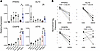
Mycobacterium tuberculosis (Mtb) survives within multiple macrophage populations during infection, including alveolar macrophages (AMs) and recruited inflammatory macrophages. In mice, itaconate, produced in macrophages by ACOD1-mediated decarboxylation of aconitate, has direct antimicrobial activity, modulates inflammatory cytokines, and is required for resistance to Mtb infection. The role of itaconate in human macrophages is less clear, and it is unknown whether itaconate mediates distinct effects in macrophage subtypes. Here, we investigated the role of itaconate in macrophages derived from human induced pluripotent stem cells (iPSCs), induced by either GM-CSF to resemble AMs (AM-like cells, hereafter ipAM-Ls) or M-CSF to resemble monocyte-derived macrophages (MDM-like cells, hereafter ipMDM-Ls). Both human macrophage types produced substantially less itaconate than mouse macrophages, and ipAM-Ls produced 4-fold less itaconate than ipMDM-Ls. Surprisingly, ACOD1-deficient ipAM-Ls, but not ipMDM-Ls, were permissive for Mtb growth. Moreover, itaconate functioned to dampen the Mtb-induced inflammatory response in ipMDM-Ls, but not ipAM-Ls, affecting both the type I IFN and TNF pathways. These results indicate that itaconate is involved in human macrophage responses to tuberculosis, with distinct roles in different macrophage subsets. These results also show that genetically tractable iPSC-derived macrophages are a useful model to dissect cellular host-pathogen interactions in human macrophages.
Authors
Adam S. Krebs, Tomi Lazarov, Anthony T. Reynolds, Kimberly A. Dill-McFarland, Abigail Xie, James M. Bean, Muxue Du, Olivier Levy, John A. Buglino, Aaron Zhong, Anna-Lena Neehus, Stéphanie Boisson-Dupuis, Jean-Laurent Casanova, Elouise E. Kroon, Marlo Möller, Thomas R. Hawn, Ting Zhou, Lydia W.S. Finley, Marc Antoine Jean Juste, Dan W. Fitzgerald, Frederic Geissmann, Michael S. Glickman
Guidelines
The Editorial Board will only consider comments that are deemed relevant and of interest to readers. The Journal will not post data that have not been subjected to peer review; or a comment that is essentially a reiteration of another comment.
- Comments appear on the Journal’s website and are linked from the original article’s web page.
- Authors are notified by email if their comments are posted.
- The Journal reserves the right to edit comments for length and clarity.
- No appeals will be considered.
- Comments are not indexed in PubMed.
Specific requirements
- Maximum length, 400 words
- Entered as plain text or HTML
- Author’s name and email address, to be posted with the comment
- Declaration of all potential conflicts of interest (even if these are not ultimately posted); see the Journal’s conflict-of-interest policy
- Comments may not include figures


