
Submit a comment
Abstract
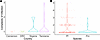
BACKGROUND Malaria caused by Plasmodium malariae is geographically widespread and sometimes associated with prolonged infection, yet little is known about its genomic epidemiology.METHODS We performed hybrid capture and whole-genome sequencing of 77 isolates collected from Cameroon (n = 7), the Democratic Republic of the Congo (n = 16), Nigeria (n = 4), and Tanzania (n = 50) between 2015 and 2021, analyzing parasite genetic population structure and demography.RESULTS There is no evidence of geographic population structure. Nucleotide diversity was significantly lower than in colocalized P. falciparum isolates, while linkage disequilibrium was significantly higher. Genome-wide selection scans identified no erythrocyte invasion ligands or antimalarial resistance orthologs as top hits; however, targeted analyses of these loci revealed evidence of selective sweeps around 4 erythrocyte invasion ligands and 6 antimalarial resistance orthologs. Demographic inference modeling suggests that African P. malariae is recovering from a bottleneck.CONCLUSION P. malariae is genomically atypical among human Plasmodium spp. and lacks strong population structure in Africa. The low diversity has potential impacts on understanding persistent versus new infection through genomic epidemiology.FUNDING Bill & Melinda Gates Foundation (grant 002202), USAID/PMI through Jhpiego and CDC, NIH (T32AI007151, T32AI070114, R01AI107949, R01AI129812, R21 AI148579, R01AI137395, R21AI152260, R01AI132547, and K24AI134990), and the DELTAS Africa initiative (DELGEME grant 107740/Z/15/Z).
Authors
Zachary R. Popkin-Hall, Kelly Carey-Ewend, Farhang Aghakhanian, Eniyou C. Oriero, Misago D. Seth, Melchior M. Kashamuka, Billy Ngasala, Innocent M. Ali, Eric Sompwe Mukomena, Celine I. Mandara, Oksana Kharabora, Rachel Sendor, Alfred Simkin, Alfred Amambua-Ngwa, Antoinette Tshefu, Abebe A. Fola, Deus S. Ishengoma, Jeffrey A. Bailey, Jonathan B. Parr, Jessica T. Lin, Jonathan J. Juliano
Guidelines
The Editorial Board will only consider comments that are deemed relevant and of interest to readers. The Journal will not post data that have not been subjected to peer review; or a comment that is essentially a reiteration of another comment.
- Comments appear on the Journal’s website and are linked from the original article’s web page.
- Authors are notified by email if their comments are posted.
- The Journal reserves the right to edit comments for length and clarity.
- No appeals will be considered.
- Comments are not indexed in PubMed.
Specific requirements
- Maximum length, 400 words
- Entered as plain text or HTML
- Author’s name and email address, to be posted with the comment
- Declaration of all potential conflicts of interest (even if these are not ultimately posted); see the Journal’s conflict-of-interest policy
- Comments may not include figures


