
Submit a comment
Abstract
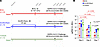
Exposure to Bacillus Calmette-Guérin (BCG) or Canarypox ALVAC/Alum vaccine elicits pro- or antiinflammatory innate responses, respectively. We tested whether prior exposure of macaques to these immunogens protected against SARS-CoV-2 replication in lungs and found more efficient replication control after the pro-inflammatory immunity elicited by BCG. The decreased virus level in lungs was linked to early infiltrates of classical monocytes producing IL-8 with systemic neutrophils, Th2 cells, and Ki67+CD95+CD4+ T cells producing CCR7. At the time of SARS-CoV-2 exposure, BCG-treated animals had higher frequencies of lung infiltrating neutrophils and higher CD14+ cells expressing efferocytosis marker MERTK, responses correlating with decreased SARS-CoV-2 replication in lung. At the same time point, plasma IL-18, TNF-α, TNFSF-10, and VEGFA levels were also higher in the BCG group and correlated with decreased virus replication. Finally, after SARS-CoV-2 exposure, decreased virus replication correlated with neutrophils producing IL-10 and CCR7 preferentially recruited to the lungs of BCG-vaccinated animals. These data point to the importance of the spatiotemporal distribution of functional monocytes and neutrophils in controlling SARS-CoV-2 levels and suggest a central role of monocyte efferocytosis in curbing replication.
Authors
Mohammad Arif Rahman, Katherine C. Goldfarbmuren, Sarkis Sarkis, Massimiliano Bissa, Anna Gutowska, Luca Schifanella, Ramona Moles, Melvin N. Doster, Hanne Andersen, Yogita Jethmalani, Leonid Serebryannyy, Timothy Cardozo, Mark G. Lewis, Genoveffa Franchini
Guidelines
The Editorial Board will only consider comments that are deemed relevant and of interest to readers. The Journal will not post data that have not been subjected to peer review; or a comment that is essentially a reiteration of another comment.
- Comments appear on the Journal’s website and are linked from the original article’s web page.
- Authors are notified by email if their comments are posted.
- The Journal reserves the right to edit comments for length and clarity.
- No appeals will be considered.
- Comments are not indexed in PubMed.
Specific requirements
- Maximum length, 400 words
- Entered as plain text or HTML
- Author’s name and email address, to be posted with the comment
- Declaration of all potential conflicts of interest (even if these are not ultimately posted); see the Journal’s conflict-of-interest policy
- Comments may not include figures


