
Go to The Journal of Clinical Investigation
  • About
  • Editors
  • Consulting Editors
  • For authors
  • Journal stats
  • Publication ethics
  • Publication alerts by email
  • Transfers
  • Advertising
  • Job board
  • Contact
  • Physician-Scientist Development
  • Current issue
  • Past issues
  • By specialty
    • COVID-19
    • Cardiology
    • Immunology
    • Metabolism
    • Nephrology
    • Oncology
    • Pulmonology
    • All ...
  • Videos
  • Collections
    • In-Press Preview
    • Resource and Technical Advances
    • Clinical Research and Public Health
    • Research Letters
    • Editorials
    • Perspectives
    • Physician-Scientist Development
    • Reviews
    • Top read articles

  • Current issue
  • Past issues
  • Specialties
  • In-Press Preview
  • Resource and Technical Advances
  • Clinical Research and Public Health
  • Research Letters
  • Editorials
  • Perspectives
  • Physician-Scientist Development
  • Reviews
  • Top read articles
  • About
  • Editors
  • Consulting Editors
  • For authors
  • Journal stats
  • Publication ethics
  • Publication alerts by email
  • Transfers
  • Advertising
  • Job board
  • Contact
Chronic Hypertension Impairs Lymphatic Drainage in Deep Cervical Lymph Nodes
Kaiming Xu, Ankita Bhardwaj, Sunil Koundal, Qin Ren, Chenyu You, Xenophon Papademetris, Helene Benveniste, Tryphon T. Georgiou
View: Text | PDF
Research In-Press Preview Aging Immunology

Chronic Hypertension Impairs Lymphatic Drainage in Deep Cervical Lymph Nodes

  • Text
  • PDF
Abstract

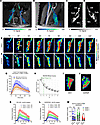
The glymphatic-meningeal pathway, important for brain homeostasis, depends on the drainage function of the cervical lymphatic system. Although new therapies aim to modulate this pathway, a lack of methods for quantifying lymphatic drainage function hinders our ability to understand how targeting the cervical lymph nodes may benefit brain health. To address this, we developed and applied a fluid transport model to dynamic contrast-enhanced magnetic resonance imaging (DCE-MRI) data to visualize and quantify tracer-tagged lymph through the deep cervical lymph nodes (dcLN). The model incorporated physical principles of solute transport to provide a biologically interpretable framework for analyzing microflows in real-time. We applied this model to investigate the effects of chronic hypertension on dcLN drainage by comparing normotensive Wistar-Kyoto rats with spontaneously hypertensive stroke-prone (SHRSP) rats. In normal rats, the model revealed complex and tortuous lymph streams, of a 200 kDa tracer transported through the sinus system of the dcLN. In contrast, SHRSP rats exhibited significantly altered fluid dynamics, characterized by simpler stream patterns and reduced flow through the dcLN. These findings demonstrated that untreated chronic hypertension adversely affects lymph node drainage function. This provides new insight into impaired lymphatic drainage as a mechanism linking systemic disease to brain health.

Authors

Kaiming Xu, Ankita Bhardwaj, Sunil Koundal, Qin Ren, Chenyu You, Xenophon Papademetris, Helene Benveniste, Tryphon T. Georgiou

×
Problems with a PDF?

This file is in Adobe Acrobat (PDF) format. If you have not installed and configured the Adobe Acrobat Reader on your system.

Having trouble reading a PDF?

PDFs are designed to be printed out and read, but if you prefer to read them online, you may find it easier if you increase the view size to 125%.

Having trouble saving a PDF?

Many versions of the free Acrobat Reader do not allow Save. You must instead save the PDF from the JCI Online page you downloaded it from. PC users: Right-click on the Download link and choose the option that says something like "Save Link As...". Mac users should hold the mouse button down on the link to get these same options.

Having trouble printing a PDF?

  1. Try printing one page at a time or to a newer printer.
  2. Try saving the file to disk before printing rather than opening it "on the fly." This requires that you configure your browser to "Save" rather than "Launch Application" for the file type "application/pdf", and can usually be done in the "Helper Applications" options.
  3. Make sure you are using the latest version of Adobe's Acrobat Reader.

- Download (48.52 MB)

Advertisement

Copyright © 2026 American Society for Clinical Investigation
ISSN 2379-3708

Sign up for email alerts