
Abstract
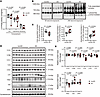
Defective synaptic transmission is a prominent pathology that underlies cognitive deficits in Alzheimer’s disease (AD), highlighting the need to elucidate molecular mechanisms of synaptic failure. Vacuolar H+-ATPase (V-ATPase), a proton-pumping enzyme, is essential for synaptic vesicle acidification and neurotransmitter loading. However, whether SV-associated V-ATPase is vulnerable to AD remains unclear. Here, using SV-rich fractions from postmortem brain tissues, we identified SV-associated V-ATPase deficits, including decreased enzymatic activity, impaired complex assembly, and altered expression of its key subunits in AD. SV-associated V-ATPase dysfunction was further associated with pathological and clinical characteristics of AD. Genetic downregulation of the V-ATPase V1D subunit, a component reduced in AD brains, disrupted V-ATPase proton transport and impaired SV acidification. Further experiments using 5×FAD mice, which exhibited AD-like SV-associated V-ATPase deficits, demonstrated the deleterious impact of V-ATPase dysfunction on SV acidification and synaptic transmission including presynaptic neurotransmitter release. In addition, ex vivo studies identified amyloid β–induced oxidative stress as a driver of V1D loss and V-ATPase disassembly, linking AD pathology to SV-associated V-ATPase dysfunction. These findings indicate that SV-associated V-ATPase dysfunction contributes to synaptic failure and cognitive deficits in AD. Therapeutic avenues to mitigate V-ATPase dysfunction have the potential to attenuate synaptic failure for the management of AD.
Authors
Yanting Chen, Khloud Ashraf Farouk Emam, Shuwen Yue, Jing Tian, Tienju Wang, Albert Park, Shalini Mishra, Gagan Deep, Zi-Jun Wang, Heng Du, Lan Guo
This file is in Adobe Acrobat (PDF) format. If you have not installed and configured the Adobe Acrobat Reader on your system.
Having trouble reading a PDF?
PDFs are designed to be printed out and read, but if you prefer to read them online, you may find it easier if you increase the view size to 125%.
Having trouble saving a PDF?
Many versions of the free Acrobat Reader do not allow Save. You must instead save the PDF from the JCI Online page you downloaded it from. PC users: Right-click on the Download link and choose the option that says something like "Save Link As...". Mac users should hold the mouse button down on the link to get these same options.
Having trouble printing a PDF?
- Try printing one page at a time or to a newer printer.
- Try saving the file to disk before printing rather than opening it "on the fly." This requires that you configure your browser to "Save" rather than "Launch Application" for the file type "application/pdf", and can usually be done in the "Helper Applications" options.
- Make sure you are using the latest version of Adobe's Acrobat Reader.


