
Go to The Journal of Clinical Investigation
  • About
  • Editors
  • Consulting Editors
  • For authors
  • Publication ethics
  • Publication alerts by email
  • Transfers
  • Advertising
  • Job board
  • Contact
  • Physician-Scientist Development
  • Current issue
  • Past issues
  • By specialty
    • COVID-19
    • Cardiology
    • Immunology
    • Metabolism
    • Nephrology
    • Oncology
    • Pulmonology
    • All ...
  • Videos
  • Collections
    • In-Press Preview
    • Resource and Technical Advances
    • Clinical Research and Public Health
    • Research Letters
    • Editorials
    • Perspectives
    • Physician-Scientist Development
    • Reviews
    • Top read articles

  • Current issue
  • Past issues
  • Specialties
  • In-Press Preview
  • Resource and Technical Advances
  • Clinical Research and Public Health
  • Research Letters
  • Editorials
  • Perspectives
  • Physician-Scientist Development
  • Reviews
  • Top read articles
  • About
  • Editors
  • Consulting Editors
  • For authors
  • Publication ethics
  • Publication alerts by email
  • Transfers
  • Advertising
  • Job board
  • Contact
Early cell-autonomous and niche-mediated epithelial response to influenza infection in primary alveolar organoids
Amber Elitz, Sharlene Fernandes, Kathleen C.S. Cook, Helen I Warheit-Niemi, Barbara Zhao, Andrea Toth, Amanda L. Zacharias, William J. Zacharias
View: Text | PDF
Resource and Technical Advance In-Press Preview Infectious disease Pulmonology

Early cell-autonomous and niche-mediated epithelial response to influenza infection in primary alveolar organoids

  • Text
  • PDF
Abstract

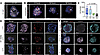
Influenza A virus (IAV) infection is a major cause of morbidity and mortality for patients worldwide. Alveolar type 2 (AT2) cells are the preferential target of IAV as part of the pathogenesis of viral pneumonia and acute respiratory distress syndrome (ARDS). Early IAV infection of alveolar cells has been challenging to model both in vitro and in vivo. To address this challenge, we used a combination of murine and human primary alveolar organoids to define methods for robust IAV infection and evaluated cell-autonomous consequences of IAV using a temporal series of multiome paired single nuclei RNA and ATAC sequencing assays. Infected AT2 cells demonstrated conserved changes defined by early loss of surfactant secretion, decreased lipid biogenesis, a rapid burst of antiviral response, and late viral-mediated suppression. Surprisingly, uninfected AT2 cells underwent substantial transcriptional and epigenomic changes in IAV-treated cultures, leading to transition to damage-associated cell states within hours via a process driven by the inflammatory milieu of murine organoids. Together, these data provide new methods for high-fidelity modeling of IAV infection in alveolar cells and defined a conserved AT2 cell response signature to IAV with implications for ARDS pathogenesis.

Authors

Amber Elitz, Sharlene Fernandes, Kathleen C.S. Cook, Helen I Warheit-Niemi, Barbara Zhao, Andrea Toth, Amanda L. Zacharias, William J. Zacharias

×

Supplemental XLSX file showing underlying data from bioinformatic analyses underlying graphical display in all figures. - Download (701.43 KB)

No preview available for this file type: xlsx
Use the download link to access the file.
Advertisement

Copyright © 2026 American Society for Clinical Investigation
ISSN 2379-3708

Sign up for email alerts