
Abstract
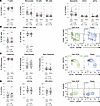
At-home blood collection devices (ABCDs) can facilitate study participation for remote and rural cohorts. Previous studies used ABCDs to interrogate samples by proteomics and sequencing approaches. We wanted to address the question of whether this approach could be used to assess live immune cells with high-parameter flow cytometry to enable remote immune monitoring. We first compared blood from standard venipuncture with ABCD blood draws, followed by assessment of the impact of sample shipping on immune cell viability and phenotyping. We found that capillary blood collected with a Tasso+ device and concurrently drawn venipuncture blood samples had highly congruent immune cell composition and phenotype. Shipment of Tasso+ samples via the United States Postal Service altered the myeloid compartment, but T cell numbers, subsets, and phenotypes remained remarkably stable compared with non-shipped samples. Finally, we describe a flow cytometry analysis framework that allowed for direct sample comparison even when samples were stained and analyzed over a time period of 1.5 years. Overall, our data highlight the feasibility of using ABCDs combined with subsequent flow cytometry analysis for remote immune monitoring. Additionally, our study also identifies areas that could be improved to further promote the use of ABCDs for immune monitoring.
Authors
Andrew J. Konecny, Fang Yun Lim, Eva Domenjo-Vila, Erika Lovas, Rachel L. Blazevic, Louise E. Kimball, Michael Boeckh, Alpana Waghmare, Martin Prlic
This file is in Adobe Acrobat (PDF) format. If you have not installed and configured the Adobe Acrobat Reader on your system.
Having trouble reading a PDF?
PDFs are designed to be printed out and read, but if you prefer to read them online, you may find it easier if you increase the view size to 125%.
Having trouble saving a PDF?
Many versions of the free Acrobat Reader do not allow Save. You must instead save the PDF from the JCI Online page you downloaded it from. PC users: Right-click on the Download link and choose the option that says something like "Save Link As...". Mac users should hold the mouse button down on the link to get these same options.
Having trouble printing a PDF?
- Try printing one page at a time or to a newer printer.
- Try saving the file to disk before printing rather than opening it "on the fly." This requires that you configure your browser to "Save" rather than "Launch Application" for the file type "application/pdf", and can usually be done in the "Helper Applications" options.
- Make sure you are using the latest version of Adobe's Acrobat Reader.


