
Abstract
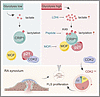
Synovial hyperplasia is a hallmark of rheumatoid arthritis (RA), yet its mechanism remains unclear. RA synovium exhibits metabolic shift, characterized by upregulated glycolysis and enhanced lactate production. In this study, we elucidated the mechanism underlying the roles of lactate metabolism and protein lactylation in RA pathology. In patients with RA, both lactate production and protein lactylation were elevated and showed a positive correlation with clinical disease activity. These changes were further implicated in driving synovial proliferation. Among the lactylated proteins, Cysteine-rich intestinal protein 1 (CRIP1) exhibited a marked increase in modification and played a central role in promoting synovial proliferation. Mechanistically, CRIP1 underwent MOF-mediated lactylation in RA synovial fibroblasts. Lactylated CRIP1 hijacked the cell-cycle regulator p21, disrupting its interaction with cyclin-dependent kinase 2 (CDK2), thereby facilitating the G1/S phase transition. Functionally, AAV-mediated delivery of a lactylation-deficient CRIP1 K49R significantly reduced synovial proliferation compared with WT CRIP1. Peptide-based interventions targeting CRIP1 K49 lactylation effectively inhibited synovial hyperplasia and disease severity in both Collagen II–induced arthritis (CIA) and humanized NSG chimeric models. Collectively, CRIP1 protein lactylation drives synovial proliferation in RA by hijacking p21 from CDK2, thereby facilitating cell cycle progression. Targeting this pathway may serve as a promising strategy for RA.
Authors
Meican Ma, Yu Zhou, Qianlin Li, Zhao Wang, Shangqi Guan, Xiaoxue Wang, Han Zhao, Zhenke Wen, Ting Liu, Fenghong Yuan
This file is in Adobe Acrobat (PDF) format. If you have not installed and configured the Adobe Acrobat Reader on your system.
Having trouble reading a PDF?
PDFs are designed to be printed out and read, but if you prefer to read them online, you may find it easier if you increase the view size to 125%.
Having trouble saving a PDF?
Many versions of the free Acrobat Reader do not allow Save. You must instead save the PDF from the JCI Online page you downloaded it from. PC users: Right-click on the Download link and choose the option that says something like "Save Link As...". Mac users should hold the mouse button down on the link to get these same options.
Having trouble printing a PDF?
- Try printing one page at a time or to a newer printer.
- Try saving the file to disk before printing rather than opening it "on the fly." This requires that you configure your browser to "Save" rather than "Launch Application" for the file type "application/pdf", and can usually be done in the "Helper Applications" options.
- Make sure you are using the latest version of Adobe's Acrobat Reader.


