
Abstract
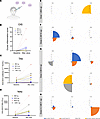
Adeno-associated viruses (AAVs) have been used in gene therapy, especially for inherited retinal diseases. Despite their effectiveness in gene transduction, immune responses to the AAV capsid and transgene products have been reported, which can compromise both the efficacy and the safety of AAV-mediated therapies. The eye is regarded as an immune-privileged organ where immune activity is constitutively suppressed. Here, we highlight that immunomonitoring in an ocular gene transfer reveals variable immune responses, whatever the species (human clinical trial, nonhuman primates, mice), the site of injection, the cassette, and the dose. We further explored factors contributing to this variability, investigating the potential correlation among immune parameters in a controlled experimental setting. In a syngeneic murine model after a subretinal injection of AAV, our results highlight an interindividual variability of immune parameters, emphasizing the importance of considering inherent variability among individuals when designing personalized therapies.
Authors
Duohao Ren, Gaelle A. Chauveau, Julie Vendomele, Emilie Cabon, Audrey Pineiro, Catherine Vignal-Clermont, Hanadi Saliba, Giuseppe Ronzitti, Anne Galy, Deniz Dalkara, Juliette Pulman, Divya Ail, Sylvain Fisson
This file is in Adobe Acrobat (PDF) format. If you have not installed and configured the Adobe Acrobat Reader on your system.
Having trouble reading a PDF?
PDFs are designed to be printed out and read, but if you prefer to read them online, you may find it easier if you increase the view size to 125%.
Having trouble saving a PDF?
Many versions of the free Acrobat Reader do not allow Save. You must instead save the PDF from the JCI Online page you downloaded it from. PC users: Right-click on the Download link and choose the option that says something like "Save Link As...". Mac users should hold the mouse button down on the link to get these same options.
Having trouble printing a PDF?
- Try printing one page at a time or to a newer printer.
- Try saving the file to disk before printing rather than opening it "on the fly." This requires that you configure your browser to "Save" rather than "Launch Application" for the file type "application/pdf", and can usually be done in the "Helper Applications" options.
- Make sure you are using the latest version of Adobe's Acrobat Reader.


