
Physician-Scientist Development
Open Access |  10.1172/jci.insight.198778
Dual-degree pathways in the residency match: a comparative analysis of application behaviors and outcomes
Daniel C. Brock,1,2 Deborah D. Rupert,1,3 Toni Darville,4,5 Caroline S. Jansen,1,6 Elias M. Wisdom,1,7 and Cynthia Y. Tang1,5
1American Physician Scientists Association, Boxborough, Massachusetts, USA.
2Medical Scientist Training Program, Baylor College of Medicine, Houston, Texas, USA.
3Department of Anesthesiology, Washington University School of Medicine in St. Louis, St. Louis, Missouri, USA.
4Department of Pediatrics and
5Medical Scientist Training Program, University of North Carolina at Chapel Hill, Chapel Hill, North Carolina, USA.
6Department of Internal Medicine, Yale School of Medicine, New Haven, Connecticut, USA.
7Medical Scientist Training Program, Oregon Health & Science University, Portland, Oregon, USA.
Address correspondence to: Cynthia Tang, University of North Carolina-Chapel Hill, 321 S Columbia St, Chapel Hill, North Carolina, 27599, USA. Phone: 208.446.7024; Email: cynthia.tang@med.unc.edu.
Find articles by Brock, D. in: PubMed | Google Scholar
1American Physician Scientists Association, Boxborough, Massachusetts, USA.
2Medical Scientist Training Program, Baylor College of Medicine, Houston, Texas, USA.
3Department of Anesthesiology, Washington University School of Medicine in St. Louis, St. Louis, Missouri, USA.
4Department of Pediatrics and
5Medical Scientist Training Program, University of North Carolina at Chapel Hill, Chapel Hill, North Carolina, USA.
6Department of Internal Medicine, Yale School of Medicine, New Haven, Connecticut, USA.
7Medical Scientist Training Program, Oregon Health & Science University, Portland, Oregon, USA.
Address correspondence to: Cynthia Tang, University of North Carolina-Chapel Hill, 321 S Columbia St, Chapel Hill, North Carolina, 27599, USA. Phone: 208.446.7024; Email: cynthia.tang@med.unc.edu.
Find articles by Rupert, D. in: PubMed | Google Scholar
1American Physician Scientists Association, Boxborough, Massachusetts, USA.
2Medical Scientist Training Program, Baylor College of Medicine, Houston, Texas, USA.
3Department of Anesthesiology, Washington University School of Medicine in St. Louis, St. Louis, Missouri, USA.
4Department of Pediatrics and
5Medical Scientist Training Program, University of North Carolina at Chapel Hill, Chapel Hill, North Carolina, USA.
6Department of Internal Medicine, Yale School of Medicine, New Haven, Connecticut, USA.
7Medical Scientist Training Program, Oregon Health & Science University, Portland, Oregon, USA.
Address correspondence to: Cynthia Tang, University of North Carolina-Chapel Hill, 321 S Columbia St, Chapel Hill, North Carolina, 27599, USA. Phone: 208.446.7024; Email: cynthia.tang@med.unc.edu.
Find articles by
Darville, T.
in:
PubMed
|
Google Scholar
|

1American Physician Scientists Association, Boxborough, Massachusetts, USA.
2Medical Scientist Training Program, Baylor College of Medicine, Houston, Texas, USA.
3Department of Anesthesiology, Washington University School of Medicine in St. Louis, St. Louis, Missouri, USA.
4Department of Pediatrics and
5Medical Scientist Training Program, University of North Carolina at Chapel Hill, Chapel Hill, North Carolina, USA.
6Department of Internal Medicine, Yale School of Medicine, New Haven, Connecticut, USA.
7Medical Scientist Training Program, Oregon Health & Science University, Portland, Oregon, USA.
Address correspondence to: Cynthia Tang, University of North Carolina-Chapel Hill, 321 S Columbia St, Chapel Hill, North Carolina, 27599, USA. Phone: 208.446.7024; Email: cynthia.tang@med.unc.edu.
Find articles by Jansen, C. in: PubMed | Google Scholar
1American Physician Scientists Association, Boxborough, Massachusetts, USA.
2Medical Scientist Training Program, Baylor College of Medicine, Houston, Texas, USA.
3Department of Anesthesiology, Washington University School of Medicine in St. Louis, St. Louis, Missouri, USA.
4Department of Pediatrics and
5Medical Scientist Training Program, University of North Carolina at Chapel Hill, Chapel Hill, North Carolina, USA.
6Department of Internal Medicine, Yale School of Medicine, New Haven, Connecticut, USA.
7Medical Scientist Training Program, Oregon Health & Science University, Portland, Oregon, USA.
Address correspondence to: Cynthia Tang, University of North Carolina-Chapel Hill, 321 S Columbia St, Chapel Hill, North Carolina, 27599, USA. Phone: 208.446.7024; Email: cynthia.tang@med.unc.edu.
Find articles by Wisdom, E. in: PubMed | Google Scholar
1American Physician Scientists Association, Boxborough, Massachusetts, USA.
2Medical Scientist Training Program, Baylor College of Medicine, Houston, Texas, USA.
3Department of Anesthesiology, Washington University School of Medicine in St. Louis, St. Louis, Missouri, USA.
4Department of Pediatrics and
5Medical Scientist Training Program, University of North Carolina at Chapel Hill, Chapel Hill, North Carolina, USA.
6Department of Internal Medicine, Yale School of Medicine, New Haven, Connecticut, USA.
7Medical Scientist Training Program, Oregon Health & Science University, Portland, Oregon, USA.
Address correspondence to: Cynthia Tang, University of North Carolina-Chapel Hill, 321 S Columbia St, Chapel Hill, North Carolina, 27599, USA. Phone: 208.446.7024; Email: cynthia.tang@med.unc.edu.
Find articles by Tang, C. in: PubMed | Google Scholar
Published February 19, 2026 - More info
JCI Insight. 2026;11(7):e198778. https://doi.org/10.1172/jci.insight.198778.
© 2026 Brock et al. This work is licensed under the Creative Commons Attribution 4.0 International License. To view a copy of this license, visit http://creativecommons.org/licenses/by/4.0/.

-
Results
TexasSTAR respondent demographics. This study analyzed responses from 36,298 fourth-year medical students at US-accredited MD programs, including 30,179 MD; 1,239 MD-PhD; 1,797 MD-MPH; 532 MD-MBA; and 2,551 MD-MSc students. We compared demographics of dual-degree students to their MD-only counterparts (Table 1). MD-PhD students were significantly older: 97.2% were over 28 years old (yo), compared with 24.3% of MD-only students. Similar but less pronounced trends were observed among MD-MPH, MD-MBA, and MD-MSc students. The MD-PhD cohort had a 13.2% lower proportion of female students compared with MD-only students, while the MD-MBA group had a 23% lower proportion. In contrast, the MD-MPH cohort had 9% more female students.
Compared with MD-only students, MD-MPH students were more likely to identify as underrepresented in medicine (UriM) (odds ratio [OR] = 1.61 [95% CI, 1.29–2.00]), as were MD-MSc students (OR = 1.43 [95% CI, 1.17–1.74]) (Table 1). First-generation college student status did not differ significantly across groups.
Application metrics. Application metrics include United States Medical Licensing Examination (USMLE) scores, academic outputs (research experiences, presentations, and peer-reviewed publications), extracurricular activities (volunteer and leadership activities), grades, and honor societies (Alpha Omega Alpha [AOA] and Gold Humanism Honors Society [GHHS]). Performance on the USMLE Step 1 and Step 2 serves as a critical determinant of residency match success (23–25). We analyzed numeric Step 1 scores prior to the exam’s transition to pass/fail in January 2022. MD-PhD students had a 2-points higher mean Step 1 score than MD-only students (Table 1). In contrast, MD-MPH and MD-MSc students had lower mean Step 1 scores. For Step 2, all dual-degree groups except MD-MPH students had lower mean scores than MD-only students (1.9–3.9 points lower).
All dual-degree groups reported significantly more research experiences, presentations, and peer-reviewed publications, compared with MD-only students (Table 1). MD-PhD students reported fewer volunteer activities, while MD-MPH students reported more. MD-MPH, MD-MBA, and MD-MSc students reported a significantly higher number of leadership roles. All dual-degree groups were less likely than MD-only students to achieve honors in clinical clerkships. However, MD-PhD students displayed a 5.2% higher rate of achieving honors in their chosen specialty. At institutions with AOA chapters, MD-MPH and MD-MSc students had lower induction rates than MD-only students by 4.3% and 4.0%, respectively. For institutions with GHHS chapters, MD-PhD students showed lower induction rates (9.3% versus 17%; OR = 0.50 [0.41–0.61]), while MD-MPH students showed higher rates (25.7% versus 17%; OR = 1.68 [1.5–1.88]), consistent with prior reports (26). Overall, dual-degree applicants displayed distinct application metrics compared with their single-degree counterparts.
Application volume, interview rates, and match outcomes. Next, we examined application, interview, and match patterns across degree pathways. MD-only students applied to a median of 34 programs (interquartile range [IQR], 21–53) (Figure 1A). In comparison, MD-PhD students applied to 29% fewer programs, with a median of 24 applications (IQR, 15–38). MD-MSc students applied to a median of 38 (IQR, 22–59).
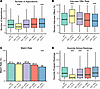 Figure 1
Comparison of application volume, interview offers, and match rates of dual-degree applicants to MD-only applicants. (A–D) Number of applications submitted, rate of interview offer–to–applications submitted (%), match rate (%), and median Doximity rankings of matched programs. In D, lower values reflect higher-ranked programs. All applicants, including those listing transitional and preliminary years as their specialties, were included in analyses. Figures are shown as box-and-whisker plots. The horizontal line within each box indicates median, box edges denote interquartile range (IQR), and whiskers extend to 1.5 × IQR. Statistical significance was analyzed using Wilcoxon signed-rank tests with FDR correction, comparing each dual-degree group with the MD-only group. Match rate comparisons were evaluated using Fisher’s exact test. *P < 0.05, **P < 0.001, ***P < 0.0001. Values below the horizontal axis labels indicate number of students per group.
To account for differences in application volume, we calculated the interview offer rate as the percentage of interview offers received relative to the number of applications submitted (Figure 1B). MD-only students had a median interview offer rate of 47.1% (IQR, 26.7–70.6). MD-PhD students had a significantly higher offer rate of 60% (IQR, 34.5–83.3). In contrast, MD-MBA and MD-MSc students reported slightly lower interview offer rates of 44.4% (IQR, 20.9–69.6) and 41.7% (IQR, 21.4–67.6), respectively. Despite differences in interview offer rates, overall residency match rates were similar across degree pathways, ranging from 84% to 88% (Figure 1C). MD-MSc students had a significantly lower match rate at 84%, compared with 87.3% for MD-only students. MD-PhD, MD-MPH, and MD-MBA students did not differ from MD students in overall match success.
To determine whether these patterns changed after the COVID-19 pandemic, we analyzed application volume, interview offer rates, and match rates before the pandemic (2017–2019) and after transition to virtual interviews (2020–2023) (Supplemental Figure 1; supplemental material available online with this article; https://doi.org/10.1172/jci.insight.198778DS1). MD (median 32–35 applicants) and MD-MBA (28.5–36) applicants applied to more programs. Interview offer rates significantly dropped for MD (from 51.4% to 45%), MD-MPH (from 54.5% to 46.7%), and MD-MBA (from 45.6% to 42.9%) applicants. Despite the decreased interview rates, match rates remained unchanged for all degree groups.
We also analyzed institutional rankings from Doximity (27) to determine whether degree pathway was associated with the prestige of matched residency programs, where lower numerical values indicate higher-ranked programs (e.g., rank 1 is the highest). MD-PhD students matched into more prestigious programs, with a median rank of 17 (IQR, 6–38), compared with a median of 48 for MD-only students (IQR, 20–93) (Figure 1D). Similarly, MD-MPH and MD-MBA students matched into significantly higher-ranked programs with median ranks of 36 (IQR, 13–80.8) and 37 (IQR, 12–90.2), respectively. We observed similar trends when using department-specific rankings from the Blue Ridge Institute for Medical Research (6. https://brimr.org/; Horse Shoe, North Carolina, USA) (Supplemental Figure 2).
Away rotations, geographic connections, and signaling. With the recent implementation of geographic connections, geographic preferencing, and program signaling, as well as increasing interest in away rotations, we examined how applicants influenced their interview and match outcomes through modifiable application strategies, including away rotations, geographic connections, geographic preferencing, and program signaling (Figure 2). When applicants were analyzed together in a multivariable logistic regression model, completing an away rotation increased the odds of receiving an interview offer by 15.3-fold (95% CI, 14.0–16.7) and the odds of matching by 6.8-fold (95% CI, 6.3–7.2). Applicants with geographic connections, defined by TexasSTAR as a personal link to the region, had an overall 3.23 times (95% CI, 3.17–3.29) higher odds of receiving an interview and 3.56 times (95% CI, 3.40–3.73) higher odds of matching. Geographic connections differ from geographic preference signaling, which was piloted by the AAMC in 2022 and expanded in 2023 (28). Geographic preference signaling had a 1.16-fold (95% CI, 1.13–1.18) increased overall association with receiving an interview invite and no association with matching. Program signaling increased the overall odds of receiving an interview by 2.36-fold (95% CI, 2.30–2.42) and of matching by 2.87-fold (95% CI, 2.71–3.03).
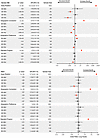 Figure 2
Modifiable residency application strategies. Multivariable logistic regression was used to assess the impact of away rotations, geographic connections, geographic preferencing, and program signaling on interview offers and match success for each degree path compared with MD-only. The overall cohort was used to generate the main effects (white rows). Dual-degree status was also included as an interaction term compared with MD-only (gray rows) to evaluate whether incremental effects of these strategies differed in predictive importance by degree path, relative to MD-only applicants. For interaction terms, an odds ratios (OR) < 1 indicates reduced marginal benefit compared with MD-only applicants, whereas OR > 1 indicates increased benefit. Squares represent OR, lines represent 95% CI, and red indicates statistical significance (P < 0.05).
However, when using dual-degree status as an interaction term compared with MD-only, we found that these application strategies had less effect for dual-degree students (Figure 2). Compared with MD-only students, away rotations had a smaller effect on interview offers for MD-PhD (OR = 0.41 [0.25–0.65]) and MD-MPH students (OR = 0.55 [0.41–0.76]), as well as match success for MD-PhD students (OR = 0.64 [0.42–0.99]). Personal geographic connections had less effect for receiving an interview offer for MD-PhD (OR = 0.63 [0.57–0.70]), MD-MPH (OR = 0.84 [0.78–0.91]), and MD-MSc students (OR = 0.88 [0.83–0.94]). For match, only MD-MPH students showed lower benefit from geographic ties (OR = 0.81 [0.67–0.98]). Geographic preference signaling had less benefit for receiving interview invites for MD-PhD students (OR = 0.86 [0.77–0.97]). Only MD-PhD students showed less benefit of program signaling on interview offers (OR = 0.79 [0.68–0.92]). Overall, while program signaling, geographic connections, geographic preferencing, and away rotations were important for overall interview and match success, these components were considerably more influential for MD-only applicants.
Interview and match patterns across specialties. Application volume and interview offer rates varied widely by specialty (Supplemental Table 1). We stratified application metrics by degree path and compared each group to MD-only students. MD-PhD students submitted significantly fewer applications across 12 of 23 specialties, reflecting the broader trend of reduced application volume (Figure 3A). These differences were most pronounced in highly competitive specialties, including dermatology, where MD-PhD applicants applied to a median of 41 fewer programs, and in surgical fields, including neurological surgery (31.5 fewer programs) and otolaryngology (19.5 fewer programs). MD-MPH students applied to more programs in physical medicine and rehabilitation (PM&R) and psychiatry.
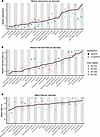 Figure 3
Specialty-level trends in applications, interviews, and match by degree path. (A) Median applications submitted per specialty, stratified by dual-degree status. (B) Median interview offer rate per specialty. (C) Match rate per specialty. The black line represents the MD-only median for each specialty and serves as the reference for comparisons to dual-degree groups. Specialties are sorted from least to greatest MD-only medians for each panel. Statistical significance (P < 0.05) for total number of applications and interview offer rates was assessed using Wilcoxon tests, whereas match rates were evaluated using multiple Fisher exact tests with FDR correction. Applicants who listed “Preliminary” or “Transitional” as their specialty were excluded.
Dual-degree students also demonstrated varying interview offer rates (Figure 3B). Compared with MD-only students, MD-PhD students demonstrated higher interview offer rates in dermatology, neurosurgery, psychiatry, internal medicine, neurology, pediatrics, and child neurology. MD-MSc students had lower offer rates in PM&R and emergency medicine, while MD-MPH students had higher interview rates in pediatrics. MD-MBA students did not differ in any specialty-specific metric.
Specialty-specific match rates did not differ across most dual-degree groups (Figure 3C). MD-MSc students demonstrated a modestly lower match rate in internal medicine. All other comparisons were not statistically significant. Overall, while application volume and interview offer rates differed across groups, these differences did not translate into differences in match rates.
Dual-degree students differ by specialty preferences. To determine whether dual-degree applicants differed in specialty preferences, we compared the specialty distributions of dual-degree applicants with those of MD-only applicants. First, we assessed whether self-reported data from TexasSTAR accurately reflected national patterns in specialty selection. We compared data from TexasSTAR and the AAMC (29), which reports total resident enrollment and MD-PhD enrollment by specialty. AAMC data are only disaggregated for MD-PhD students, permitting its use as a national benchmark. We found that specialty-specific ORs derived from TexasSTAR were highly correlated with those from the AAMC (R2 = 0.918; P < 0.001) (Supplemental Figure 3 and Supplemental Table 2). These findings show that, despite its self-reported nature, TexasSTAR captures specialty selection trends consistent with national data.
We found that each degree path pursued different medical specialties (Table 2). Compared with MD-only applicants, MD-PhD applicants were more likely to pursue internal medicine, neurosurgery, radiation oncology, dermatology, pathology, neurology, and child neurology but less likely to pursue family medicine, internal medicine-pediatrics, obstetrics and gynecology (OB-GYN), orthopedic surgery, general surgery, anesthesiology, emergency medicine, and PM&R. MD-MPH applicants were more likely to pursue family medicine, internal medicine-pediatrics, OB-GYN, and diagnostic radiology but less likely to pursue ophthalmology, orthopedic surgery, anesthesiology, and dermatology. MD-MSc applicants were more likely to pursue neurosurgery, general surgery, and pathology. MD-MBA and MD-MSc applicants were less likely to pursue pediatrics.


Article tools
- Download citation information
- Send a comment
- Terms of use
- Standard abbreviations
- Need help? Email the journal
Related Collection:
Article
-
The national MD-PhD program outcomes study: Relationships between medical specialty, training duration, research effort, and career paths
-
The national MD-PhD program outcomes study: Outcomes variation by sex, race, and ethnicity
-
Mind the gap: Expediting gender parity in MD-PhD admissions
-
Trends in NIH-supported career development funding: implications for institutions, trainees, and the future research workforce
-
Pearls of wisdom for aspiring physician-scientist residency applicants and program directors
-
New insights into an old question: can the MD-PhD physician-scientist pipeline be improved?
-
Gaps between college and starting an MD-PhD program are adding years to physician-scientist training time
-
Predoctoral MD-PhD grants as indicators of future NIH funding success
-
Sociodemographic factors and research experience impact MD-PhD program acceptance
-
Interventions to support fellowship application success among predoctoral physician-scientists
-
Training the physician-scientist: views from program directors and aspiring young investigators
-
The National MD-PhD Program Outcomes Study: career paths followed by Black and Hispanic graduates
-
Is it time to reduce the length of postgraduate training for physician-scientists in internal medicine?
-
Dispelling the myth: comparable duration and impact of research training for MD-PhD and PhD graduates
-
More women than ever are entering MD-PhD programs. What lies ahead for them?
-
The financial impact of MD-PhD training compared with MD training for academic physicians
-
Science: our past, our present, and always our future
-
The physician-scientist: looking back, looking forward
-
Paving the physician-scientist career path: from grassroots gathering to national forum
-
A study of MD-PhD pre-health advising identifies challenges to building a robust MD-PhD applicant pool
-
Admissions to MD-PhD programs: how well do application metrics predict short- or long-term physician-scientist outcomes?
-
Development and evaluation of a symposium model for building physician-scientist skills, connections, and persistence
-
An insider’s guide to understanding and obtaining an NIH K career development award
-
Comparing MD-PhD trainee experiences by disciplinary background
-
From improvised to intentional: re-imagining the physician-scientist career path
-
Residency matches of MD-PhD versus MD-only students: compatibility with continued research momentum
-
Stabilizing and strengthening the US physician-scientist faculty workforce in academic medicine: a proposed institutional framework
-
Navigating physician-scientist careers: insights from American Board of Internal Medicine Research Pathway graduates
-
Predoctoral grant writing among physician-scientist trainees: a national survey of barriers and facilitators of success


