
Abstract
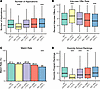
Dual-degree medical students pursue additional training to prepare for careers in research, public health, and administration, but how these experiences influence residency application behaviors and outcomes are poorly understood. We analyzed 36,298 residency applicants from the Texas Seeking Transparency in Application to Residency (TexasSTAR) database spanning 2017–2023 to compare application, interview, and match patterns among single-degree MD applicants and those with MD-PhD, MD-MPH, MD-MBA, or MD-MSc degrees. Despite differences in academic metrics, application strategies, and interview rates, match rates were similar across degree groups. MD-PhD students applied to fewer programs but had the highest interview offer–to–application rate and matched at more prestigious programs based on Doximity rankings. Beyond traditional application metrics such as board scores, research productivity, grades, and honor society membership, strategies including away rotations, geographic preferencing, and program signaling were associated with increased interview offers and match success among all applicants but were less influential for dual-degree applicants. These findings suggest dual-degree applicants require specialized advising and evaluation.
Authors
Daniel C. Brock, Deborah D. Rupert, Toni Darville, Caroline S. Jansen, Elias M. Wisdom, Cynthia Y. Tang
This file is in Adobe Acrobat (PDF) format. If you have not installed and configured the Adobe Acrobat Reader on your system.
Having trouble reading a PDF?
PDFs are designed to be printed out and read, but if you prefer to read them online, you may find it easier if you increase the view size to 125%.
Having trouble saving a PDF?
Many versions of the free Acrobat Reader do not allow Save. You must instead save the PDF from the JCI Online page you downloaded it from. PC users: Right-click on the Download link and choose the option that says something like "Save Link As...". Mac users should hold the mouse button down on the link to get these same options.
Having trouble printing a PDF?
- Try printing one page at a time or to a newer printer.
- Try saving the file to disk before printing rather than opening it "on the fly." This requires that you configure your browser to "Save" rather than "Launch Application" for the file type "application/pdf", and can usually be done in the "Helper Applications" options.
- Make sure you are using the latest version of Adobe's Acrobat Reader.


