
Abstract
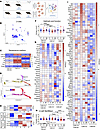
Cellular senescence is an irreversible stress response, which leads to loss of cellular function and remodeling of the cellular secretory profile. In humans, pancreatic β cells undergo cellular senescence during the progression to type 2 diabetes (T2D). However, the mechanism linking β cell senescence to islet dysfunction remains unknown, and thus the therapeutic potential of targeting senescent cells in T2D is not established. Herein, we identified a subpopulation of senescent β cells expressing p21, which emerged early in the progression of T2D in humans and mice. Spatial transcriptomics and proteomics analyses confirmed senescence and loss of cellular identity in this subpopulation in humans. Functional analysis revealed lack of glucose responsiveness, high basal insulin secretion, and transcription of senescence-associated secretory phenotype (SASP) factors. SASP factors from p21+ β cells induced secondary senescence in neighboring cells, characterized by dysfunction and loss of identity. JAK inhibitors counteracted the induction of secondary senescence and restored β cell function in islets from humans with T2D and in mice fed a high-fat diet. These findings reveal the critical role of p21+ β cells in T2D pathogenesis and the therapeutic potential of targeting this pathophysiological process.
Authors
Kanako Iwasaki, Priscila Carapeto, Cristian Abarca, Francesko Hela, Stephanie Sanjines, Sebastian Pena, Sandra Le, Hui Pan, Maya Jackson, Christopher Cahill, Ayush Midha, Juliana Alcoforado Diniz, Dylan Baker, Sergii Domanskyi, Sara Espinoza, Alejandro Peña, Francisco G. Cigarroa, Jillian L. Woodworth, Jeffrey H. Chuang, Vesna D. Garovic, James L. Kirkland, Tamara Tchkonia, Nicolas Musi, George A. Kuchel, Paul Robson, Cristina Aguayo-Mazzucato
This file is in Adobe Acrobat (PDF) format. If you have not installed and configured the Adobe Acrobat Reader on your system.
Having trouble reading a PDF?
PDFs are designed to be printed out and read, but if you prefer to read them online, you may find it easier if you increase the view size to 125%.
Having trouble saving a PDF?
Many versions of the free Acrobat Reader do not allow Save. You must instead save the PDF from the JCI Online page you downloaded it from. PC users: Right-click on the Download link and choose the option that says something like "Save Link As...". Mac users should hold the mouse button down on the link to get these same options.
Having trouble printing a PDF?
- Try printing one page at a time or to a newer printer.
- Try saving the file to disk before printing rather than opening it "on the fly." This requires that you configure your browser to "Save" rather than "Launch Application" for the file type "application/pdf", and can usually be done in the "Helper Applications" options.
- Make sure you are using the latest version of Adobe's Acrobat Reader.


