
Abstract
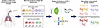
Survival after lung transplantation is limited by chronic, progressive graft failure, termed chronic lung allograft dysfunction (CLAD). Graft-resident mesenchymal cells (MCs) drive CLAD pathogenesis and exhibit stable dysregulated signaling, yet the transcriptomic and epigenomic drivers underlying this fibrogenic transformation remain elusive. We used single-cell multiomic profiling to characterize gene expression and chromatin accessibility in MCs isolated from bronchoalveolar lavage fluid of lung transplant recipients with and without CLAD, collected early after transplantation or after disease onset. MCs obtained after CLAD onset demonstrated a distinct transcriptomic signature compared with non-CLAD controls, enabling classification of disease status at the single-cell level with greater than 98% accuracy using signature genes. Chromatin accessibility analyses identified enrichment of CCAAT-enhancer-binding protein family transcription factors, specifically CEBPD, in CLAD MCs. MCs early after transplantation showed minimal accessibility differences, suggesting that CEBPD-associated regulatory changes emerge over time. Integration analyses identified 8 MC states and a CLAD-specific shift toward a fibrotic state. CEBPD, SOX4, and FOXP2 were identified as putative regulators of this state with substantial overlap in predicted targets. Targeting CEBPD reversed fibrotic phenotypes of CLAD MCs (decreased ECM expression, contractility, proliferation, and migration). Together, these data provide insights into transcriptomic and epigenomic changes in posttransplant MCs, facilitating the nomination of biomarkers and therapeutic targets.
Authors
Lu Lu, A. Patrick McLinden, Natalie M. Walker, Ragini Vittal, Yichen Wang, Fatemeh Fattahi, Stephen T. Russell, Michael P. Combs, Joshua D. Welch, Vibha N. Lama
This file is in Adobe Acrobat (PDF) format. If you have not installed and configured the Adobe Acrobat Reader on your system.
Having trouble reading a PDF?
PDFs are designed to be printed out and read, but if you prefer to read them online, you may find it easier if you increase the view size to 125%.
Having trouble saving a PDF?
Many versions of the free Acrobat Reader do not allow Save. You must instead save the PDF from the JCI Online page you downloaded it from. PC users: Right-click on the Download link and choose the option that says something like "Save Link As...". Mac users should hold the mouse button down on the link to get these same options.
Having trouble printing a PDF?
- Try printing one page at a time or to a newer printer.
- Try saving the file to disk before printing rather than opening it "on the fly." This requires that you configure your browser to "Save" rather than "Launch Application" for the file type "application/pdf", and can usually be done in the "Helper Applications" options.
- Make sure you are using the latest version of Adobe's Acrobat Reader.


