
Go to The Journal of Clinical Investigation
  • About
  • Editors
  • Consulting Editors
  • For authors
  • Publication ethics
  • Publication alerts by email
  • Transfers
  • Advertising
  • Job board
  • Contact
  • Physician-Scientist Development
  • Current issue
  • Past issues
  • By specialty
    • COVID-19
    • Cardiology
    • Immunology
    • Metabolism
    • Nephrology
    • Oncology
    • Pulmonology
    • All ...
  • Videos
  • Collections
    • In-Press Preview
    • Resource and Technical Advances
    • Clinical Research and Public Health
    • Research Letters
    • Editorials
    • Perspectives
    • Physician-Scientist Development
    • Reviews
    • Top read articles

  • Current issue
  • Past issues
  • Specialties
  • In-Press Preview
  • Resource and Technical Advances
  • Clinical Research and Public Health
  • Research Letters
  • Editorials
  • Perspectives
  • Physician-Scientist Development
  • Reviews
  • Top read articles
  • About
  • Editors
  • Consulting Editors
  • For authors
  • Publication ethics
  • Publication alerts by email
  • Transfers
  • Advertising
  • Job board
  • Contact

Citations to this article
A Porcine Commotio Retinae Model for Pre-clinical evaluation of Post Traumatic Photoreceptor Degeneration
Juan Amaral, Irina Bunea, Arvydas Maminishkis, Maria M. Campos, Francesca Barone, Rohan Gupta, Mitra Farnoodian, Jonathan Newport, M. Joseph Phillips, Ruchi Sharma, David M. Gamm, Kapil Bharti, Richard J. Blanch
View: Text | PDF
Research In-Press Preview Neuroscience Ophthalmology

A Porcine Commotio Retinae Model for Pre-clinical evaluation of Post Traumatic Photoreceptor Degeneration

  • Text
  • PDF
Abstract

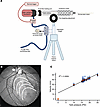
Commotio retinae (CR) resulting from retinal trauma can lead to focal photoreceptor degeneration and permanent vision loss. Currently no therapies exist for CR-induced retinal degeneration, in part due to a lacking large animal model that replicates human injury pathology and allows testing of therapeutics. Severe CR is clinically characterized by subretinal fluid and focal photoreceptor outer nuclear layer thinning. To develop a porcine CR model, we developed a laser-guided projectile apparatus and optimized projectile delivery procedure using porcine cadaveric eyes embedded in a 3D-printed porcine skull. Scleral and corneal impacts, resulted in retinal damage consistent with patient injury but corneal impacts also led to cornea damage and opacification, which precluded follow up imaging. In live porcine eyes, scleral impacts of 39.5 m/s induced transient blood retinal barrier breakdown evidenced by subretinal fluid on optical coherence tomography (OCT), leakage observed on fluorescein and indocyanine green angiography, and transient photoreceptor outer segment disruption seen by OCT and multifocal electroretinography. Impacts above 39.5 m/s induced longer-lasting photoreceptor degeneration, but only transient blood retinal barrier breakdown. This porcine model, combined with clinically relevant imaging and diagnostic modalities will be valuable for testing the safety and efficacy of therapies to restore vision after focal photoreceptor degeneration.

Authors

Juan Amaral, Irina Bunea, Arvydas Maminishkis, Maria M. Campos, Francesca Barone, Rohan Gupta, Mitra Farnoodian, Jonathan Newport, M. Joseph Phillips, Ruchi Sharma, David M. Gamm, Kapil Bharti, Richard J. Blanch

×

Loading citation information...
Advertisement

Copyright © 2026 American Society for Clinical Investigation
ISSN 2379-3708

Sign up for email alerts