
Abstract
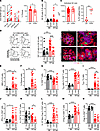
Glutaminolysis is enhanced in T cells of patients with lupus and in Tfh cells, a critical subset of CD4+ T cells that provide help to autoreactive B cells, in lupus mice. Glutaminolysis inhibitors reduced lupus activity in association with a decreased frequency of Th17 cells in mice. Here, we thought to determine the role of glutaminolysis in murine Tfh cells. The pharmacological inhibition of glutaminolysis with DON reduced the expression of the critical costimulatory molecule ICOS on lupus Tfh cells, in association with a reduction of autoantibody production and B cell differentiation markers. Accordingly, profound transcriptomic and metabolic changes, including a reduction of glycolysis, were induced by DON in lupus Tfh cells, whereas healthy Tfh cells showed minor changes. The T cell–specific genetic inhibition of glutaminolysis largely phenocopied the effects of DON on Tfh cells and B cells in an autoimmune genetic background with minor changes in Tfh and B cells in healthy controls. Furthermore, we showed that T cell–specific glutaminolysis inhibition impaired T-dependent humoral responses in autoimmune mice as well as their Tfh response to a viral infection. Overall, these results suggest that lupus Tfh cells have a greater intrinsic requirement of glutaminolysis for their helper functions.
Authors
Seung-Chul Choi, Yong Ge, Milind V. Joshi, Damian Jimenez, Abigail Castellanos Garcia, Cassandra LaPlante, Lauren T. Padilla, Chaoyu Ma, Nu Zhang, Jeffrey C. Rathmell, Mansour Mohamadzadeh, Laurence Morel
This file is in Adobe Acrobat (PDF) format. If you have not installed and configured the Adobe Acrobat Reader on your system.
Having trouble reading a PDF?
PDFs are designed to be printed out and read, but if you prefer to read them online, you may find it easier if you increase the view size to 125%.
Having trouble saving a PDF?
Many versions of the free Acrobat Reader do not allow Save. You must instead save the PDF from the JCI Online page you downloaded it from. PC users: Right-click on the Download link and choose the option that says something like "Save Link As...". Mac users should hold the mouse button down on the link to get these same options.
Having trouble printing a PDF?
- Try printing one page at a time or to a newer printer.
- Try saving the file to disk before printing rather than opening it "on the fly." This requires that you configure your browser to "Save" rather than "Launch Application" for the file type "application/pdf", and can usually be done in the "Helper Applications" options.
- Make sure you are using the latest version of Adobe's Acrobat Reader.


