
Abstract
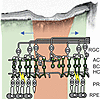
Degenerative retinal disorders leading to irreversible photoreceptor death are a common cause of blindness. Optogenetic gene therapy aims to restore vision in affected individuals by introducing light-sensitive opsins into the surviving neurons of the inner retina. While up until now, the main focus of optogenetic therapy has been on terminally blind individuals, treating at stages where residual native vision is present could have several advantages. However, it is still unknown how residual native and optogenetic vision would interact if present at the same time. Using transgenic mice expressing the optogenetic tool ReaChR in ON-bipolar cells, we herein examine this interaction through electroretinography (ERG) and visually evoked potentials (VEP). We find that optogenetic responses show a peculiar ERG signature and are enhanced in retinas without photoreceptor loss. Conversely, native responses are dampened in the presence of ReaChR. Moreover, in VEP recordings, we find that optogenetic responses reach the cortex asynchronous to the native response. These findings should be taken into consideration when planning future clinical trials and may direct future preclinical research to optimize optogenetic approaches for visual restoration. The identified ERG signatures, moreover, may serve to track treatment efficiency in clinical trials.
Authors
Eleonora Carpentiero, Steven Hughes, Jessica Rodgers, Nermina Xhaferri, Sumit Biswas, Michael J. Gilhooley, Mark W. Hankins, Moritz Lindner
This file is in Adobe Acrobat (PDF) format. If you have not installed and configured the Adobe Acrobat Reader on your system.
Having trouble reading a PDF?
PDFs are designed to be printed out and read, but if you prefer to read them online, you may find it easier if you increase the view size to 125%.
Having trouble saving a PDF?
Many versions of the free Acrobat Reader do not allow Save. You must instead save the PDF from the JCI Online page you downloaded it from. PC users: Right-click on the Download link and choose the option that says something like "Save Link As...". Mac users should hold the mouse button down on the link to get these same options.
Having trouble printing a PDF?
- Try printing one page at a time or to a newer printer.
- Try saving the file to disk before printing rather than opening it "on the fly." This requires that you configure your browser to "Save" rather than "Launch Application" for the file type "application/pdf", and can usually be done in the "Helper Applications" options.
- Make sure you are using the latest version of Adobe's Acrobat Reader.


