
Abstract
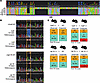
Insulin/insulin growth factor signaling is a conserved pathway that regulates lifespan. However, long-lived loss-of-function mutants often produce insulin resistance, slow growth, and impair reproduction. Recently, a gain-of-function mutation in the kinase insert domain (KID) of the Drosophila insulin/IGF receptor was seen to dominantly extend lifespan without impairing insulin sensitivity, growth, or reproduction. This substitution occurs within residues conserved in mammalian insulin receptor (IR) and insulin growth factor-1 receptor (IGF-1R). We produced 2 knock-in mouse strains that carry the homologous KID Arg/Cys substitution in murine IR or IGF-1R, and we replicated these genotypes in human cells. Cells with heterodimer receptors of IR or IGF-1R induce receptor phosphorylation and phospho-Akt when stimulated with insulin or IGF. Heterodimer receptors of IR fully induce pERK, but ERK was less phosphorylated in cells with IGF-1R heterodimers. Adults with a single KID allele (producing heterodimer receptors) have normal growth and glucose regulation. At 4 months, these mice variably display hormonal markers that associate with successful aging counteraction, including elevated adiponectin and FGF21, as well as reduced leptin and IGF-1. Livers of IGF-1R females show decreased transcriptome-based biological age, which may point toward delayed aging and warrants an actual lifespan experiment. These data suggest that KID mutants may slow mammalian aging while they avoid the complications of insulin resistance.
Authors
Ulalume Hernández-Arciga, Jun Kyoung Kim, Jacob L. Fisher, Alexander Tyshkovskiy, Alibek Moldakozhayev, Catherine Hall, Souvik Ghosh, Yashvandhini Govindaraj, Ian J. Sipula, Jake Kastroll, Diana Cooke, Jinping Luo, Jonathan K. Alder, Stacey J. Sukoff Rizzo, Gene P. Ables, Eunhee Choi, Vadim N. Gladyshev, Michael J. Jurczak, Marc Tatar, Andrey A. Parkhitko
This file is in Adobe Acrobat (PDF) format. If you have not installed and configured the Adobe Acrobat Reader on your system.
Having trouble reading a PDF?
PDFs are designed to be printed out and read, but if you prefer to read them online, you may find it easier if you increase the view size to 125%.
Having trouble saving a PDF?
Many versions of the free Acrobat Reader do not allow Save. You must instead save the PDF from the JCI Online page you downloaded it from. PC users: Right-click on the Download link and choose the option that says something like "Save Link As...". Mac users should hold the mouse button down on the link to get these same options.
Having trouble printing a PDF?
- Try printing one page at a time or to a newer printer.
- Try saving the file to disk before printing rather than opening it "on the fly." This requires that you configure your browser to "Save" rather than "Launch Application" for the file type "application/pdf", and can usually be done in the "Helper Applications" options.
- Make sure you are using the latest version of Adobe's Acrobat Reader.


