
Abstract
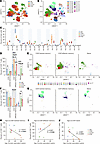
We developed a 29-color spectral cytometry panel to enhance nonhuman primate (NHP) models for cross-reactive immunophenotyping. This panel is suitable for biosafety level 4 (BSL-4) viruses and can be used with both human and NHP samples in BSL-2 research settings. Tissues from humans, rhesus monkeys (RhMs), crab-eating macaques (CEMs), and green monkeys (GMs) were stained with a 29-color immunophenotyping panel requiring only 2 clone substitutions. Comparable staining was observed for all samples. Unbiased analysis showed acceptable overlap in T cell phenotypes across samples, with differences in human and NHP B cells and granulocytes. In CEMs, most circulating CD8+ T cells were from effector memory cells, with significantly higher levels than in humans, RhMs, and GMs. Analysis of samples from various anatomical sites revealed distinct location-specific phenotypes. In Nipah virus–exposed animals, splenocytes showed a substantial increase in IgM+ B cells and a reduction in effector memory CD8+ T cells compared with unexposed controls. Lymph nodes from Ebola virus–exposed animals showed a loss of CXCR3+CD8+ T cells versus unexposed controls. This panel may guide the development of additional multicolor panels in preclinical and clinical settings and may increase understanding of the pathogenesis of diseases caused by emerging and reemerging viruses.
Authors
Andrew P. Platt, Bobbi Barr, Anthony Marketon, Rebecca Bernbaum, Deja F.P. Rivera, Vincent J. Munster, Daniel S. Chertow, Michael R. Holbrook, Scott M. Anthony, Bapi Pahar
This file is in Adobe Acrobat (PDF) format. If you have not installed and configured the Adobe Acrobat Reader on your system.
Having trouble reading a PDF?
PDFs are designed to be printed out and read, but if you prefer to read them online, you may find it easier if you increase the view size to 125%.
Having trouble saving a PDF?
Many versions of the free Acrobat Reader do not allow Save. You must instead save the PDF from the JCI Online page you downloaded it from. PC users: Right-click on the Download link and choose the option that says something like "Save Link As...". Mac users should hold the mouse button down on the link to get these same options.
Having trouble printing a PDF?
- Try printing one page at a time or to a newer printer.
- Try saving the file to disk before printing rather than opening it "on the fly." This requires that you configure your browser to "Save" rather than "Launch Application" for the file type "application/pdf", and can usually be done in the "Helper Applications" options.
- Make sure you are using the latest version of Adobe's Acrobat Reader.


