
Abstract
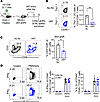
CD154 is a promising target for immunosuppression in transplantation, autoimmunity, and inflammatory diseases. We previously identified CD11b as a novel alternative receptor for CD154 during alloimmunity. However, the impact of specific CD154:CD11b blockade on immune responses to infection has not been well characterized. Here, we have shown that in contrast with its immunosuppressive effect on graft-specific CD8+ T cells, CD154:CD11b blockade unexpectedly improved both the quantity and quality of murine herpesvirus-68–specific CD8+ T cells as measured by an increase in tetramer-positive KLRG1loCD127hi memory precursor effector cells. The differential effect of CD154:CD11b blockade on graft- versus virus-specific CD8+ T cells was underpinned by differences in phosphorylated S6 downstream of mTOR complex 1; however, differential expression of key transcription factors Eomes and TCF-1 was dictated by the type of antigen stimulus. These data demonstrate that priming conditions play an important role in determining the outcome of immunotherapy and suggest that specific inhibition of CD154:CD11b interactions could be effective for suppressing alloimmune responses while maintaining protective immunity to minimize infectious complications following transplantation.
Authors
Katie L. Alexander, Kelsey B. Bennion, Danya Liu, Mandy L. Ford
This file is in Adobe Acrobat (PDF) format. If you have not installed and configured the Adobe Acrobat Reader on your system.
Having trouble reading a PDF?
PDFs are designed to be printed out and read, but if you prefer to read them online, you may find it easier if you increase the view size to 125%.
Having trouble saving a PDF?
Many versions of the free Acrobat Reader do not allow Save. You must instead save the PDF from the JCI Online page you downloaded it from. PC users: Right-click on the Download link and choose the option that says something like "Save Link As...". Mac users should hold the mouse button down on the link to get these same options.
Having trouble printing a PDF?
- Try printing one page at a time or to a newer printer.
- Try saving the file to disk before printing rather than opening it "on the fly." This requires that you configure your browser to "Save" rather than "Launch Application" for the file type "application/pdf", and can usually be done in the "Helper Applications" options.
- Make sure you are using the latest version of Adobe's Acrobat Reader.


