
Go to The Journal of Clinical Investigation
  • About
  • Editors
  • Consulting Editors
  • For authors
  • Publication ethics
  • Publication alerts by email
  • Transfers
  • Advertising
  • Job board
  • Contact
  • Physician-Scientist Development
  • Current issue
  • Past issues
  • By specialty
    • COVID-19
    • Cardiology
    • Immunology
    • Metabolism
    • Nephrology
    • Oncology
    • Pulmonology
    • All ...
  • Videos
  • Collections
    • In-Press Preview
    • Resource and Technical Advances
    • Clinical Research and Public Health
    • Research Letters
    • Editorials
    • Perspectives
    • Physician-Scientist Development
    • Reviews
    • Top read articles

  • Current issue
  • Past issues
  • Specialties
  • In-Press Preview
  • Resource and Technical Advances
  • Clinical Research and Public Health
  • Research Letters
  • Editorials
  • Perspectives
  • Physician-Scientist Development
  • Reviews
  • Top read articles
  • About
  • Editors
  • Consulting Editors
  • For authors
  • Publication ethics
  • Publication alerts by email
  • Transfers
  • Advertising
  • Job board
  • Contact
T cell phenotype and clonality changes in myeloma patients with short overall survival
Alenka Djarmila Behsen, … , Anne Marit Sponaas, Kristine Misund
Published April 29, 2025
Citation Information: JCI Insight. 2025;10(11):e181096. https://doi.org/10.1172/jci.insight.181096.
View: Text | PDF
Research Article Hematology Immunology Oncology

T cell phenotype and clonality changes in myeloma patients with short overall survival

  • Text
  • PDF
Abstract

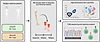
Overall survival (OS) in multiple myeloma (MM) varies between a couple of months to more than 20 years, influenced by tumor characteristics, the tumor microenvironment (TME), and patient factors such as age and frailty. We analyzed sequential BM samples from 45 MM patients with OS less than 3 years versus more than 8 years using mass cytometry and bulk TCRβ sequencing. Patients with long OS demonstrated stability in the TME and T cell environments, while those with short OS had significant changes at relapse, including fewer T cells, increased Tregs, and more activated and exhausted CD8+ T cells. Notably, higher programmed cell death 1 expression in CD8+ T cells at diagnosis correlated with short OS. Additionally, short-OS patients exhibited a more monoclonal T cell environment at relapse, with abundance of hyperexpanded clones. These findings reveal distinct immune cell differences between patients with short and long OS.

Authors

Alenka Djarmila Behsen, Esten Nymoen Vandsemb, Tobias Schmidt Slørdahl, Karen Dybkær, Maja Zimmer Jakobsen, Muhammad Kashif, Johan Lund, Vincent Luong, Astrid Marta Olsnes, Anders Waage, Anne Marit Sponaas, Kristine Misund

×

Supplemental table 1 - Download (10.86 KB)

No preview available for this file type: xlsx
Use the download link to access the file.
Advertisement

Copyright © 2025 American Society for Clinical Investigation
ISSN 2379-3708

Sign up for email alerts