
Go to The Journal of Clinical Investigation
  • About
  • Editors
  • Consulting Editors
  • For authors
  • Publication ethics
  • Publication alerts by email
  • Transfers
  • Advertising
  • Job board
  • Contact
  • Physician-Scientist Development
  • Current issue
  • Past issues
  • By specialty
    • COVID-19
    • Cardiology
    • Immunology
    • Metabolism
    • Nephrology
    • Oncology
    • Pulmonology
    • All ...
  • Videos
  • Collections
    • In-Press Preview
    • Resource and Technical Advances
    • Clinical Research and Public Health
    • Research Letters
    • Editorials
    • Perspectives
    • Physician-Scientist Development
    • Reviews
    • Top read articles

  • Current issue
  • Past issues
  • Specialties
  • In-Press Preview
  • Resource and Technical Advances
  • Clinical Research and Public Health
  • Research Letters
  • Editorials
  • Perspectives
  • Physician-Scientist Development
  • Reviews
  • Top read articles
  • About
  • Editors
  • Consulting Editors
  • For authors
  • Publication ethics
  • Publication alerts by email
  • Transfers
  • Advertising
  • Job board
  • Contact
Adipsin and adipocyte-derived C3aR1 regulate thermogenic fat in a sex-dependent fashion
Lunkun Ma, Ankit Gilani, Alfonso Rubio-Navarro, Eric Cortada, Ang Li, Shannon M. Reilly, Liling Tang, James C. Lo
View: Text | PDF
Research Article Inflammation Metabolism

Adipsin and adipocyte-derived C3aR1 regulate thermogenic fat in a sex-dependent fashion

  • Text
  • PDF
Abstract

Thermogenesis in beige/brown adipose tissues can be leveraged to combat metabolic disorders such as type 2 diabetes and obesity. The complement system plays pleiotropic roles in metabolic homeostasis and organismal energy balance with canonical effects on immune cells and noncanonical effects on nonimmune cells. The adipsin/C3a/C3a receptor 1 (C3aR1) pathway stimulates insulin secretion and sustains pancreatic β cell mass. However, its role in adipose thermogenesis has not been defined. Here, we show that male Adipsin/Cfd-knockout mice exhibited increased energy expenditure and white adipose tissue (WAT) browning. In addition, male adipocyte-specific C3aR1-knockout mice exhibited enhanced WAT thermogenesis and increased respiration. In stark contrast, female adipocyte-specific C3aR1-knockout mice displayed decreased brown fat thermogenesis and were cold intolerant. Female mice expressed lower levels of Adipsin in thermogenic adipocytes and adipose tissues than males. C3aR1 was also lower in female subcutaneous adipose tissue than in males. Collectively, these results reveal sexual dimorphism in the adipsin/C3a/C3aR1 axis in regulating adipose thermogenesis and defense against cold stress. Our findings establish a potentially new role of the alternative complement pathway in adaptive thermogenesis and highlight sex-specific considerations in potential therapeutic targets for metabolic diseases.

Authors

Lunkun Ma, Ankit Gilani, Alfonso Rubio-Navarro, Eric Cortada, Ang Li, Shannon M. Reilly, Liling Tang, James C. Lo

×

Figure 2

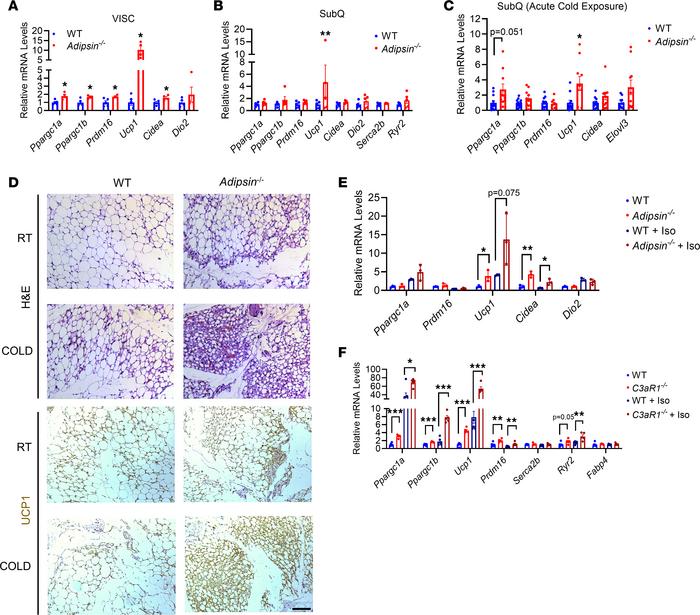
Adipsin deficiency promotes white adipose beiging.
Options: View larger image (or click on image) Download as PowerPoint
Adipsin deficiency promotes white adipose beiging.
(A and B) Thermogenic...
(A and B) Thermogenic gene expression in visceral (VISC) (A) and subcutaneous (SubQ) (B) fat of 10- to 12-week-old WT and Adipsin-KO male mice fed a regular diet at ambient temperature. n = 4–5/group. Cidea, cell death inducing DFFA like effector a; Dio2, deiodinase, iodothyronine, type II; Ryr2, ryanodine receptor 2, cardiac; Elovl3, ELOVL fatty acid elongase 3; Fabp4, fatty acid binding protein 4, adipocyte. (C) Thermogenic gene expression in SubQ fat of 10- to 12-week-old WT and Adipsin-KO male mice following an acute (6 hours) cold exposure. n = 10–11/group. (D) Hematoxylin and eosin (H&E) and UCP1 immunohistochemistry staining of inguinal white adipose tissue (WAT) sections from 10-week-old WT and Adipsin-KO male mice at room temperature (RT) and following acute cold exposure. Images are shown at 20× original magnification. Scale bar, 200 μm. (E) Thermogenic gene expression in primary SubQ adipocytes treated with or without isoproterenol (Iso) from WT and Adipsin-KO mice. n = 3/group. (F) Thermogenic gene expression in primary SubQ adipocytes treated with or without Iso from WT and C3aR1-KO mice. n = 5–6/group. Data are presented as mean ± SEM. Unpaired 2-tailed t test is used for comparison between WT and KO and between WT + Iso and KO + Iso groups for E and F. *P < 0.05, **P < 0.01, ***P < 0.001.

Copyright © 2026 American Society for Clinical Investigation
ISSN 2379-3708

Sign up for email alerts