
Submit a comment
Abstract
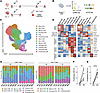
BACKGROUND IL-7 is a critical cytokine in T cell development, survival, and homeostasis. Previous preclinical and clinical studies reported that IL-7 treatment increased T cell counts, but its effect on peripheral blood T cells in cancer patients and molecular mechanisms have not been explored.METHODS We investigated effects of long-acting recombinant human IL-7 conjugated to a hybrid IgD/IgG4 Fc domain (rhIL-7-hyFc) on peripheral T cells in patients with advanced solid tumors. Peripheral blood samples were collected before and after treatment, followed by analysis through single-cell transcriptomics and flow cytometry.RESULTS We found that rhIL-7-hyFc induced marked expansion of proliferating T cells, and promoted transcriptional changes associated with immune activation, cell cycle progression, and antiapoptosis. Trajectory analysis revealed that posttreatment T cells had distinct transcriptional states enriched for cytokine- and TCR-mediated signaling pathways. Notably, a second dose administered after 3 weeks yielded diminished proliferation and minimal transcriptional changes, which were independent of antidrug antibody or CD127 downmodulation. Examination of elements of the IL-7 signaling pathway revealed intact proximal signaling (e.g., STAT5 phosphorylation) but downregulation of distal elements, including PIM-1 kinase and c-Myc.CONCLUSIONS Our results demonstrate that rhIL-7-hyFc induces robust peripheral T cell expansion and activation in patients with solid tumors, supporting its potential use for lymphopenic patients treated with cancer immunotherapy.TRIAL REGISTRATION ClinicalTrials.gov NCT03478995 and NCT03619239.FUNDING National Research Foundation of Korea (NRF-2022R1A2C3007292 and RS-2024-00439160), Ministry of Food and Drug Safety (RS-2025-02213409), and the Korea Health Technology R&D Project through the Korea Health Industry Development Institute (RS-2025-25460003).
Authors
Hocheol Jang, Jeong Yeon Kim, Sojeong Kim, Heewon Kim, Mi Sun Byun, Myung Ah Lee, Jong Hee Chang, Do-Hyun Nam, Tae Won Kim, Sin-Soo Jeun, Joo Hyuk Sohn, Su-Hyung Park, Eui-Cheol Shin
Guidelines
The Editorial Board will only consider comments that are deemed relevant and of interest to readers. The Journal will not post data that have not been subjected to peer review; or a comment that is essentially a reiteration of another comment.
- Comments appear on the Journal’s website and are linked from the original article’s web page.
- Authors are notified by email if their comments are posted.
- The Journal reserves the right to edit comments for length and clarity.
- No appeals will be considered.
- Comments are not indexed in PubMed.
Specific requirements
- Maximum length, 400 words
- Entered as plain text or HTML
- Author’s name and email address, to be posted with the comment
- Declaration of all potential conflicts of interest (even if these are not ultimately posted); see the Journal’s conflict-of-interest policy
- Comments may not include figures


