
Submit a comment
Abstract
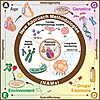
Aging is a major contributor to cardiovascular disease and mortality in older adults. Yet most preclinical and experimental cardiac studies fail to account for age as a primary biological variable, leaving a critical gap in our understanding of how aging contributes to disease progression. Bridging this gap requires integrating aging biology, cardiac pathophysiology, and cutting-edge biotechnology to uncover the mechanisms underlying age-related cardiac dysfunction. We offer a new approach methodologies (NAMs) perspective on how emerging bioengineering strategies may reshape the study of cardiac aging by enabling multidimensional monitoring of cardiac function, aging trajectories, and therapeutic responses. To capture this complexity, we propose the A×G×E×D framework, where A stands for age, G for genetics, E for environment, and D for drug exposure, as a multidimensional lens for understanding how these factors converge to determine cardiac vulnerability during aging. We highlight the integration of long-term cardiac microtissues with advancements in biotechnology to model age. This Perspective opens new frontiers for understanding how A×G×E×D interactions manifest at the molecular, cellular, and electrophysiological levels and for designing responsive, personalized interventions that align with each individual’s evolving physiology. By developing robust bioengineered platforms that recapitulate human cardiac aging, we can advance toward precision geromedicine for cardiovascular health.
Authors
Kritika Chaddha, Mabel Bartlett, Tzahi Cohen-Karni, Aditi Gurkar
Guidelines
The Editorial Board will only consider comments that are deemed relevant and of interest to readers. The Journal will not post data that have not been subjected to peer review; or a comment that is essentially a reiteration of another comment.
- Comments appear on the Journal’s website and are linked from the original article’s web page.
- Authors are notified by email if their comments are posted.
- The Journal reserves the right to edit comments for length and clarity.
- No appeals will be considered.
- Comments are not indexed in PubMed.
Specific requirements
- Maximum length, 400 words
- Entered as plain text or HTML
- Author’s name and email address, to be posted with the comment
- Declaration of all potential conflicts of interest (even if these are not ultimately posted); see the Journal’s conflict-of-interest policy
- Comments may not include figures


