
Go to The Journal of Clinical Investigation
  • About
  • Editors
  • Consulting Editors
  • For authors
  • Publication ethics
  • Publication alerts by email
  • Transfers
  • Advertising
  • Job board
  • Contact
  • Physician-Scientist Development
  • Current issue
  • Past issues
  • By specialty
    • COVID-19
    • Cardiology
    • Immunology
    • Metabolism
    • Nephrology
    • Oncology
    • Pulmonology
    • All ...
  • Videos
  • Collections
    • In-Press Preview
    • Resource and Technical Advances
    • Clinical Research and Public Health
    • Research Letters
    • Editorials
    • Perspectives
    • Physician-Scientist Development
    • Reviews
    • Top read articles

  • Current issue
  • Past issues
  • Specialties
  • In-Press Preview
  • Resource and Technical Advances
  • Clinical Research and Public Health
  • Research Letters
  • Editorials
  • Perspectives
  • Physician-Scientist Development
  • Reviews
  • Top read articles
  • About
  • Editors
  • Consulting Editors
  • For authors
  • Publication ethics
  • Publication alerts by email
  • Transfers
  • Advertising
  • Job board
  • Contact

Submit a comment

Performance of expanded diagnostic criteria for APECED in independent cohorts and implications for earlier diagnosis
Elise M.N. Ferré, Joseph Pechacek, Monica M. Schmitt, Taura Webb, Heather Moorman, Thomas DiMaggio, Princess Barber, Vasielios Oikonomou, Stacey R. Rose, Peter D. Burbelo, Lindsey B. Rosen, Amy P. Hsu, Jennifer Stoddard, Shakuntala Rampertaap, Sergio D. Rosenzweig, Anjali Rai, Maria Teresa Magone, Chantal Cousineau-Krieger, Niki M. Moutsopoulos, Pamela J. Gardner, Heidi H. Kong, Leslie Castelo-Soccio, Ariane Soldatos, Katherine R. Calvo, Meryl Waldman, Behdad Afzali, Stefania Pittaluga, David Kleiner, Steven M. Holland, Kevin Fennelly, Jill Rothschild, Bryce A. Seifert, Magdalena Walkiewicz-Yvon, Theo Heller, Karen Winer, Michail S. Lionakis
View: Text | PDF
Research Article Clinical Research Immunology

Performance of expanded diagnostic criteria for APECED in independent cohorts and implications for earlier diagnosis

  • Text
  • PDF
Abstract

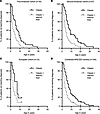
Autoimmune polyendocrinopathy-candidiasis-ectodermal dystrophy (APECED/APS-1) is a monogenic autoimmune disorder of impaired central tolerance classically diagnosed by the presence of 2 out of 3 classic triad manifestations: chronic mucocutaneous candidiasis, hypoparathyroidism, and adrenal insufficiency. However, many patients develop non-triad manifestations years earlier, delaying recognition and care. In 2016, we proposed expanded diagnostic criteria incorporating 3 early clinical manifestations — APECED rash, autoimmune enteritis, and enamel hypoplasia — based on observations in 35 North American patients. Here, we provide further support for the clinical utility of these expanded diagnostic criteria in independent cohorts of 57 American and 12 European patients enrolled in a prospective natural history study at the NIH. Across all cohorts, the expanded diagnostic criteria decreased the time to diagnosis by half relative to the classic diagnostic criteria. Patients exhibited an enrichment of early non-endocrine autoimmune manifestations, underscoring disease heterogeneity and the potential for developing organ-specific autoimmunity before endocrine failure. These findings demonstrate the clinical utility of the expanded APECED diagnostic criteria and support the notion that their adoption might enable earlier disease recognition and timely immunomodulatory therapy to improve long-term outcomes.

Authors

Elise M.N. Ferré, Joseph Pechacek, Monica M. Schmitt, Taura Webb, Heather Moorman, Thomas DiMaggio, Princess Barber, Vasielios Oikonomou, Stacey R. Rose, Peter D. Burbelo, Lindsey B. Rosen, Amy P. Hsu, Jennifer Stoddard, Shakuntala Rampertaap, Sergio D. Rosenzweig, Anjali Rai, Maria Teresa Magone, Chantal Cousineau-Krieger, Niki M. Moutsopoulos, Pamela J. Gardner, Heidi H. Kong, Leslie Castelo-Soccio, Ariane Soldatos, Katherine R. Calvo, Meryl Waldman, Behdad Afzali, Stefania Pittaluga, David Kleiner, Steven M. Holland, Kevin Fennelly, Jill Rothschild, Bryce A. Seifert, Magdalena Walkiewicz-Yvon, Theo Heller, Karen Winer, Michail S. Lionakis

×

Guidelines

The Editorial Board will only consider comments that are deemed relevant and of interest to readers. The Journal will not post data that have not been subjected to peer review; or a comment that is essentially a reiteration of another comment.

  • Comments appear on the Journal’s website and are linked from the original article’s web page.
  • Authors are notified by email if their comments are posted.
  • The Journal reserves the right to edit comments for length and clarity.
  • No appeals will be considered.
  • Comments are not indexed in PubMed.

Specific requirements

  • Maximum length, 400 words
  • Entered as plain text or HTML
  • Author’s name and email address, to be posted with the comment
  • Declaration of all potential conflicts of interest (even if these are not ultimately posted); see the Journal’s conflict-of-interest policy
  • Comments may not include figures
This field is required

Copyright © 2026 American Society for Clinical Investigation
ISSN 2379-3708

Sign up for email alerts