
Submit a comment
Abstract
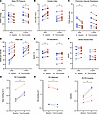
Preclinical studies suggest beneficial effects of GLP-1 agonists in pulmonary arterial hypertension (PAH). This first-in-disease study evaluated acute hemodynamic effects of GLP-1 agonist, exenatide administered i.v. in patients with idiopathic PAH and CTEPH as well as in a PAH rodent model. Seventeen patients (9 idiopathic PAH) received an exenatide infusion during right heart catheterization, which included multisite sampling for circulating metabolites. Acute effects of exenatide were also assessed by cardiac magnetic resonance imaging in monocrotaline (MCT) PAH and control rats. In the clinical study, exenatide was well tolerated, reduced mean pulmonary artery pressure (45 ± 15 mmHg versus 40 ± 18 mmHg), and improved cardiac index (2.1 ± 0.6 L/min versus 2.4 ± 0.9 L/min/m2) and pulmonary vascular resistance (7.8 ± 8.0 WU versus 5.9 ± 5.0 WU) across all patients. Right ventricular (RV) contractility and afterload improved in a subset of patients undergoing pressure-volume measurements. In an exploratory metabolomics analysis, 47 metabolite levels changed after exenatide infusion, predominantly in free fatty acid pathways. Six metabolites with prognostic relevance in PAH within myocardial glycolytic and lipid oxidation pathways were also altered after exenatide. In MCT rats, exenatide improved RV stroke-volume, RV ejection fraction, and RV-arterial coupling. These findings support the further evaluation of exenatide within chronic studies as a potentially novel pulmonary vasodilator therapy.
Authors
Chinthaka B. Samaranayake, Marili Niglas, Nicoleta Baxan, Alexander Kempny, Ali Ashek, Michael Gatzoulis, Laura C. Price, Konstantinos Dimopoulos, Martin R. Wilkins, Stephen Wort, Christopher J. Rhodes, Lan Zhao, Colm McCabe
Guidelines
The Editorial Board will only consider comments that are deemed relevant and of interest to readers. The Journal will not post data that have not been subjected to peer review; or a comment that is essentially a reiteration of another comment.
- Comments appear on the Journal’s website and are linked from the original article’s web page.
- Authors are notified by email if their comments are posted.
- The Journal reserves the right to edit comments for length and clarity.
- No appeals will be considered.
- Comments are not indexed in PubMed.
Specific requirements
- Maximum length, 400 words
- Entered as plain text or HTML
- Author’s name and email address, to be posted with the comment
- Declaration of all potential conflicts of interest (even if these are not ultimately posted); see the Journal’s conflict-of-interest policy
- Comments may not include figures


