
Submit a comment
Abstract
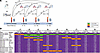
BACKGROUND There are no known serum biomarkers that provide mechanistic insight or prognostic enrichment for post–COVID-19 pulmonary fibrosis.METHODS We tested associations of serum biomarkers with radiographic fibrosis-like abnormalities (reticulation, traction bronchiectasis, or honeycombing) on thoracic computed tomography (CT) scans 4 months, 15 months, and 3 years after hospitalization in an American discovery cohort of severe-to-critical COVID-19 survivors, and externally validated findings in 2 Canadian cohorts of moderate-to-critical COVID-19 survivors. In the discovery cohort, we investigated the dose-response relationship of the biomarker with CT-derived airway-to-lung ratio. We performed single-cell RNA sequencing (scRNA-seq) of transbronchial lung biopsies from COVID-19 survivors obtained 3 years after COVID-19 hospitalization and conducted immunofluorescence analysis of COVID-19 lung explants.RESULTS Among 150 discovery cohort participants, only higher levels of circulating club cell secretory protein-16 (CC16, encoded by the SCGB1A1 gene) at hospital discharge, 4 months, 15 months, and 3 years were associated with thoracic CT fibrosis-like abnormalities in cross-sectional and longitudinal analyses. Higher CC16 levels were associated with thoracic CT fibrosis-like abnormalities in 2 validation cohorts (n = 56 and n = 37). CC16 levels were linearly associated with increased airway-to-lung ratio. scRNA-seq revealed increased proportions of epithelial cells expressing SCGB1A1 and SCGB1A1/MUC5B in COVID-19 survivors with fibrosis. Immunofluorescence analysis of COVID-19 lung explants demonstrated increased numbers of SCGB1A1-expressing epithelial cells only in small (<100 μm) airways, with 3-fold more CC16/MUC5B-coexpressing cells in respiratory bronchioles..CONCLUSION. Higher CC16 levels are associated with CT fibrosis-like abnormalities for up to 3 years following moderate-to-critical COVID-19. Increased CC16 reflects dysregulated small airway epithelial progenitor cell remodeling and increased expansion of CC16+MUC5B+ epithelial cells in respiratory bronchioles after COVID-19.TRIAL REGISTRATION Not applicable.FUNDING Department of Defense, NIH, and Japan Society for the Promotion of Science for Young Scientists.
Authors
Matthew R. Baldwin, Ansley E. Jones, David Zhang, Chandan Gurung, Zain Khan, Anjali Saqi, Xuehan Yang, Ying Wei, Renu Nandakumar, Scarlett O. Murphy, Claire F. McGroder, Faisal Shaikh, Selim Arcasoy, Luke Benvenuto, Harpreet Grewal, Benjamin M. Smith, Eric A. Hoffman, Agnes C.Y. Yuen, Parteek Johal, Christopher Carlsten, Christopher J. Ryerson, J. Brent Richards, Alyson W. Wong, Tomoko Nakanishi, Aditi S. Shah, Christine Kim Garcia
Guidelines
The Editorial Board will only consider comments that are deemed relevant and of interest to readers. The Journal will not post data that have not been subjected to peer review; or a comment that is essentially a reiteration of another comment.
- Comments appear on the Journal’s website and are linked from the original article’s web page.
- Authors are notified by email if their comments are posted.
- The Journal reserves the right to edit comments for length and clarity.
- No appeals will be considered.
- Comments are not indexed in PubMed.
Specific requirements
- Maximum length, 400 words
- Entered as plain text or HTML
- Author’s name and email address, to be posted with the comment
- Declaration of all potential conflicts of interest (even if these are not ultimately posted); see the Journal’s conflict-of-interest policy
- Comments may not include figures


