
Submit a comment
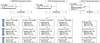
Abstract
BACKGROUND Individuals with autoimmune diseases (ADs) on immunosuppressants often have suboptimal responses to COVID-19 vaccines. We evaluated the efficacy and safety of additional COVID-19 vaccines in those treated with mycophenolate mofetil/mycophenolic acid (MMF/MPA), methotrexate (MTX), and B cell–depleting therapy (BCDT), including the impact of withholding MMF/MPA and MTX.METHODS In this open-label, multicenter, randomized trial, 22 participants taking MMF/MPA, 26 taking MTX, and 93 treated with BCDT who had suboptimal antibody responses to initial COVID-19 vaccines (2 doses of BNT162b2 or mRNA-1273 or 1 dose of AD26.COV2.S) received an additional homologous vaccine. Participants taking MMF/MPA and MTX were randomized (1:1) to continue or withhold treatment around vaccination. The primary outcome was the change in anti–Wuhan-Hu-1 receptor-binding domain (RBD) concentrations at 4 weeks after additional vaccination. Secondary outcomes included adverse events, COVID-19, and AD activity through 48 weeks.RESULTS Additional vaccination increased anti-RBD concentrations in participants taking MMF/MPA and MTX, irrespective of immunosuppressant withholding. BCDT-treated participants also demonstrated increased anti-RBD concentrations, albeit lower than MMF/MPA- and MTX-treated cohorts. COVID-19 occurred in 33% of participants; infections were predominantly mild and included only 3 nonfatal hospitalizations. Additional vaccination was well tolerated, with low frequencies of severe disease flares and adverse events.CONCLUSION Additional COVID-19 vaccination is effective and safe in individuals with ADs treated with immunosuppressants, regardless of whether MMF/MPA or MTX is withheld.TRIAL REGISTRATION ClinicalTrials.gov (NCT05000216; registered August 6, 2021: https://clinicaltrials.gov/ct2/show/NCT05000216).FUNDING The NIH/NIAID supported the study through the Autoimmunity Centers of Excellence and the Intramural Research Program
Authors
Meggan Mackay, Catriona A. Wagner, Ashley Pinckney, Jeffrey A. Cohen, Zachary S. Wallace, Arezou Khosroshahi, Jeffrey A. Sparks, Sandra Lord, Amit Saxena, Roberto Caricchio, Alfred H.J. Kim, Diane L. Kamen, Fotios Koumpouras, Anca D. Askanase, Kenneth Smith, Joel M. Guthridge, Gabriel Pardo, Yang Mao-Draayer, Susan Macwana, Sean McCarthy, Matthew A. Sherman, Sanaz Daneshfar Hamrah, Maria Veri, Sarah Walker, Kate York, Sara K. Tedeschi, Jennifer Wang, Gabrielle Dziubla, Mike Castro, Robin Carroll, Sandeep Narpala, Bob C. Lin, Leonid Serebryannyy, Adrian B. McDermott, ACV01 Study Team, William T. Barry, Ellen Goldmuntz, James McNamara, Aimee S. Payne, Amit Bar-Or, Dinesh Khanna, Judith A. James
Guidelines
The Editorial Board will only consider comments that are deemed relevant and of interest to readers. The Journal will not post data that have not been subjected to peer review; or a comment that is essentially a reiteration of another comment.
- Comments appear on the Journal’s website and are linked from the original article’s web page.
- Authors are notified by email if their comments are posted.
- The Journal reserves the right to edit comments for length and clarity.
- No appeals will be considered.
- Comments are not indexed in PubMed.
Specific requirements
- Maximum length, 400 words
- Entered as plain text or HTML
- Author’s name and email address, to be posted with the comment
- Declaration of all potential conflicts of interest (even if these are not ultimately posted); see the Journal’s conflict-of-interest policy
- Comments may not include figures


