
Submit a comment
Abstract
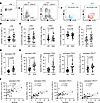
Cellular metabolism plays a key role in T cell biology. Increased glycolysis and mitochondrial respiration have been identified in CD4+ helper T cells from both patients with systemic lupus erythematosus (SLE) and lupus mouse models. Inhibiting this metabolic activity can reduce T cell activation and ameliorate disease symptoms in lupus mice. However, the metabolic differences among circulating follicular helper T (cTfh) cell subsets in patients with SLE versus healthy controls (HCs) have not been thoroughly studied. While the frequencies of cTfh cells and their subsets were similar between patients with SLE and HCs, patients exhibited a higher proportion of activated ICOS+ programmed cell death 1–positive cells, which correlated with disease activity. cTfh17 cells from both patients with SLE and HCs demonstrated heightened glycolytic activity and expression of glycolysis-related genes compared with cTfh1 and cTfh2. Glucose deprivation significantly diminished costimulatory molecule expression and cytokine production, including IL-17A, IL-10, IL-2, and TNF-α. Glycolysis inhibition reduced the B cell activation capacity of cTfh17 cells. This glucose dependence was more pronounced in cTfh17 than cTfh2 from patients with SLE, but it similarly affected both cTfh2 and cTfh17 cells from HCs. These findings highlight distinct metabolic dependencies among cTfh subsets and the critical role of glycolysis in cTfh17-mediated B cell activation in SLE.
Authors
Vera Kim, Takaya Misao, Hong Tian, Meggan Mackay, Cynthia Aranow, Sun Jung Kim
Guidelines
The Editorial Board will only consider comments that are deemed relevant and of interest to readers. The Journal will not post data that have not been subjected to peer review; or a comment that is essentially a reiteration of another comment.
- Comments appear on the Journal’s website and are linked from the original article’s web page.
- Authors are notified by email if their comments are posted.
- The Journal reserves the right to edit comments for length and clarity.
- No appeals will be considered.
- Comments are not indexed in PubMed.
Specific requirements
- Maximum length, 400 words
- Entered as plain text or HTML
- Author’s name and email address, to be posted with the comment
- Declaration of all potential conflicts of interest (even if these are not ultimately posted); see the Journal’s conflict-of-interest policy
- Comments may not include figures


