
Submit a comment
Abstract
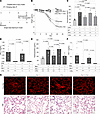
Mutation studies of plasminogen activator inhibitor 1 (PAI-1) have previously implied that PAI-1 promotes lung fibrosis via a vitronectin-dependent (VTN-dependent) mechanism. In the present study, employing 2 distinct murine fibrosis models and VTN-deficient mice, we found that VTN is not required for PAI-1 to drive lung scarring. This result suggested the existence of a profibrotic interaction involving the VTN-binding site on PAI-1 with an unidentified ligand. Using an unbiased proteomic approach, we identified sortilin-related receptor 1 (SorLA) as the most highly enriched PAI-1 binding partner in the fibrosing lung. Investigating the role of SorLA in pulmonary fibrosis demonstrated that deficiency of this protein protected against lung scarring in a murine model. We further found that SorLA is required for PAI-1 to promote scarring in mice, that both SorLA and PAI-1 protein levels are increased in human idiopathic pulmonary fibrosis (IPF) explants, and that these proteins are associated in IPF tissue. Finally, confocal microscopy showed that expression of SorLA in CHO cells increased cellular uptake of PAI-1, and these proteins colocalized in the cytoplasm. Together, these data elucidate a mechanism by which the potent profibrotic mediator PAI-1 drives lung fibrosis and implicate SorLA as a potential therapeutic target in IPF treatment.
Authors
Thomas H. Sisson, John J. Osterholzer, Lisa Leung, Venkatesha Basrur, Alexey Nesvizhskii, Natalya Subbotina, Mark Warnock, Daniel Torrente, Ammara Q. Virk, Sergey S. Gutor, Jeffrey C. Horowitz, Mary Migliorini, Dudley K. Strickland, Kevin K. Kim, Steven K. Huang, Daniel A. Lawrence
Guidelines
The Editorial Board will only consider comments that are deemed relevant and of interest to readers. The Journal will not post data that have not been subjected to peer review; or a comment that is essentially a reiteration of another comment.
- Comments appear on the Journal’s website and are linked from the original article’s web page.
- Authors are notified by email if their comments are posted.
- The Journal reserves the right to edit comments for length and clarity.
- No appeals will be considered.
- Comments are not indexed in PubMed.
Specific requirements
- Maximum length, 400 words
- Entered as plain text or HTML
- Author’s name and email address, to be posted with the comment
- Declaration of all potential conflicts of interest (even if these are not ultimately posted); see the Journal’s conflict-of-interest policy
- Comments may not include figures


