
Abstract
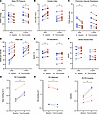
Preclinical studies suggest beneficial effects of GLP-1 agonists in pulmonary arterial hypertension (PAH). This first-in-disease study evaluated acute hemodynamic effects of GLP-1 agonist, exenatide administered i.v. in patients with idiopathic PAH and CTEPH as well as in a PAH rodent model. Seventeen patients (9 idiopathic PAH) received an exenatide infusion during right heart catheterization, which included multisite sampling for circulating metabolites. Acute effects of exenatide were also assessed by cardiac magnetic resonance imaging in monocrotaline (MCT) PAH and control rats. In the clinical study, exenatide was well tolerated, reduced mean pulmonary artery pressure (45 ± 15 mmHg versus 40 ± 18 mmHg), and improved cardiac index (2.1 ± 0.6 L/min versus 2.4 ± 0.9 L/min/m2) and pulmonary vascular resistance (7.8 ± 8.0 WU versus 5.9 ± 5.0 WU) across all patients. Right ventricular (RV) contractility and afterload improved in a subset of patients undergoing pressure-volume measurements. In an exploratory metabolomics analysis, 47 metabolite levels changed after exenatide infusion, predominantly in free fatty acid pathways. Six metabolites with prognostic relevance in PAH within myocardial glycolytic and lipid oxidation pathways were also altered after exenatide. In MCT rats, exenatide improved RV stroke-volume, RV ejection fraction, and RV-arterial coupling. These findings support the further evaluation of exenatide within chronic studies as a potentially novel pulmonary vasodilator therapy.
Authors
Chinthaka B. Samaranayake, Marili Niglas, Nicoleta Baxan, Alexander Kempny, Ali Ashek, Michael Gatzoulis, Laura C. Price, Konstantinos Dimopoulos, Martin R. Wilkins, Stephen Wort, Christopher J. Rhodes, Lan Zhao, Colm McCabe
This file is in Adobe Acrobat (PDF) format. If you have not installed and configured the Adobe Acrobat Reader on your system.
Having trouble reading a PDF?
PDFs are designed to be printed out and read, but if you prefer to read them online, you may find it easier if you increase the view size to 125%.
Having trouble saving a PDF?
Many versions of the free Acrobat Reader do not allow Save. You must instead save the PDF from the JCI Online page you downloaded it from. PC users: Right-click on the Download link and choose the option that says something like "Save Link As...". Mac users should hold the mouse button down on the link to get these same options.
Having trouble printing a PDF?
- Try printing one page at a time or to a newer printer.
- Try saving the file to disk before printing rather than opening it "on the fly." This requires that you configure your browser to "Save" rather than "Launch Application" for the file type "application/pdf", and can usually be done in the "Helper Applications" options.
- Make sure you are using the latest version of Adobe's Acrobat Reader.


