
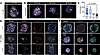
Abstract
Influenza A virus (IAV) infection is a major cause of morbidity and mortality for patients worldwide. Alveolar type 2 (AT2) cells are the preferential target of IAV as part of the pathogenesis of viral pneumonia and acute respiratory distress syndrome (ARDS). Early IAV infection of alveolar cells has been challenging to model both in vitro and in vivo. To address this challenge, we used a combination of murine and human primary alveolar organoids to define methods for robust IAV infection and evaluated cell-autonomous consequences of IAV using a temporal series of multiome paired single-nucleus RNA and ATAC sequencing assays. Infected AT2 cells demonstrated conserved changes defined by early loss of surfactant secretion, decreased lipid biogenesis, a rapid burst of antiviral response, and late virus-mediated suppression. Surprisingly, uninfected AT2 cells underwent substantial transcriptional and epigenomic changes in IAV-treated cultures, leading to transition to damage-associated cell states within hours via a process driven by the inflammatory milieu of murine organoids. Together, these data provide methods for high-fidelity modeling of IAV infection in alveolar cells and defined a conserved AT2 cell response signature to IAV with implications for ARDS pathogenesis.
Authors
Amber Elitz, Sharlene Fernandes, Kathleen C.S. Cook, Helen I. Warheit-Niemi, Barbara Zhao, Andrea Toth, Amanda L. Zacharias, William J. Zacharias
This file is in Adobe Acrobat (PDF) format. If you have not installed and configured the Adobe Acrobat Reader on your system.
Having trouble reading a PDF?
PDFs are designed to be printed out and read, but if you prefer to read them online, you may find it easier if you increase the view size to 125%.
Having trouble saving a PDF?
Many versions of the free Acrobat Reader do not allow Save. You must instead save the PDF from the JCI Online page you downloaded it from. PC users: Right-click on the Download link and choose the option that says something like "Save Link As...". Mac users should hold the mouse button down on the link to get these same options.
Having trouble printing a PDF?
- Try printing one page at a time or to a newer printer.
- Try saving the file to disk before printing rather than opening it "on the fly." This requires that you configure your browser to "Save" rather than "Launch Application" for the file type "application/pdf", and can usually be done in the "Helper Applications" options.
- Make sure you are using the latest version of Adobe's Acrobat Reader.


