
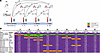
Abstract
BACKGROUND There are no known serum biomarkers that provide mechanistic insight or prognostic enrichment for post–COVID-19 pulmonary fibrosis.METHODS We tested associations of serum biomarkers with radiographic fibrosis-like abnormalities (reticulation, traction bronchiectasis, or honeycombing) on thoracic computed tomography (CT) scans 4 months, 15 months, and 3 years after hospitalization in an American discovery cohort of severe-to-critical COVID-19 survivors, and externally validated findings in 2 Canadian cohorts of moderate-to-critical COVID-19 survivors. In the discovery cohort, we investigated the dose-response relationship of the biomarker with CT-derived airway-to-lung ratio. We performed single-cell RNA sequencing (scRNA-seq) of transbronchial lung biopsies from COVID-19 survivors obtained 3 years after COVID-19 hospitalization and conducted immunofluorescence analysis of COVID-19 lung explants.RESULTS Among 150 discovery cohort participants, only higher levels of circulating club cell secretory protein-16 (CC16, encoded by the SCGB1A1 gene) at hospital discharge, 4 months, 15 months, and 3 years were associated with thoracic CT fibrosis-like abnormalities in cross-sectional and longitudinal analyses. Higher CC16 levels were associated with thoracic CT fibrosis-like abnormalities in 2 validation cohorts (n = 56 and n = 37). CC16 levels were linearly associated with increased airway-to-lung ratio. scRNA-seq revealed increased proportions of epithelial cells expressing SCGB1A1 and SCGB1A1/MUC5B in COVID-19 survivors with fibrosis. Immunofluorescence analysis of COVID-19 lung explants demonstrated increased numbers of SCGB1A1-expressing epithelial cells only in small (<100 μm) airways, with 3-fold more CC16/MUC5B-coexpressing cells in respiratory bronchioles..CONCLUSION. Higher CC16 levels are associated with CT fibrosis-like abnormalities for up to 3 years following moderate-to-critical COVID-19. Increased CC16 reflects dysregulated small airway epithelial progenitor cell remodeling and increased expansion of CC16+MUC5B+ epithelial cells in respiratory bronchioles after COVID-19.TRIAL REGISTRATION Not applicable.FUNDING Department of Defense, NIH, and Japan Society for the Promotion of Science for Young Scientists.
Authors
Matthew R. Baldwin, Ansley E. Jones, David Zhang, Chandan Gurung, Zain Khan, Anjali Saqi, Xuehan Yang, Ying Wei, Renu Nandakumar, Scarlett O. Murphy, Claire F. McGroder, Faisal Shaikh, Selim Arcasoy, Luke Benvenuto, Harpreet Grewal, Benjamin M. Smith, Eric A. Hoffman, Agnes C.Y. Yuen, Parteek Johal, Christopher Carlsten, Christopher J. Ryerson, J. Brent Richards, Alyson W. Wong, Tomoko Nakanishi, Aditi S. Shah, Christine Kim Garcia
This file is in Adobe Acrobat (PDF) format. If you have not installed and configured the Adobe Acrobat Reader on your system.
Having trouble reading a PDF?
PDFs are designed to be printed out and read, but if you prefer to read them online, you may find it easier if you increase the view size to 125%.
Having trouble saving a PDF?
Many versions of the free Acrobat Reader do not allow Save. You must instead save the PDF from the JCI Online page you downloaded it from. PC users: Right-click on the Download link and choose the option that says something like "Save Link As...". Mac users should hold the mouse button down on the link to get these same options.
Having trouble printing a PDF?
- Try printing one page at a time or to a newer printer.
- Try saving the file to disk before printing rather than opening it "on the fly." This requires that you configure your browser to "Save" rather than "Launch Application" for the file type "application/pdf", and can usually be done in the "Helper Applications" options.
- Make sure you are using the latest version of Adobe's Acrobat Reader.


